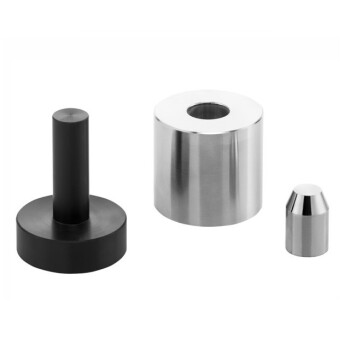
High-precision compression molding tools serve as the stabilizing foundation of the In-Mold Assembly (IMA) process for metal-plastic composites. These tools utilize integrated electric heating and thermocouple monitoring to create a strictly controlled isothermal environment, essential for managing the high pressures of 150–250 bar required to bond metal and plastic.
Core Takeaway: Success in In-Mold Assembly relies on the mold’s ability to act as an active processing environment, not just a shape definer. By maintaining rigorous thermal and pressure stability, these tools enable the simultaneous forming of thermoplastics and bonding of metal, ensuring composite integrity through both mechanical anchoring and chemical adhesion.
Creating the Ideal Process Environment
To achieve a viable metal-plastic composite, the manufacturing environment must be controlled with extreme accuracy. High-precision molding tools facilitate this by managing two critical variables: heat and pressure.
Isothermal Stability
The mold is equipped with integrated electric heating elements and constant thermocouple monitoring.
This setup ensures a stable isothermal environment, preventing temperature fluctuations that could lead to uneven curing or warping of the polymer matrix.
High-Pressure Management
The IMA process operates under substantial pressures, typically ranging from 150 to 250 bar.
The molding tool must be robust enough to sustain these forces without deformation, ensuring the pressure is applied effectively to the composite materials.
Uniform Pressure Transmission
Beyond simply applying force, the mold must ensure uniform pressure distribution across the entire forming area.
This uniformity is critical for eliminating voids and ensuring the material properties are consistent throughout the part.
Facilitating Simultaneous Bonding
The primary advantage of IMA is efficiency—combining forming and assembly into one step. The molding tool is the mechanism that makes this dual action possible.
Optimizing Material Flow
Under high pressure, the tool forces Glass Mat Thermoplastics (GMT) to flow and completely fill the mold cavity.
This ensures the polymer matrix wraps perfectly around the metal strips, leaving no gaps that could compromise structural integrity.
Enabling Dual-Mechanism Adhesion
The precision of the tool promotes two types of bonding simultaneously: mechanical anchoring and chemical bonding.
By ensuring intimate contact between the polymer and the metal surface, the tool allows the plastic to mechanically lock into the metal's surface texture while facilitating chemical adhesion at the interface.
The Necessity of Geometric Precision
Defining Dimensional Accuracy
High-precision metal molds are engineered to define the final geometric dimensions of the part with minimal error.
For example, these tools can maintain sample thickness deviations within +/- 0.1 mm, which is a tight tolerance essential for high-performance applications.
Ensuring Homogeneity
When pressure is distributed evenly and geometry is strictly defined, the resulting specimen is homogeneous.
This consistency is vital for creating parts that yield reliable data in standardized mechanical tests, such as ISO 178.
Common Pitfalls to Avoid
While high-precision tools enable advanced bonding, neglecting the "precision" aspect leads to significant failure points.
The Risk of Uneven Pressure
If the mold faces are not perfectly parallel or rigid, pressure transmission becomes uneven.
This results in "weak spots" where the polymer fails to mechanically anchor to the metal, leading to delamination under stress.
Thermal Inconsistency
Failure to monitor thermocouples or maintain the isothermal environment ruins the chemical bonding process.
If the mold is too cool in certain areas, the thermoplastic may freeze off before wetting the metal surface adequately, preventing adhesion regardless of the pressure applied.
Making the Right Choice for Your Goal
The level of precision required in your tooling often depends on the specific performance metrics you aim to achieve.
- If your primary focus is Structural Bond Strength: Prioritize tooling with robust heating and high-pressure capabilities (150+ bar) to maximize mechanical anchoring and chemical adhesion.
- If your primary focus is R&D and Standardized Testing: Prioritize tooling with strict dimensional controls to ensure thickness deviations stay within +/- 0.1 mm for valid, reproducible data.
Ultimate reliability in metal-plastic composites is not just about the materials used, but the absolute control of the environment in which they are joined.
Summary Table:
| Feature | Requirement | Impact on IMA Process |
|---|---|---|
| Temperature Control | Isothermal (Integrated Heating) | Ensures chemical adhesion and prevents polymer warping |
| Pressure Range | 150 – 250 Bar | Facilitates mechanical anchoring and eliminates voids |
| Geometric Precision | +/- 0.1 mm Tolerance | Guarantees dimensional accuracy and sample homogeneity |
| Pressure Distribution | Uniform Transmission | Prevents delamination and ensures consistent material properties |
Elevate Your Material Research with KINTEK
Precision is the difference between a failed bond and a high-performance composite. KINTEK specializes in comprehensive laboratory pressing solutions designed for the most demanding R&D environments. Whether you are conducting battery research or developing advanced metal-plastic hybrids, our equipment provides the absolute thermal and pressure control necessary for success.
Our specialized range includes:
- Manual & Automatic Hydraulic Presses
- Heated & Multifunctional Pressing Stations
- Glovebox-Compatible & Isostatic (Cold/Warm) Presses
Ensure your composites meet the highest standards of homogeneity and strength. Contact KINTEK today to find your laboratory solution and see how our expertise can streamline your assembly process.
References
- Deviprasad Chalicheemalapalli Jayasankar, Thorsten Marten. Process Development for Hybrid Brake Pedals Using Compression Molding with Integrated In-Mold Assembly. DOI: 10.3390/polym17121644
This article is also based on technical information from Kintek Solution Knowledge Base .
Related Products
- Lab Polygon Press Mold
- Lab Ball Press Mold
- Lab Round Bidirectional Press Mold
- Special Shape Lab Press Mold for Laboratory Applications
- XRF KBR Steel Ring Lab Powder Pellet Pressing Mold for FTIR
People Also Ask
- What is the purpose of incorporating cartridge heaters into a lab press mold for MLCC block compression? Optimize Results
- How do the design and geometric precision of pressing molds and mandrels affect the quality of PTFE composite samples?
- What role do precision positioning and pressure molds play in single-lap joints? Ensure 100% Data Integrity
- What are the requirements for pressing molds when using SSCG? Key Materials for Complex Single Crystal Production
- How do industrial-grade pressure molds affect zinc metal pouch cells? Maximize Energy Density & Performance