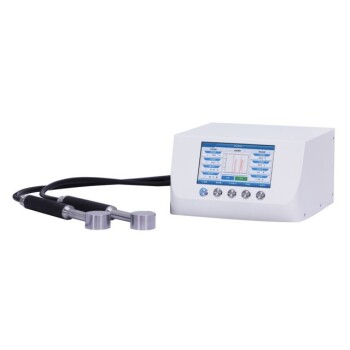
Laboratory constant temperature hot plates or ovens serve as the critical activation source for the polymerization process in PETEA electrolytes. By supplying precise, stable thermal energy, these devices induce the decomposition of the chemical initiator (AIBN), generating the free radicals required to transform liquid monomers into a solid polymer network.
The primary role of this equipment is not merely to heat the material, but to strictly regulate the kinetics of the reaction. By maintaining specific temperatures (typically 60°C or 70°C), the equipment controls the polymerization rate and cross-linking density, which are the decisive factors in the electrolyte's final mechanical and electrochemical performance.
The Mechanism of Thermal Curing
Activation of the Initiator
The thermal curing phase begins when the heating device applies energy to the PETEA solution.
This energy is targeted specifically at the thermal initiator, AIBN.
Upon reaching the target temperature, AIBN decomposes thermally.
Generational of Free Radicals
The decomposition of AIBN releases free radicals into the mixture.
These radicals are the catalysts for the entire solidification process.
They trigger free radical chain polymerization by reacting with the PETEA monomers.
Why Precision Control Matters
Regulating Polymerization Rate
The consistency of the heat source is paramount.
Constant temperature devices ensure that the thermal energy input remains steady throughout the process.
This steady input regulates the speed at which the polymerization reaction occurs, preventing runaway reactions or stalled curing.
Defining Cross-Linking Density
The temperature setting directly influences the architecture of the resulting polymer.
By controlling the heat at specific set points, such as 60°C or 70°C, you dictate the final cross-linking density.
A higher or more controlled density results in a more robust polymer network.
Impact on Final Electrolyte Performance
Mechanical Strength
The physical durability of the solid-state electrolyte is a direct result of the curing process.
The cross-linking density achieved through controlled heating determines the mechanical strength of the polymer.
A well-cured electrolyte can better withstand physical stress within the battery cell.
Electrochemical Window
The chemical stability of the electrolyte is also established during this phase.
The polymer structure formed under precise thermal conditions defines the electrochemical window.
This window dictates the voltage range in which the electrolyte can operate without degrading.
Understanding the Trade-offs
The Risk of Temperature Fluctuation
While heat is the catalyst, inconsistent heat is detrimental.
If the laboratory equipment fails to maintain a constant temperature, the polymerization rate becomes variable.
This fluctuation leads to uneven cross-linking density across the electrolyte.
Consequences of Poor Control
An inconsistent polymer network creates weak points in the material.
This results in reduced mechanical strength and a narrower electrochemical window.
Ultimately, the reliability of the solid-state electrolyte relies entirely on the stability of the thermal environment provided during curing.
Making the Right Choice for Your Goal
To ensure the successful synthesis of PETEA electrolytes, align your thermal processing strategy with your specific performance targets.
- If your primary focus is Mechanical Integrity: Prioritize equipment with high thermal stability to ensure uniform cross-linking density, which directly reinforces the polymer structure.
- If your primary focus is Electrochemical Stability: Strictly adhere to the optimal temperature set points (e.g., 60°C or 70°C) to establish a wide and stable electrochemical window.
Final Summary: The constant temperature device is the governor of the electrolyte's quality, translating thermal energy into the precise structural properties required for high-performance energy storage.
Summary Table:
| Process Phase | Function of Thermal Equipment | Key Outcome |
|---|---|---|
| Initiator Activation | Decomposes AIBN via precise thermal energy | Generation of free radicals |
| Kinetics Regulation | Maintains steady temperature (60°C/70°C) | Controlled polymerization rate |
| Structural Formation | Drives monomer-to-polymer transformation | Optimized cross-linking density |
| Performance Tuning | Ensures uniform heat distribution | Enhanced mechanical & electrochemical stability |
Elevate Your Battery Research with Precision Thermal Solutions
Achieving the perfect cross-linking density in PETEA electrolytes requires absolute thermal stability. KINTEK specializes in comprehensive laboratory pressing and thermal solutions designed for the rigorous demands of solid-state battery development. From manual and automatic heated presses to glovebox-compatible models and advanced isostatic presses, our equipment ensures your polymerization process is consistent and reproducible.
Ready to optimize your electrolyte performance? Contact KINTEK today to find the ideal equipment for your research goals!
References
- Daniel Vogt, Arno Kwade. Mechanical and Electrochemical Performance of a PETEA‐Based Solid‐State Electrolyte for Multifunctional Structural Battery Composites. DOI: 10.1002/nano.70094
This article is also based on technical information from Kintek Solution Knowledge Base .
Related Products
- Automatic High Temperature Heated Hydraulic Press Machine with Heated Plates for Lab
- Infrared Heating Quantitative Flat Plate Mold for Precise Temperature Control
People Also Ask
- Function of a Laboratory Hydraulic Press with Heated Platens in SSE? Enhance Battery Density & Conductivity
- How does a laboratory heated hydraulic press facilitate PBN sample prep for WAXS? Achieve Precise X-Ray Scattering
- What are the requirements for electrode pressing with high-viscosity ionic liquids like EMIM TFSI? Optimize Performance
- What are the industrial applications of heated hydraulic presses? Master Heat & Force for Precision Manufacturing
- Why is a laboratory hydraulic press with heating plates required for PLA/TEC films? Achieve Precise Sample Integrity