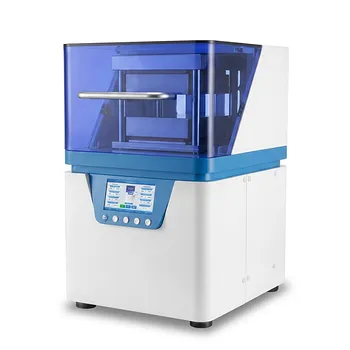
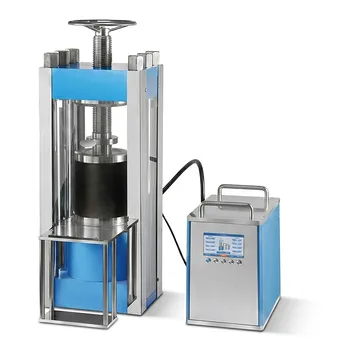
The hot-press machine is the critical hardware responsible for transforming loose constituent materials into a monolithic, leak-proof thermal energy storage unit. It provides the simultaneous high temperature (typically 150–170°C) and mechanical pressure (8–10 MPa) required to melt the polymer matrix and encapsulate active phase change components. This process ensures the composite is formed into a dense, shape-stabilized sheet with uniform thickness, consistent mechanical properties, and structural integrity.
The hot-press machine enables "integrated molding" by synchronizing thermal melting with mechanical compression to create a stable, high-density matrix. This dual-action approach eliminates internal voids and establishes a robust physical barrier that prevents liquid leakage during the material's subsequent thermal cycles.
The Dual Role of Temperature and Pressure
A hot-press machine functions by crossing specific thermodynamic thresholds to change the physical state of the composite ingredients.
Melting the Polymer Matrix
High-temperature plates heat the polymer (such as HDPE or polyurethane) above its melting point or glass transition temperature. This allows the polymer to flow freely, acting as a binder that fully encapsulates microencapsulated phase change materials and additives like expanded graphite.
Achieving Material Densification
While the polymer is in a molten state, the machine applies precise mechanical pressure to force the material into a specific volume. This high-pressure environment (often 8–10 MPa) ensures the components are packed tightly, reaching a high level of physical density that manual mixing cannot achieve.
Preventing Liquid Leakage
By fusing the polymer matrix around the phase change core under pressure, the machine creates a shape-stabilized structure. This structure retains its solid form even when the internal phase change material melts, effectively preventing liquid leakage and ensuring long-term operational stability.
Optimizing Microstructure and Interface
Beyond basic shaping, the hot-press machine allows researchers to fine-tune the internal architecture of the composite.
Eliminating Internal Defects
The application of pressure during the heating phase is essential for eliminating internal air bubbles and voids. Removing these defects is critical for ensuring the material can withstand mechanical testing and provide consistent thermal conductivity across the entire sheet.
Enhancing Interfacial Bonding
The machine facilitates diffusion bonding and strengthens Van der Waals forces between different material layers. This increases the contact area between the photothermal conversion interface and the energy storage center, resulting in more efficient heat transfer.
Controlling Morphology and Crystallization
By accurately adjusting the heating plate temperature and the subsequent cooling rate, the machine allows for the fine control of crystallization behavior. This capability is vital for researchers who need to study how the microscopic morphology of the polymer affects the composite’s final performance.
Understanding the Trade-offs
While hot-pressing is essential for stabilization, it requires a delicate balance of parameters to avoid material failure.
The Risk of Microcapsule Rupture
Excessive pressure during the pressing cycle can lead to the mechanical failure of microcapsules. If the capsules rupture, the phase change material will leak into the matrix, potentially degrading the thermal properties and structural life of the composite.
Thermal Degradation Limits
Subjecting materials to temperatures significantly above their required melting point can trigger chemical degradation or oxidation. Finding the "processing window"—where the polymer flows but the phase change core remains stable—is the primary challenge in hot-press calibration.
Applying Hot-Pressing to Your Project
To achieve the best results with shape-stabilized composites, your processing parameters must align with your specific material ingredients.
- If your primary focus is leak prevention: Prioritize higher pressures (near 10 MPa) and temperatures above the polymer melting point to ensure the matrix forms a completely non-porous, integrated seal around the phase change core.
- If your primary focus is preserving microcapsule integrity: Use a lower, more controlled pressure and a temperature just slightly above the glass transition point to facilitate bonding without crushing the encapsulated cores.
- If your primary focus is thermal conductivity: Incorporate expanded graphite and use the hot-press to maximize density, as higher packing fractions typically result in superior heat transfer rates.
By masterfully balancing heat and force, the hot-press machine serves as the bridge between raw chemical components and a high-performance, functional energy storage device.
Summary Table:
| Key Function | Mechanism | Impact on Material |
|---|---|---|
| Integrated Molding | Simultaneous heat (150-170°C) and pressure (8-10 MPa) | Creates a monolithic, dense, and uniform structural sheet. |
| Leak Prevention | Encapsulation of PCM within a molten polymer matrix | Establishes a robust physical barrier against liquid leakage. |
| Densification | Mechanical compression during melting state | Eliminates internal voids and air bubbles for structural integrity. |
| Bonding Enhancement | Facilitating diffusion bonding and Van der Waals forces | Improves interfacial heat transfer and photothermal conversion. |
| Morphology Control | Precision cooling and heating rate adjustment | Allows fine-tuning of polymer crystallization and microstructure. |
Elevate Your PCM Research with KINTEK Precision
Unlock the full potential of your thermal energy storage projects with KINTEK’s specialized laboratory pressing solutions. Whether you are developing leak-proof phase change composites or advancing battery research, our equipment provides the exact thermal and mechanical control needed for superior material densification.
Our Comprehensive Range Includes:
- Manual & Automatic Hot Presses: Perfect for precise integrated molding.
- Heated & Multifunctional Models: Tailored for complex polymer-matrix encapsulation.
- Glovebox-Compatible & Isostatic Presses: Ideal for sensitive battery and material science applications.
Don't let internal defects or microcapsule rupture compromise your results. Trust KINTEK to deliver the stability and density your research demands.
Contact Our Experts Today to find the perfect pressing solution for your lab!
References
- Xianglei Wang, Yupeng Hua. Review on heat transfer enhancement of phase-change materials using expanded graphite for thermal energy storage and thermal management. DOI: 10.25236/ajets.2021.040105
This article is also based on technical information from Kintek Solution Knowledge Base .
Related Products
- Automatic High Temperature Heated Hydraulic Press Machine with Heated Plates for Lab
- Heated Hydraulic Press Machine with Heated Plates for Vacuum Box Laboratory Hot Press
- Automatic Heated Hydraulic Press Machine with Hot Plates for Laboratory
- Automatic Hydraulic Heat Press Machine with Multi Stage Programmable Control and Integrated Water Cooling Plate Size 180x180mm
- Laboratory Split Manual Heated Hydraulic Press Machine with Hot Plates
People Also Ask
- How is the temperature of the hot plate controlled in a hydraulic lab press? Achieve Thermal Precision (20°C-200°C)
- Why is a heated laboratory hydraulic press necessary for PVC test specimens? Ensure Precise Tensile & Rheology Data
- How does a laboratory heated hydraulic press facilitate PBN sample prep for WAXS? Achieve Precise X-Ray Scattering
- What are the industrial applications of heated hydraulic presses? Master Heat & Force for Precision Manufacturing
- What are the requirements for electrode pressing with high-viscosity ionic liquids like EMIM TFSI? Optimize Performance