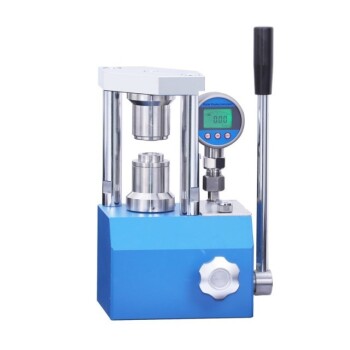
A laboratory coin cell sealer establishes the physical baseline required for valid electrochemical testing. It functions by applying precisely regulated mechanical pressure to encapsulate the silicon nanowire electrode, separator, and electrolyte within a stainless steel housing, creating a hermetically sealed environment.
Core Takeaway The sealer transforms a loose assembly of components into a unified electrochemical system. By ensuring uniform internal pressure, it minimizes contact resistance and prevents electrolyte loss, guaranteeing that performance data reflects the true properties of the silicon nanowire material rather than assembly defects.
The Mechanics of Reliable Data
Establishing Internal Continuity
The primary function of the sealer is to force the internal components—the positive electrode, negative electrode, and separator—into tight physical contact.
Without this mechanical pressure, gaps between layers create interfacial voids. These voids significantly increase contact resistance, which artificially hampers the flow of electrons and distorts performance data.
Protection Against Environmental Variables
The sealer crimps the stainless steel housing to lock the electrolyte inside and keep the external atmosphere out.
This creates a reliable environment that prevents the evaporation or leakage of the electrolyte. It also prevents air ingress, ensuring the chemical reactions are not compromised by environmental interference.
Why Precision Matters for Performance Evaluation
Ensuring Data Reproducibility
For a material like silicon nanowires, evaluating performance requires eliminating mechanical variables.
The sealer provides uniform and stable pressure across every cell produced. This consistency ensures that data regarding cycle life and rate performance is repeatable and accurate, rather than the result of random assembly variations.
Enabling Long-Term Cycle Testing
Performance evaluation often involves charging and discharging the cell hundreds of times.
A proper seal is critical for long-term cycle testing. If the seal is imperfect, the electrolyte will slowly dry out over time, causing the cell to fail prematurely regardless of the electrode quality.
Understanding the Trade-offs
The Risk of Mechanical Variation
While the sealer aims for uniformity, the quality of the data is entirely dependent on the precision of the forming control.
If the mechanical pressure is too low, contact resistance remains high, leading to poor rate capability. Conversely, improper crimping mechanics can deform the shell or gasket, compromising the seal and leading to slow leaks that invalidate long-term studies.
Maximizing Test Validity
To ensure your evaluation of silicon nanowire electrodes is scientifically sound, consider how the sealing process impacts your specific metrics:
- If your primary focus is Cycle Life: A perfect hermetic seal is your priority to prevent electrolyte evaporation and ensure the cell survives the duration of the test.
- If your primary focus is Rate Performance: Uniform, high mechanical pressure is essential to minimize contact resistance and allow electrons to flow freely at higher currents.
The laboratory coin cell sealer acts as a mechanical standardization tool, removing physical variables so the electrochemical reality of your material can be observed.
Summary Table:
| Key Feature | Impact on Performance Evaluation |
|---|---|
| Hermetic Sealing | Prevents electrolyte evaporation and air ingress for long-term cycling. |
| Mechanical Pressure | Minimizes contact resistance to reveal true electrode rate capability. |
| Pressure Uniformity | Ensures data reproducibility and eliminates assembly-related variables. |
| Structural Integrity | Prevents interfacial voids between the silicon nanowire and separator. |
Elevate Your Battery Research with Precision Engineering
Unlock the true potential of your silicon nanowire electrodes with KINTEK. As specialists in comprehensive laboratory pressing solutions, we provide the precision tools necessary to eliminate mechanical variables from your data. Whether you require manual, automatic, heated, multifunctional, or glovebox-compatible models, our range of coin cell sealers and isostatic presses ensures uniform pressure and airtight integrity for every test.
Ready to standardize your cell assembly? Contact us today to find the perfect sealing solution for your laboratory’s needs.
References
- Rashmi Tripathi, Rajiv O. Dusane. Phosphorus Doped Silicon Nanowires as High‐Performance Li‐Ion Battery Anodes and Supercapacitor Electrodes. DOI: 10.1002/admi.202500520
This article is also based on technical information from Kintek Solution Knowledge Base .
Related Products
- Button Battery Sealing Press Machine for Lab
- Button Battery Sealing Machine for Button Batteries
- Lab Button Battery Tablet Press Sealing Mold
- Manual Button Battery Sealing Machine for Battery Sealing
- Lab Button Battery Disassembly and Sealing Mold
People Also Ask
- Why use standardized CR2032 components & high-precision presses? Ensure reliability in lithium metal battery research.
- Why is a laboratory battery sealing press essential for desolvation energy testing? Ensure Reliable Kinetic Data
- Why is a laboratory hydraulic press or battery sealing machine essential? Ensure Coin Cell Data Integrity
- How do laboratory battery sealing machines ensure performance consistency? Master Your Lithium and LFP Battery Assembly
- What role does a laboratory sealing press play in thermal analysis of solid dispersion films? Ensure Data Integrity