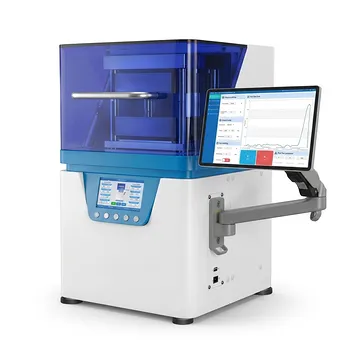
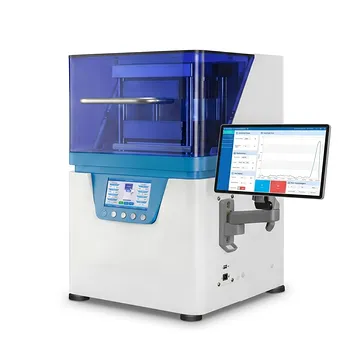
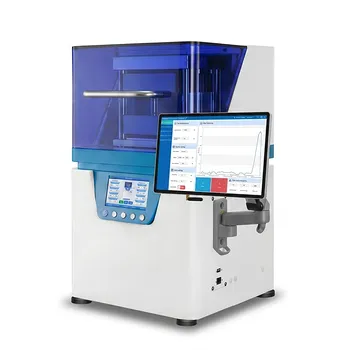
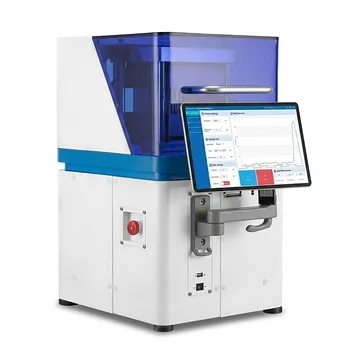
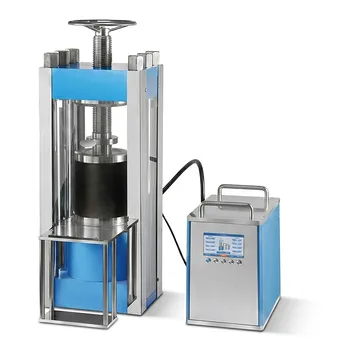
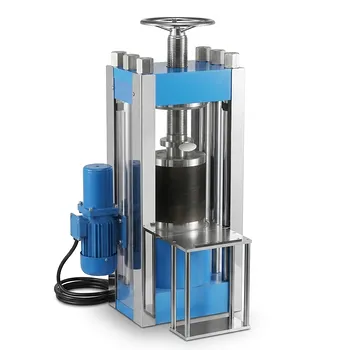
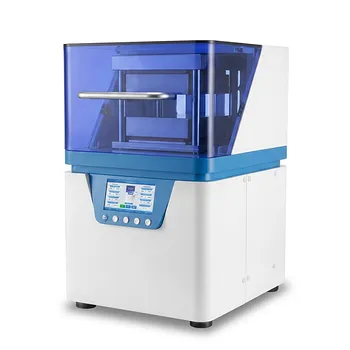
The laboratory heating press acts as the primary regulator of scaffold architecture during the salt particle pre-pressing stage. It applies a precisely controlled mechanical load of up to 600 kN to the salt particle bed within a mold. This compaction increases the packing density of the salt particles, which reduces the volume available for polymer infiltration and allows for the precise calibration of final PEEK scaffold porosity between 75% and 85%.
The heating press serves as a precision tool for volume control; by mechanically densifying the salt template, it dictates the exact space PEEK can occupy, ensuring the resulting scaffold meets specific biological and mechanical requirements.
Achieving Precision Through Mechanical Densification
Controlling the Salt Template Geometry
In the pre-pressing stage, the heating press functions as a high-force compressor that stabilizes the salt particle bed. By applying loads up to 600 kN, the press forces the particles into a tighter configuration. This creates a stable, interconnected "negative" template that determines the final shape and internal structure of the PEEK scaffold.
Regulating Final Porosity Levels
The primary objective of this stage is the manipulation of void volume. As the press increases the packing density of the salt, it leaves less room for the molten PEEK to inhabit. This mechanism is the key to achieving a specific porosity range of 75% to 85%, which is critical for bone cell ingrowth and nutrient transport.
The Synergistic Role of Pressure and Thermal Energy
Overcoming Viscous Resistance
While the pre-pressing focuses on the salt template, the heating press later provides the thermal conduction necessary to reach temperatures around 420°C. At these levels, PEEK powder melts and gains the fluidity required to infiltrate the salt bed. The press then maintains a constant pressure (often around 100 kN) to overcome the viscous resistance of the molten polymer.
Eliminating Structural Defects
The application of consistent pressure during and after the pre-pressing stage is vital for structural integrity. The press helps exclude trace gases and eliminates internal air bubbles within the composite. This results in a dense, uniform PEEK-salt matrix that, once the salt is leached out, maintains superior tensile strength and high crystallinity.
Understanding the Trade-offs
Risk of Over-Compaction
Applying excessive pressure during the salt pre-pressing stage can lead to "dead zones" where the salt particles are too tightly packed. If the density is too high, the molten PEEK may fail to fully infiltrate the gaps, leading to incomplete scaffold formation or fragile sections.
Thermal Management Challenges
Maintaining a precise temperature (e.g., 380°C to 420°C) is difficult but necessary to avoid polymer degradation. If the heating plates provide uneven thermal compensation, the PEEK may not bond correctly with the salt template, resulting in non-uniform mechanical properties across the scaffold.
Making the Right Choice for Your Goal
When configuring your laboratory heating press for PEEK scaffold fabrication, consider your primary objective:
- If your primary focus is high porosity for cell signaling: Use lower pre-pressing loads to maintain a looser salt bed, allowing more space for the final PEEK structure to be airy and interconnected.
- If your primary focus is maximum mechanical strength: Increase the pre-pressing load to its upper limits (near 600 kN) to create a denser, more robust polymer framework that can withstand higher physiological loads.
- If your primary focus is structural uniformity: Utilize a vacuum-capable hot press and multi-stage pressure holding to ensure all air is evacuated and the PEEK melts consistently through the salt template.
The precision of the laboratory heating press during the pre-pressing stage is what ultimately transforms a simple mixture of materials into a sophisticated, biomimetic medical implant.
Summary Table:
| Stage | Key Action / Parameter | Benefit for PEEK Scaffold |
|---|---|---|
| Salt Pre-pressing | Mechanical load (up to 600 kN) | Regulates packing density and porosity (75-85%) |
| PEEK Melting | Thermal energy (up to 420°C) | Lowers polymer viscosity for deep template infiltration |
| Infiltration | Constant pressure application | Eliminates air bubbles and prevents internal structural defects |
| Post-Processing | Controlled cooling under pressure | Enhances crystallinity and final scaffold tensile strength |
Elevate Your Research with KINTEK Precision Pressing Solutions
Achieving the perfect balance of porosity and mechanical strength in PEEK scaffolds requires absolute control over pressure and temperature. KINTEK specializes in comprehensive laboratory pressing solutions designed for high-stakes material science and battery research.
Whether you need manual, automatic, heated, or multifunctional models, or specialized glovebox-compatible and isostatic presses (cold and warm), our equipment delivers the precision your fabrication process demands.
Ready to optimize your scaffold architecture? Contact our technical experts today to find the ideal pressing solution for your laboratory's needs!
References
- Abdur Rahman Siddiq, A.R. Kennedy. Compression moulding and injection over moulding of porous PEEK components. DOI: 10.1016/j.jmbbm.2020.103996
This article is also based on technical information from Kintek Solution Knowledge Base .
Related Products
- Automatic Large Format Laboratory Heated Hydraulic Press 400x400mm Plate Capacity
- 24T 30T 60T Heated Hydraulic Lab Press Machine with Hot Plates for Laboratory
- Cylindrical Lab Electric Heating Press Mold for Laboratory Use
- Automatic Heated Hydraulic Lab Press with Programmable Touch Screen Controls and Precision Temperature Regulation
- Automatic Heated Hydraulic Press Machine with Hot Plates for Laboratory
People Also Ask
- Why is a laboratory heated hydraulic press required? Ensure Precise Vulcanization for NBR/EPDM Nanocomposites
- What role does a Laboratory Heated Hydraulic Press play in rubber vulcanization? Master Precision Specimen Molding
- How does a laboratory heated hydraulic press improve the performance of dried composite solid-state membranes? Guide
- What role does a laboratory heated hydraulic press play in PLA/MCC molding? Achieve superior composite density.
- Role of Laboratory Heated Hydraulic Presses in Solid Electrolyte Fabrication: Enhance Density & Ionic Conductivity