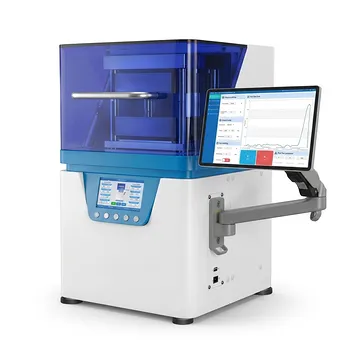
Laboratory hydraulic presses serve as fundamental tools across a diverse spectrum of scientific and industrial disciplines. primarily facilitating precise sample preparation and material analysis. They are most widely utilized in material research, pharmacy, catalytic reaction studies, ceramics, the electronic industry, and spectroscopy.
The Core Utility While applications range from fundamental academic research to industrial quality control, the primary value of a laboratory hydraulic press lies in its ability to generate immense, uniform force on a small scale. This makes it indispensable for tasks requiring high-density sample compaction, such as preparing KBr pellets for spectroscopy or prototyping ceramic components.
Material Science and Electronics
Researching Advanced Materials
In material research labs, hydraulic presses are critical for studying how substances behave under high-pressure conditions. Researchers use them to test strength, durability, and density of new compounds.
Ceramics and Hard Materials
The ceramics industry relies on these presses to compact powders into solid forms before sintering. The high force capability is essential for achieving the necessary structural integrity in ceramic prototypes.
Electronics and Component Fabrication
In the electronic industries, presses are used for lamination and punching electrodes. They allow for the precise layering of materials required in battery research and semiconductor development.
Polymer and Plastic Testing
Polymer testing labs utilize these machines for rubber and plastic molding. They are essential for creating uniform sheets or samples for physical property testing.
Pharmaceutical and Chemical Applications
Pharmaceutical Development
In the pharmacy sector, laboratory presses are vital for R&D and short production runs. They are used to compress powder formulations into pills or pellets to test dissolution rates and stability.
Catalytic Reaction Studies
Specialized presses are used to study catalytic reactions. By applying pressure, researchers can simulate specific reaction environments to analyze catalyst efficiency and behavior.
Undergraduate Chemistry
Hydraulic mini presses are frequently found in academic settings. They serve as teaching tools in undergraduate chemistry labs, allowing students to safely practice material synthesis and sample preparation.
Spectroscopy and Analysis
Sample Preparation for FTIR and XRF
One of the most common uses for laboratory presses is in spectroscopy. They are standard equipment for preparing samples for Fourier Transform Infrared Spectroscopy (FTIR) and X-ray Fluorescence (XRF).
Creating KBr Discs
Specifically, these presses are used to compress mixtures of potassium bromide (KBr) and sample material into transparent 7 mm discs. This ensures the sample is thin and uniform enough for accurate optical analysis.
Understanding the Operational Trade-offs
Speed vs. Precision
Laboratory presses are designed for precision and control, not high-speed mass production. While they are excellent for "lean manufacturing" and limited runs, they are not suitable for high-volume industrial output.
Manual vs. Automated Systems
Many lab presses are manual, requiring physical effort to pump the hydraulic fluid. While cost-effective for occasional use, high-volume labs often require automated systems to reduce operator fatigue and ensure consistent pressure application across hundreds of samples.
Force Requirements
Pneumatic systems generally cap out at around 100 psi, whereas hydraulic systems can achieve 10,000 psi or more. However, using excessive force on a delicate sample (like certain biological materials or soft polymers) can destroy the sample structure before analysis is possible.
Making the Right Choice for Your Application
To determine if a hydraulic press fits your laboratory's needs, consider your primary objective:
- If your primary focus is Analytical Spectroscopy: Prioritize a press specifically designed for making pellets and discs (such as KBr for FTIR), as precision in sample thickness is paramount.
- If your primary focus is Material Engineering: Ensure the press offers high tonnage and heating capabilities to handle tasks like ceramic sintering, lamination, and durability testing.
- If your primary focus is Pharmaceutical R&D: Look for a press that supports versatile die sets for different tablet shapes and offers precise pressure control for consistency in short production runs.
Select the equipment that aligns with your specific material constraints to ensure data accuracy and operational safety.
Summary Table:
| Application Field | Primary Use Cases | Key Benefit |
|---|---|---|
| Spectroscopy | KBr pellets for FTIR/XRF | Ensures thin, transparent, uniform samples |
| Material Science | Ceramic sintering & polymer molding | High-density compaction & durability testing |
| Pharmaceuticals | Tablet R&D & dissolution testing | Precise pressure control for short-run production |
| Electronics | Lamination & electrode punching | Critical for battery and semiconductor prototypes |
| Education | Undergraduate chemistry labs | Safe practice for material synthesis and analysis |
Maximize Your Research Precision with KINTEK Pressing Solutions
Precision and repeatability are the cornerstones of successful laboratory research. KINTEK specializes in a comprehensive range of laboratory pressing solutions designed to meet the rigorous demands of modern science. From manual and automatic models to specialized heated, multifunctional, and glovebox-compatible presses, our equipment is engineered for excellence.
Whether you are performing advanced battery research using our cold and warm isostatic presses or preparing KBr discs for spectroscopy, KINTEK provides the reliability your data deserves. Our expert team is ready to help you select the ideal force capability and system automation for your specific workflow.
Ready to elevate your lab's performance? Contact KINTEK Today to Find Your Ideal Press
Related Products
- Laboratory Hydraulic Press Lab Pellet Press Button Battery Press
- Laboratory Hydraulic Press 2T Lab Pellet Press for KBR FTIR
- Laboratory Hydraulic Press Lab Pellet Press Machine for Glove Box
- 24T 30T 60T Heated Hydraulic Lab Press Machine with Hot Plates for Laboratory
- Automatic Laboratory Hydraulic Press Lab Pellet Press Machine
People Also Ask
- How is a laboratory hydraulic press used for HAP composite gels? Master Mineral Substrate Standardization
- What role does a laboratory hydraulic press play in reaction pellets? Optimizing Lunar Soil and Metal Fuel Density
- What role does a laboratory hydraulic press play in the preparation of piezoelectric ceramic discs for DC-PG? | KINTEK
- What role does a laboratory hydraulic press play in the assembly of all-solid-state battery test cells? Expert Guide
- Why is a laboratory hydraulic press required for PBAT and PLA sample preparation? Achieve Flawless Characterization