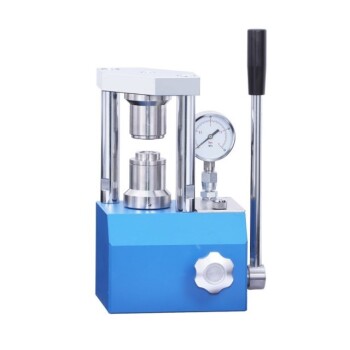
The laboratory hydraulic press acts as the critical precision instrument for the final assembly of coin cell batteries. It provides the stable, controlled mechanical force required to crimp the battery case edges (typically for 2032-type cells). This process hermetically seals the cell while simultaneously compressing the internal components to ensure functional electrical connectivity.
Core Takeaway A hydraulic press serves two distinct but equally vital functions: it creates a hermetic physical seal to prevent leakage and contamination, and it applies uniform internal pressure to minimize contact resistance. Without precise pressure control, electrochemical test data becomes unreliable due to variable internal impedance.
The Physics of the Sealing Process
Precision Mechanical Crimping
The primary function of the press is to drive a sealing mold that mechanically deforms the edges of the coin cell case.
Unlike simple clamping, this process requires controlled force to crimp the metal casing onto the sealing gasket.
This mechanical action creates a robust physical barrier that locks the internal components in place.
Achieving Hermetic Isolation
A proper seal is the battery's only defense against the environment.
The press ensures the casing and gasket bond tightly enough to prevent the volatile liquid electrolyte from leaking out.
Simultaneously, it prevents external contaminants—specifically moisture and oxygen—from entering the cell, which would otherwise degrade the lithium or sodium components immediately.
Optimizing Electrical Performance
Minimizing Contact Resistance
The most overlooked role of the press is its impact on the battery's internal resistance (impedance).
The press applies vertical pressure that forces the positive and negative electrodes, the separator, and the current collectors into intimate physical contact.
This tightness minimizes "ohmic" contact resistance, ensuring that the electrons flow efficiently between the active materials and the casing.
Facilitating Ion Transport
For advanced chemistries, such as quasi-solid-state or lithium metal batteries, this pressure is even more critical.
References indicate that precise pressure helps "wet" the interface between solid electrolytes and anodes.
This ensures uniform ion distribution and reduces interfacial impedance, which is a prerequisite for high-performance cycling (e.g., achieving 5000-hour stability).
The Importance of Consistency
Ensuring Data Reproducibility
In a laboratory setting, consistency is the metric of success.
If two identical batteries are sealed with different pressures, they will exhibit different internal resistances.
Using a hydraulic press to apply a specific, repeatable force (e.g., 5 MPa) ensures that any variance in test data is due to the battery chemistry, not the assembly process.
Long-Term Reliability
A seal that is "good enough" for a day may fail over weeks of testing.
Uniform crimping pressure ensures the seal remains intact during the expansion and contraction cycles of the battery materials.
This structural integrity is vital for valid long-term cycle life testing and rate capability analysis.
Understanding the Trade-offs
The Risk of Over-Compression
While contact is good, excessive force is destructive.
Applying too much pressure via the hydraulic press can crush the internal separator or distort the casing.
This often leads to internal short circuits or a compromised seal that leaks electrolyte under thermal stress.
Manual vs. Automatic Limitations
Manual hydraulic presses rely on the operator to pump the lever to a specific gauge reading, introducing human error and potential inconsistency between batches.
Automatic presses eliminate this variable by electronically controlling the pressure dwell time and force.
However, automatic systems significantly increase equipment costs, creating a trade-off between budget and data precision.
Making the Right Choice for Your Goal
To select the right pressing workflow, assess your specific testing requirements:
- If your primary focus is Standard Liquid Electrolyte Testing: A manual press is generally sufficient, provided operators are trained to hit exact pressure targets on the gauge.
- If your primary focus is Solid-State or High-Precision R&D: An automatic press is recommended to ensure the exact, high-pressure contact required to minimize interfacial impedance.
- If your primary focus is Long-Term Cycle Life: Prioritize equipment with high rigidity and verified pressure calibration to ensure the seal does not degrade over thousands of hours.
Ultimately, the hydraulic press is not just a packaging tool; it is a variable that directly dictates the internal resistance and validity of your electrochemical data.
Summary Table:
| Feature | Role in Battery Assembly | Impact on R&D |
|---|---|---|
| Mechanical Crimping | Deforms casing edges onto gaskets | Creates a hermetic, leak-proof seal |
| Pressure Control | Compresses internal cell layers | Minimizes contact resistance and impedance |
| Consistency | Repeatable force application | Ensures data reproducibility across batches |
| Environmental Protection | Prevents oxygen/moisture ingress | Maintains chemical stability of electrolytes |
Optimize Your Battery Research with KINTEK Precision
At KINTEK, we understand that the integrity of your electrochemical data depends on the precision of your seal. As specialists in comprehensive laboratory pressing solutions, we offer a versatile range of equipment including manual, automatic, heated, and multifunctional presses, as well as glovebox-compatible models designed specifically for sensitive battery R&D.
Whether you are performing standard liquid electrolyte testing or advanced solid-state research, our cold and warm isostatic presses provide the uniform pressure required to eliminate interfacial impedance and ensure long-term cycle stability.
Ready to elevate your laboratory's efficiency and data accuracy? Contact KINTEK Today to Find Your Pressing Solution
References
- Lingwei Zhang, Wenbo Yue. Fabrication of NiFe-LDHs Modified Carbon Nanotubes as the High-Performance Sulfur Host for Lithium–Sulfur Batteries. DOI: 10.3390/nano14030272
This article is also based on technical information from Kintek Solution Knowledge Base .
Related Products
- Button Battery Sealing Press Machine for Lab
- Laboratory Hydraulic Press Lab Pellet Press Button Battery Press
- Lab Button Battery Tablet Press Sealing Mold
- 24T 30T 60T Heated Hydraulic Lab Press Machine with Hot Plates for Laboratory
- Manual Button Battery Sealing Machine for Battery Sealing
People Also Ask
- Why use standardized CR2032 components & high-precision presses? Ensure reliability in lithium metal battery research.
- Why is a laboratory battery sealing press essential for desolvation energy testing? Ensure Reliable Kinetic Data
- Why is a laboratory hydraulic press or battery sealing machine essential? Ensure Coin Cell Data Integrity
- How do laboratory battery sealing machines ensure performance consistency? Master Your Lithium and LFP Battery Assembly
- What role does a laboratory sealing press play in thermal analysis of solid dispersion films? Ensure Data Integrity