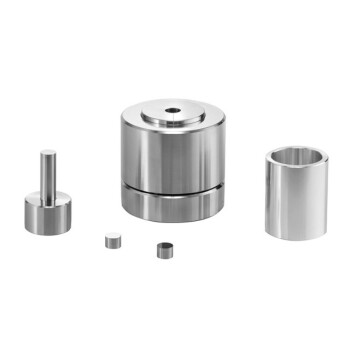
A laboratory powder press acts as the critical fabrication tool for engineering stable interfaces within solid-state batteries. It enables a sequential, step-by-step pressing method to introduce a protective sulfide electrolyte layer between lithium metal and chemically unstable halide electrolytes.
Core Takeaway: By utilizing a controlled step-by-step pressing technique, the powder press creates a multi-layer "sandwich" structure. This physically separates incompatible materials while ensuring tight solid-solid interfaces, preventing immediate chemical degradation and enabling valid lithium stripping and plating tests.
The Engineering of Interface Stability
The primary challenge in testing advanced electrolytes is preventing unwanted chemical reactions before the test even begins. The laboratory press solves this through precise mechanical structuring.
Creating a Protective Barrier
Lithium metal is highly reactive and often chemically incompatible with high-performance halide electrolytes. To solve this, the press is used to insert a protective sulfide electrolyte layer.
This intermediate layer acts as a physical buffer. It is chemically stable against the lithium anode, effectively isolating the unstable halide electrolyte while maintaining ionic conductivity.
The Step-by-Step Pressing Method
You cannot simply pile materials together and press them once. The laboratory press facilitates a step-by-step pressing method.
Operators apply specific pressure and duration settings for each individual layer. This sequential approach allows for the gradual build-up of the electrolyte pellet, ensuring structural integrity without damaging the underlying layers.
Achieving Electrochemical Integrity
Beyond simple shaping, the press plays a vital role in defining the electrochemical environment of the test cell.
Ensuring Uniform Contact
For valid stripping and plating tests, the interface between layers must be flawless. The press applies sufficient force to create tight and uniform solid-solid interfaces.
This eliminates microscopic voids that would otherwise cause high interfacial resistance. A uniform interface ensures that the current distribution is even, which is essential for studying lithium deposition stability accurately.
Preventing Chemical Degradation
By compacting the protective layer tightly against the halide layer, the press prevents direct chemical reactions.
Without this mechanical intervention, the halide electrolyte would react with the lithium metal, degrading the cell immediately. The press ensures the "sandwich" structure holds, providing the necessary conditions to study the material's true electrochemical window.
Understanding the Trade-offs
While the powder press is essential for fabrication, improper usage can introduce new variables that skew experimental data.
Pressure Precision vs. Material Integrity
There is a fine line between compaction and destruction. Over-pressing can lead to internal cracks or density gradients within the electrolyte pellet, potentially causing short circuits or uneven ion flux.
Complexity of Multi-Step Fabrication
The step-by-step method introduces human error and variability. If the duration or pressure is not identical across different samples, the interface quality will vary, making it difficult to reproduce results or compare different electrolyte formulations objectively.
Making the Right Choice for Your Goal
To maximize the effectiveness of your laboratory press in these applications, consider the following strategic approach:
- If your primary focus is Interface Stability: Prioritize the uniformity of the protective sulfide layer by optimizing the pressure duration during the initial pressing steps.
- If your primary focus is Electrochemical Windows: Ensure the step-by-step compaction provides a completely void-free boundary to prevent leakage currents between the lithium and halide layers.
The laboratory powder press is not just for shaping; it is a mechanism for chemical isolation that makes advanced solid-state battery testing possible.
Summary Table:
| Feature | Role in Multi-Layer Construction | Impact on Battery Testing |
|---|---|---|
| Step-by-Step Pressing | Enables sequential layer deposition | Prevents material mixing and structural damage |
| Sulfide Buffer Layer | Acts as a protective chemical barrier | Prevents degradation of unstable halide electrolytes |
| Solid-Solid Interface | Eliminates microscopic voids | Reduces interfacial resistance for even current flux |
| Pressure Control | Achieves uniform pellet compaction | Ensures structural integrity and prevents short circuits |
Elevate Your Battery Research with KINTEK Precision
Unlock superior electrochemical performance in your solid-state battery studies. KINTEK specializes in comprehensive laboratory pressing solutions designed for the rigorous demands of battery research. Whether you need manual, automatic, heated, or glovebox-compatible models—or advanced cold and warm isostatic presses—our equipment ensures the precise interface stability required for valid lithium stripping and plating tests.
Ready to achieve flawless multi-layer electrolyte structures? Contact us today to find the perfect press for your lab's specific needs.
References
- Priya Ganesan, Axel Groß. In‐Depth Analysis of the Origin of Enhanced Ionic Conductivity of Halide‐Based Solid‐State Electrolyte by Anion Site Substitution. DOI: 10.1002/batt.202500378
This article is also based on technical information from Kintek Solution Knowledge Base .
Related Products
- Lab Round Bidirectional Press Mold
- Lab Polygon Press Mold
- XRF KBR Plastic Ring Lab Powder Pellet Pressing Mold for FTIR
- Lab XRF Boric Acid Powder Pellet Pressing Mold for Laboratory Use
- Assemble Square Lab Press Mold for Laboratory Use
People Also Ask
- What is the purpose of incorporating cartridge heaters into a lab press mold for MLCC block compression? Optimize Results
- Why is precise cooling management of the lab press mold necessary? Protect Core Integrity in Thermoforming
- What is the function of a pressing tool in thermoplastic panels? Master Precision Shaping & Fusion Bonding
- Why is a high-performance laboratory molding press critical for in-situ electrolyte formation? Unlock Battery Success
- How do the design and geometric precision of pressing molds and mandrels affect the quality of PTFE composite samples?