
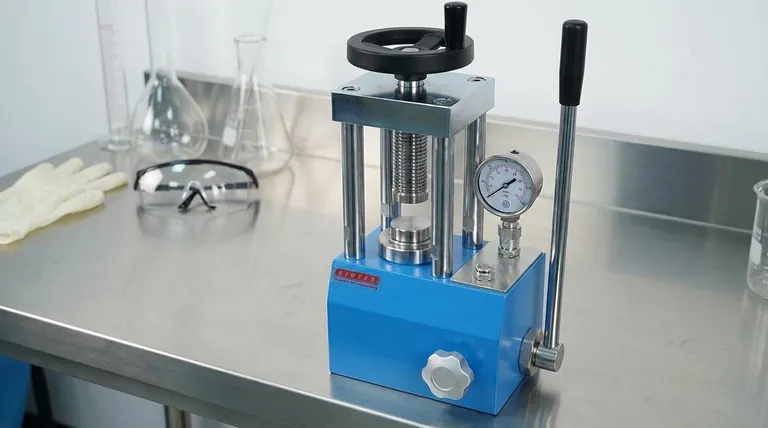
Manual hydraulic pellet presses primarily incorporate automatic pressure relief mechanisms and clear pressure force displays to ensure operator safety. These integrated systems are designed to prevent structural failure from overstress and allow for precise, real-time monitoring of applied force to avoid exceeding operational limits.
The safety architecture of a manual hydraulic press is designed to mitigate the risks of high-pressure environments while ensuring the reproducibility required for spectral analysis.
Critical Safety Mechanisms
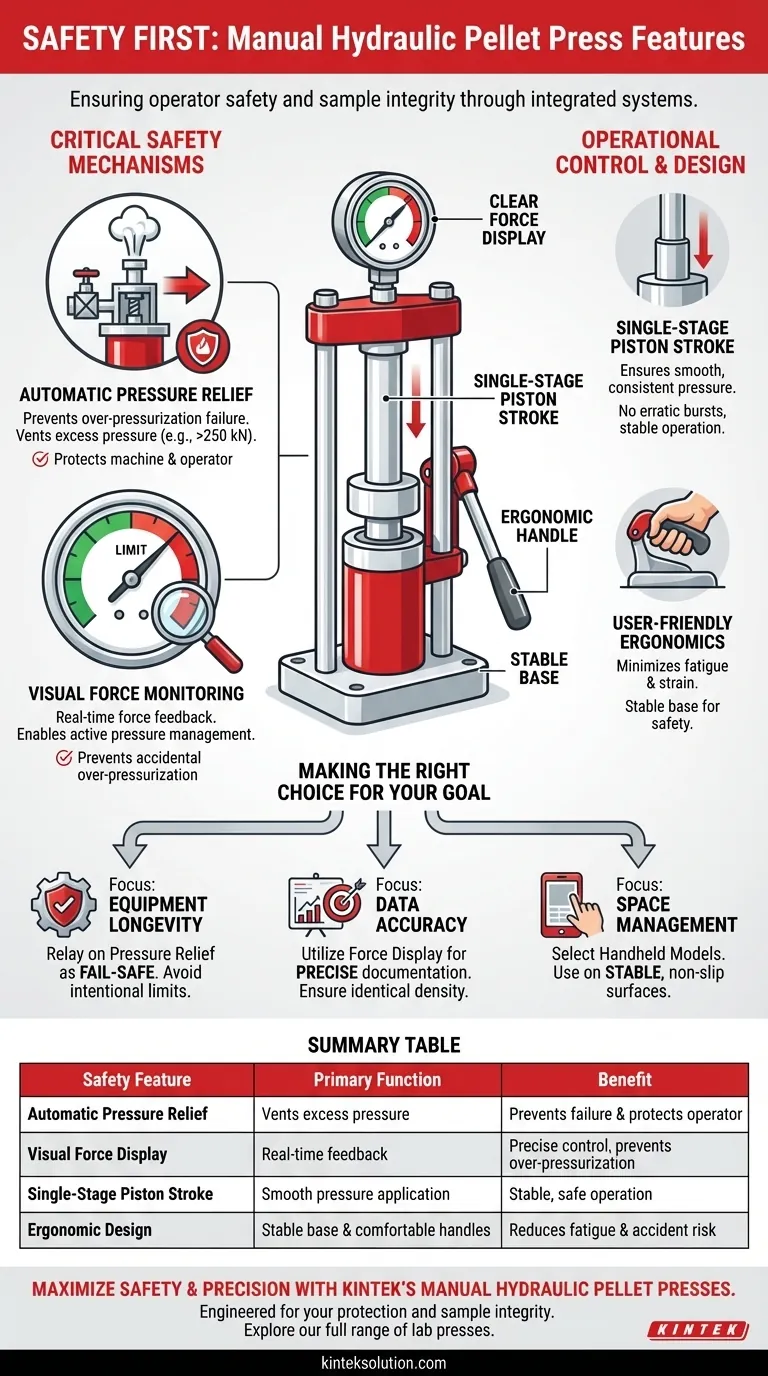
Automatic Pressure Relief
The cornerstone of operator safety in these devices is the automatic pressure relief mechanism. This system is engineered to activate immediately if the internal stress exceeds the machine's operational limits (often rated up to 250 kN).
By automatically venting excess pressure, the mechanism prevents dangerous over-pressurization. This protects the hydraulic components from bursting and prevents the die set from shattering under excessive load.
Visual Force Monitoring
Manual presses are equipped with a clear pressure force display or gauge. This provides the user with immediate, visual feedback on the current load being applied to the sample.
This transparency allows the operator to actively monitor pressure levels. It serves as a preventative measure, helping users stop pumping before the automatic safety valves are forced to engage.
Operational Control and Design
Single-Stage Piston Stroke
Many manual presses utilize a single-stage piston stroke. This mechanical design ensures that pressure is applied consistently and smoothly, rather than in erratic bursts.
Smooth pressure application is critical for safety. It prevents sudden shocks to the system that could dislodge the sample or destabilize the press on the laboratory bench.
User-Friendly Ergonomics
Whether utilizing a full-size unit or a handheld model, these presses prioritize user-friendly design. This includes stable bases and ergonomic handles that allow for high-force application without compromising operator balance.
Understanding the Trade-offs
Manual Exertion vs. Automation
While the pressure relief valve protects the machine, the manual nature of the press introduces human factors. Operators must physically pump the handle, and fatigue can lead to inconsistent handling or ergonomic strain over time.
The "Cold" Pressing Factor
Manual hydraulic presses operate by exerting high pressure without applying additional heat. While this eliminates the safety risks associated with thermal burns found in hot presses, it requires the operator to manage significantly higher physical forces to achieve pellet cohesion.
Making the Right Choice for Your Goal
To maximize the effectiveness of these safety features, align your operation with your specific objectives:
- If your primary focus is Equipment Longevity: Rely on the pressure relief mechanism as a fail-safe, but train operators to never intentionally hit this limit during routine use.
- If your primary focus is Data Accuracy: Utilize the force display to document the exact pressure used for every pellet, ensuring identical density for FTIR or XRF analysis.
- If your primary focus is Space Management: Select handheld models, ensuring they are used on a stable, non-slip surface to compensate for their lighter weight.
By respecting the pressure limits and utilizing the visual gauges, you ensure both the safety of the laboratory environment and the integrity of your analytical data.
Summary Table:
| Safety Feature | Primary Function | Benefit |
|---|---|---|
| Automatic Pressure Relief | Vents excess pressure if limits are exceeded. | Prevents machine failure and protects the operator. |
| Visual Force Display | Provides real-time feedback on applied pressure. | Enables precise control and prevents over-pressurization. |
| Single-Stage Piston Stroke | Ensures smooth, consistent pressure application. | Eliminates erratic bursts for stable, safe operation. |
| Ergonomic Design | Features stable bases and comfortable handles. | Reduces operator fatigue and risk of accidents. |
Maximize safety and precision in your lab with KINTEK's manual hydraulic pellet presses.
Our presses are engineered with the critical safety features you need—like automatic pressure relief and clear force displays—to protect your operators and ensure the integrity of your samples for accurate FTIR or XRF analysis. KINTEK specializes in robust laboratory equipment, including automatic lab presses, isostatic presses, and heated lab presses, designed to meet the rigorous demands of modern laboratories.
Ready to enhance your lab's safety and efficiency? Contact our experts today to find the perfect press for your specific application and discover the KINTEK difference in quality and support.
Visual Guide
Related Products
- Manual Laboratory Hydraulic Pellet Press Lab Hydraulic Press
- Automatic Laboratory Hydraulic Press Lab Pellet Press Machine
- Manual Laboratory Hydraulic Press Lab Pellet Press
- Automatic Laboratory Hydraulic Press for XRF and KBR Pellet Pressing
- Manual Cold Isostatic Pressing CIP Machine Pellet Press
People Also Ask
- What is the primary purpose of a manual lab hydraulic pellet press? Ensure Accurate Sample Prep for XRF and FTIR
- What is the primary purpose of manual lab hydraulic pellet presses? Achieve High-Precision Sample Preparation for Spectroscopy
- What is the primary function of a laboratory hydraulic press in evaluating the ionic conductivity of Li6PS5X (LMSX)?
- What role does a lab hydraulic press play in researching squishy granular matter? Expert Insights into Material Physics
- What is the purpose of initial axial molding using a lab hydraulic press? Optimizing Electrolyte Green Bodies



















