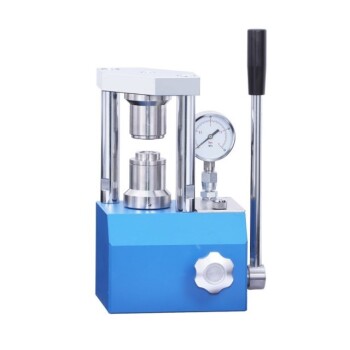
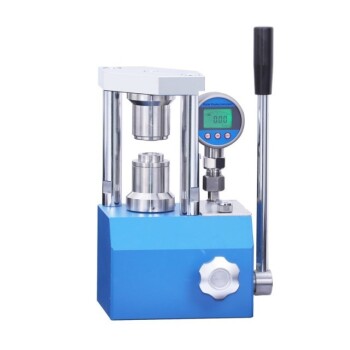
The unique value of a high-pressure cell disruptor, commonly known as a French Press, lies in its ability to combine powerful mechanical force with strict thermal control. By forcing a cell suspension through a microscopic orifice to generate fluid shear forces, this equipment achieves consistent cell breakage without the damaging heat generation often associated with other mechanical methods.
While many methods can rupture a yeast cell wall, the French Press distinguishes itself by protecting the biological "cargo" during extraction. It is the premier choice for isolating heat-sensitive biomolecules, ensuring that unstable enzymes and functional peptides remain intact and active.
The Mechanism of High-Quality Extraction
Utilizing Fluid Shear Forces
The core efficiency of a French Press comes from its hydraulic operation. It forces the yeast cell suspension through an extremely small orifice under high pressure.
Upon exiting this orifice, the suspension experiences a sudden, drastic drop in pressure. This rapid decompression creates intense fluid shear forces.
These forces physically tear open the cell walls. Unlike chemical lysis, which introduces foreign agents, this is a purely physical method that leaves the extract free of lysis chemicals.
Achieving High Consistency
Uniformity is critical in the preparation of yeast derivatives. Because every cell passes through the same orifice under the same pressure conditions, the disruption is highly uniform.
This disruption consistency ensures that the yield is predictable. It prevents the variability often seen in methods like bead beating, where "shadow zones" can leave some cells intact while pulverizing others.
Preserving Biological Integrity
The Low-Temperature Advantage
The most significant benefit of this technology is its ability to operate effectively at low temperatures.
Mechanical disruption generates energy, which usually translates to heat. However, the design of a French Press allows the sample to be chilled throughout the process.
This feature minimizes thermal denaturation. It is essential when the target molecule loses its structure or function when exposed to heat.
Ideal for Fragile Targets
This method is specifically indicated for extracting heat-sensitive biomolecules.
It is particularly valuable for isolating unstable enzymes that would degrade under the friction heat of bead mills or sonicators.
It is also the preferred method for extracting functional peptides, where maintaining the specific amino acid chain structure is vital for bioactivity.
Understanding the Trade-offs
The Risk of Clogging
The very mechanism that creates value—the extremely small orifice—is also the system's primary operational constraint.
Because the opening is so narrow, the input suspension must be uniform and free of large particulate clumps. Without proper pre-processing or filtration, the unit is prone to clogging, which can interrupt the workflow.
Throughput Limitations
While the French Press offers superior quality, it generally operates as a batch or semi-continuous process.
Scaling this up for massive industrial volumes can be challenging compared to continuous flow homogenizers. It is a tool prioritized for quality and purity rather than massive bulk throughput.
Making the Right Choice for Your Goal
To decide if a high-pressure cell disruptor is the right tool for your specific yeast derivative project, consider your end product.
- If your primary focus is Enzyme Activity: This is your best option, as the low-temperature operation preserves the catalytic function of unstable enzymes.
- If your primary focus is Functional Peptides: Use this method to ensure the shear forces liberate the peptides without thermal damage to their structure.
- If your primary focus is Massive Scale Biomass: You may need to evaluate if the batch-style throughput of a standard French Press meets your volume requirements.
Select the French Press when the integrity of the molecule is just as important as the yield of the extraction.
Summary Table:
| Feature | High-Pressure Cell Disruptor (French Press) | Traditional Mechanical Methods |
|---|---|---|
| Disruption Mechanism | Precise Fluid Shear Forces | Friction and Impact |
| Thermal Control | Excellent (Chilled Operation) | High Heat Generation |
| Biological Integrity | Preserves Unstable Enzymes & Peptides | Risk of Thermal Denaturation |
| Yield Consistency | High (Uniform Pressure) | Variable (Shadow Zones) |
| Scalability | Best for Quality-Focused Batches | Suited for Large Bulk Volumes |
Maximize Your Research Precision with KINTEK
Preserving the integrity of fragile biomolecules requires the right equipment. KINTEK specializes in comprehensive laboratory pressing solutions designed for accuracy and durability. Whether you are conducting advanced battery research or isolating sensitive yeast derivatives, our range of manual, automatic, heated, and multifunctional models—including specialized cold and warm isostatic presses—provides the controlled environment your samples deserve.
Don't let thermal damage compromise your results. Contact our laboratory experts today to find the perfect high-pressure solution for your specific application.
References
- Marcin Łukaszewicz, Joanna Kawa‐Rygielska. Potential Applications of Yeast Biomass Derived from Small-Scale Breweries. DOI: 10.3390/app14062529
This article is also based on technical information from Kintek Solution Knowledge Base .
Related Products
- Manual Laboratory Hydraulic Press Lab Pellet Press
- Laboratory Hydraulic Split Electric Lab Pellet Press
- Lab Button Battery Disassembly and Sealing Mold
- Automatic High Temperature Heated Hydraulic Press Machine with Heated Plates for Lab
- Split Automatic Heated Hydraulic Press Machine with Heated Plates
People Also Ask
- How does a laboratory manual hydraulic press assist in powder canning? Maximize Density and Structural Integrity
- What is the primary objective of using a laboratory manual hydraulic press at 20 MPa? Achieve Perfect Green Body Shaping
- What is the primary purpose of manual lab hydraulic pellet presses? Achieve High-Precision Sample Preparation for Spectroscopy
- What is the primary purpose of a manual lab hydraulic pellet press? Ensure Accurate Sample Prep for XRF and FTIR
- How do lab pellet presses support customization and flexibility? Optimize Your Sample Prep for Any Material