
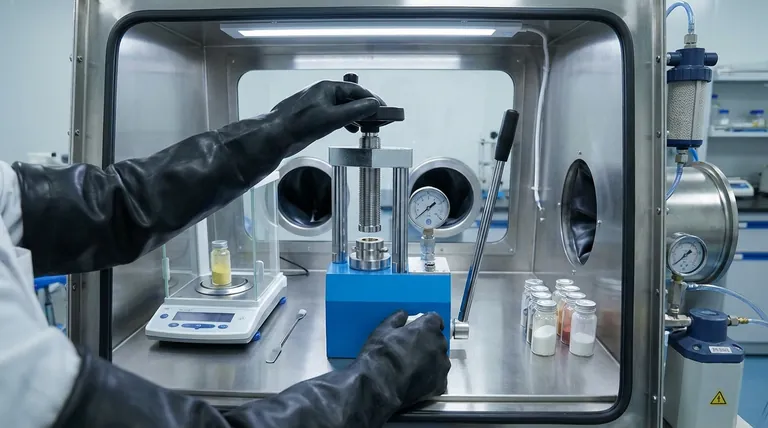
To prevent sample degradation, a laboratory press is typically integrated directly into a glove box workstation. This enclosure is filled with a dry, inert gas—most commonly nitrogen—allowing researchers to compact powders into pellets without ever exposing them to ambient moisture or oxygen.
Halide solid-state electrolytes are chemically unstable in air; even brief exposure can ruin their performance. The definitive solution is to house the compaction equipment entirely within an inert atmosphere, ensuring the material’s intrinsic properties are preserved from synthesis through final assembly.
The Critical Role of Atmospheric Isolation
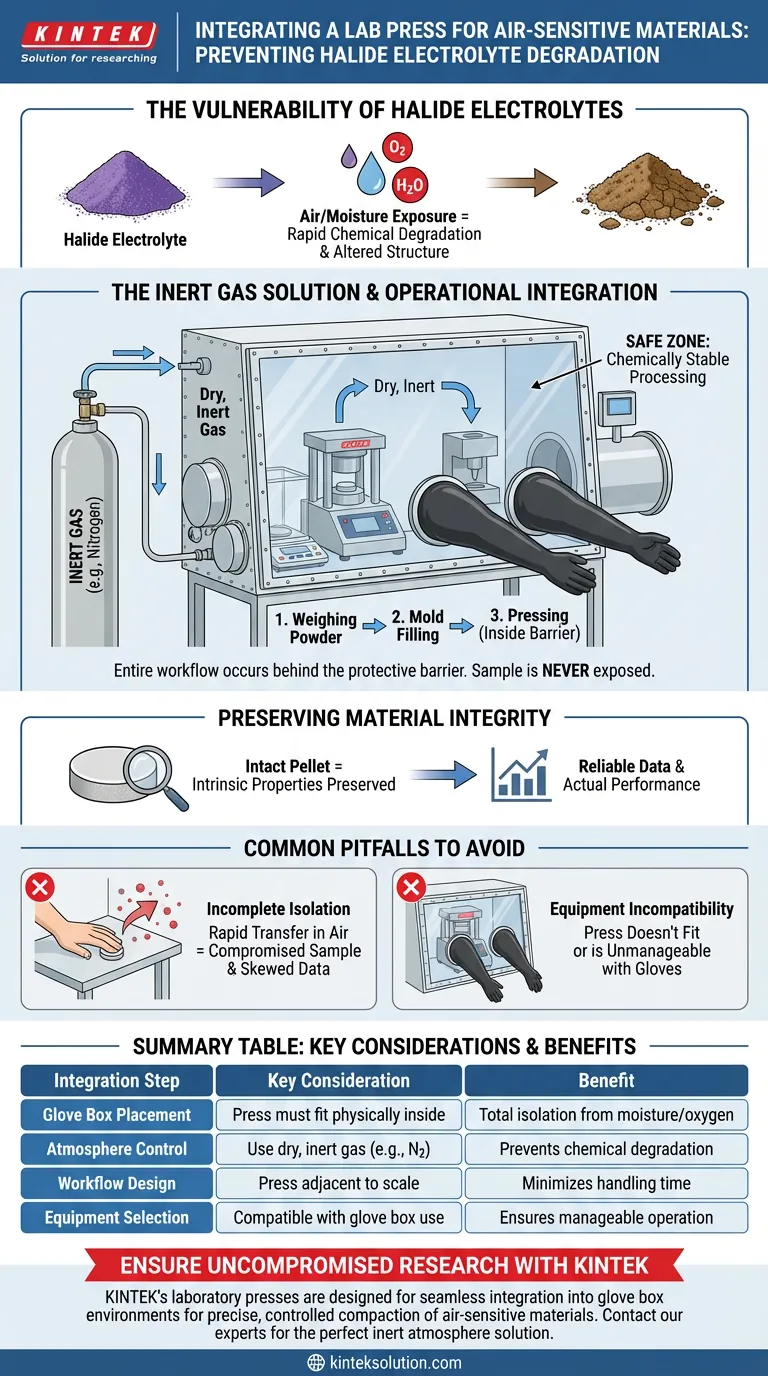
The Vulnerability of Halide Electrolytes
Halide solid-state electrolytes are highly sensitive to environmental factors.
Contact with standard ambient air introduces moisture and oxygen to the sample. This interaction causes rapid chemical degradation, altering the material structure before testing even begins.
The Inert Gas Solution
To counteract this, the laboratory press is operated within a controlled inert atmosphere.
By flooding the workspace with dry nitrogen or a similar noble gas, the reactive elements of air are displaced. This creates a "safe zone" where the material remains chemically stable during physical processing.
Operational Integration
Placement Within the Glove Box
The integration is physical, not just procedural. The laboratory press itself is placed inside the glove box.
This allows the entire workflow—weighing, mold filling, and pressing—to occur behind the protective barrier. The sample is never transferred out of this environment during its most vulnerable state.
Preserving Material Integrity
The primary goal of this integration is the preservation of intrinsic properties.
By compacting the powder in this environment, you ensure the final pellet represents the true capabilities of the material. This guarantees that subsequent testing reflects the electrolyte's actual performance, rather than the effects of contamination.
Common Pitfalls to Avoid
Incomplete Isolation
A common error is assuming that rapid transfer in air is "good enough."
Because these materials are so sensitive, total isolation is required. Attempting to press a sample on an open bench—even quickly—will likely result in a compromised component and skewed data.
Equipment Compatibility
Not all presses are suitable for glove box integration.
You must ensure the press fits physically within the antechamber or the box itself. Furthermore, the operation of the press must be manageable through the thick gloves used to access the workspace.
Making the Right Choice for Your Goal
To ensure your data is reliable, your workflow must be built around the sensitivity of your materials.
- If your primary focus is Data Accuracy: Ensure your press is permanently installed in a high-quality glove box to eliminate all variable exposure to moisture.
- If your primary focus is Workflow Efficiency: Organize your glove box layout so that the press is immediately adjacent to your weighing scale to minimize handling time.
By treating the pressing environment as a critical variable, you ensure the validity of your research on solid-state electrolytes.
Summary Table:
| Integration Step | Key Consideration | Benefit |
|---|---|---|
| Glove Box Placement | Press must fit physically inside the enclosure | Total isolation from moisture and oxygen |
| Atmosphere Control | Use dry, inert gas (e.g., nitrogen) | Prevents chemical degradation of electrolytes |
| Workflow Design | Press adjacent to weighing scale inside box | Minimizes handling and exposure risk |
| Equipment Selection | Choose a press compatible with glove box operation | Ensures manageable use through thick gloves |
Ensure your solid-state electrolyte research is uncompromised by sample degradation. KINTEK's laboratory presses are designed for seamless integration into glove box environments, providing the precise, controlled compaction needed for air-sensitive materials like halide electrolytes. Our automatic lab presses, isostatic presses, and heated lab presses are built to fit your workflow, helping you maintain material integrity from synthesis to testing. Contact our experts today to find the perfect press for your inert atmosphere needs and achieve reliable, accurate results.
Visual Guide
Related Products
- Laboratory Hydraulic Press Lab Pellet Press Machine for Glove Box
- Heated Hydraulic Press Machine with Heated Plates for Vacuum Box Laboratory Hot Press
- Laboratory Hydraulic Press Lab Pellet Press Button Battery Press
- 24T 30T 60T Heated Hydraulic Lab Press Machine with Hot Plates for Laboratory
- Manual Laboratory Hydraulic Press Lab Pellet Press
People Also Ask
- How does a laboratory hydraulic press contribute to the preparation of Li3-3xScxSb samples? Optimize Ionic Conductivity
- What is the function of a laboratory hydraulic press in FT-IR of curcumin-coated MWCNTs? Achieve Optical Clarity.
- Why is a laboratory hydraulic press required for compression molding boron-siloxane? Solve High-Loading Density Challenges
- What role does a laboratory hydraulic press play in reaction pellets? Optimizing Lunar Soil and Metal Fuel Density
- What role does a laboratory hydraulic press play in the preparation of piezoelectric ceramic discs for DC-PG? | KINTEK



















