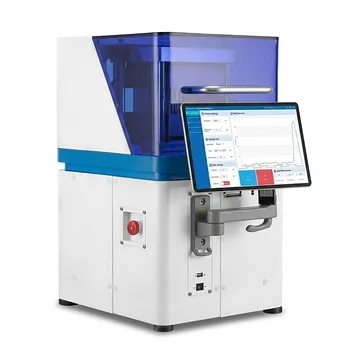
Precision in laboratory presses depends primarily on mechanical stability, thermal uniformity, and load control. To ensure accurate sample preparation, a press must feature uniform temperature distribution across the platen surface and high mechanical solidity to prevent deformation. These features work in tandem to guarantee constant sample thickness and consistent closure force during operation.
The Core Insight: A laboratory press is not just about applying force; it is about eliminating variables. High mechanical solidity and thermal uniformity are required to guarantee reproducible sample thickness and density, which are prerequisites for valid statistical analysis.
The Pillars of Mechanical Precision
High Mechanical Solidity
The structural integrity of the press is the foundation of precision. A press with high mechanical solidity resists flexing or deformation when high pressure is applied.
If the frame or platens yield under load, the sample will suffer from uneven thickness. Rigidity ensures that the closure force remains consistent and the platens remain parallel throughout the pressing cycle.
Uniform Pressure Distribution
Achieving a specific force is useless if that force is not applied evenly across the entire sample area. Uniform pressure is critical for tasks like the densification of coated electrodes.
Consistent distribution ensures that active material particles are spread evenly on current collectors. This optimization of electrode porosity prevents localized material looseness, which could otherwise skew experimental data.
Precise and Repeatable Load Control
Advanced applications, such as preparing Sulfide-based solid-state electrolytes, require exact load control.
Because some materials are highly sensitive to pressure, the press must be able to replicate the exact same pressure profile every time. This repeatability minimizes porosity and establishes stable ion transport channels, ensuring that every sample produced is comparable to the last.
Thermal Accuracy and Consistency
Uniform Temperature Distribution
For processes involving curing or molding, pressure is only half the equation. The press must deliver uniform temperature distribution across the entire platen surface.
Any cold or hot spots on the platen will lead to uneven curing or bonding within the composite laminate. Thermal consistency ensures that the material properties are uniform throughout the sample, not just at the center.
Eliminating Density Variations
When heat and pressure are synchronized perfectly, the press eliminates material density variations.
Fluctuations in either temperature or pressure during the cycle can cause density gradients. By maintaining constant conditions, the press ensures the sample is homogenous, which is vital for evaluating characteristics like acoustic potential or mechanical strength.
Understanding the Trade-offs
The Risk of Data Interference
The primary trade-off in selecting a press is often between cost and the level of precision required for statistical validity.
If a press lacks mechanical solidity or precise control, it introduces "noise" into your data. Uneven electrode thickness or density variations create data interference. This makes subsequent comparative analysis—such as Micro-CT scanning—unreliable, as you cannot distinguish between material performance and sample preparation errors.
Making the Right Choice for Your Goal
To select the right equipment, you must match the machine's capabilities to your specific research requirements.
- If your primary focus is Battery Research (Electrodes/Electrolytes): Prioritize precise load control and uniform pressure to optimize porosity and ensure stable ion transport channels.
- If your primary focus is Composite Materials or Curing: Prioritize uniform temperature distribution and high mechanical solidity to eliminate density variations and ensure consistent thickness.
- If your primary focus is Statistical Comparative Analysis: Prioritize repeatability features to ensure that any variance in your data is due to the material, not the equipment.
True precision is achieved when the equipment disappears from the equation, leaving only the properties of the material itself.
Summary Table:
| Key Feature | Impact on Sample Preparation | Critical Application |
|---|---|---|
| High Mechanical Solidity | Prevents platen deformation; ensures constant thickness. | Composite Material Molding |
| Uniform Pressure | Optimizes porosity; prevents localized material looseness. | Coated Electrode Densification |
| Precise Load Control | Ensures repeatable pressure profiles; stable ion transport. | Solid-state Electrolytes |
| Thermal Uniformity | Eliminates hot/cold spots; ensures even curing & bonding. | Composite Laminates |
| Repeatability | Minimizes data noise for valid statistical analysis. | Comparative Material Studies |
Elevate Your Research with Precision Pressing Solutions
Don't let equipment variability compromise your experimental data. KINTEK specializes in comprehensive laboratory pressing solutions designed to eliminate 'noise' from your workflow. Whether you require manual, automatic, heated, multifunctional, or glovebox-compatible models—or advanced cold and warm isostatic presses—our technology ensures the mechanical stability and thermal uniformity your battery research and material science demand.
Ready to achieve superior sample consistency? Contact KINTEK Today to Find Your Ideal Pressing Solution
Related Products
- Laboratory Hydraulic Press Lab Pellet Press Button Battery Press
- Laboratory Hydraulic Press Lab Pellet Press Machine for Glove Box
- Laboratory Split Manual Heated Hydraulic Press Machine with Hot Plates
- Laboratory Hydraulic Pellet Press for XRF KBR FTIR Lab Press
- Laboratory Hydraulic Split Electric Lab Pellet Press
People Also Ask
- How is a laboratory hydraulic press used for HAP composite gels? Master Mineral Substrate Standardization
- What role does a laboratory hydraulic press play in the preparation of piezoelectric ceramic discs for DC-PG? | KINTEK
- What role does a laboratory hydraulic press play in reaction pellets? Optimizing Lunar Soil and Metal Fuel Density
- Why is a laboratory hydraulic press required for PBAT and PLA sample preparation? Achieve Flawless Characterization
- What role does a laboratory hydraulic press play in the assembly of all-solid-state battery test cells? Expert Guide