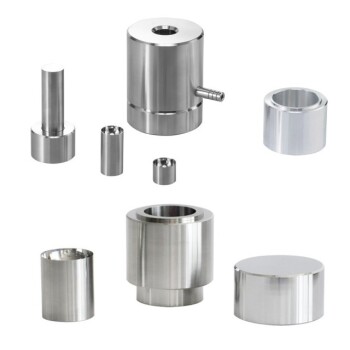
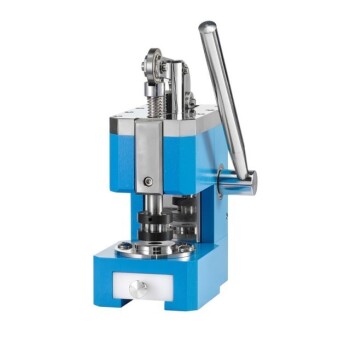
Reliable microstructural analysis depends entirely on sample quality. Laboratory grinding and pelleting equipment are indispensable because they convert irregular, hardened geopolymer mortar into the ultra-fine, uniform states required by sensitive instruments. This standardization removes physical variables—such as particle size differences and surface roughness—that would otherwise distort analytical data, ensuring that the detected signals represent the true material properties.
The validity of your chemical insights rests on physical preparation. By eliminating signal interference through precise grinding and pelleting, you ensure that test results reflect the true mineral composition and hardening mechanisms of the geopolymer, rather than artifacts of sample preparation.
The Critical Role of Fine Grinding
To understand the internal structure of geopolymers, you must first eliminate the physical inconsistencies of the hardened mortar.
Creating Uniform Powders
Laboratory grinding equipment is designed to reduce hardened geopolymer samples into extremely fine, homogeneous powders.
This reduction is necessary to expose the material's internal structure without the bias of large aggregates or uneven clumps.
Enabling Accurate Phase Detection
For techniques like X-ray diffraction (XRD), the "fineness" of the powder is directly linked to data quality.
Properly ground samples ensure that diffraction peak intensities are accurate.
This accuracy is required to quantitatively monitor specific chemical changes, such as the consumption of Portlandite (calcium hydroxide) or the formation of new mineral phases.
The Necessity of High-Precision Pelleting
Once a sample is ground, it often requires compression into a specific physical form to interact correctly with analytical equipment.
Eliminating Surface Roughness
A pelleting press compresses loose powder into a flat, dense disc or pellet.
This standardization of the sample surface is critical for removing "noise" from the data.
Irregular surfaces scatter signals unpredictably; a perfectly flat pellet ensures that the information retrieved regarding mineral phase composition is authentic and clear.
Optimizing for Spectroscopy
Different analysis methods require specific pellet properties that manual preparation cannot achieve.
For Fourier Transform Infrared Spectroscopy (FTIR), presses create Potassium Bromide (KBr) pellets that are transparent to infrared light, allowing for deep molecular analysis.
Similarly, X-ray Fluorescence (XRF) relies on dense, uniform pellets to prevent irregularities that would lead to inaccurate chemical readings.
Common Pitfalls to Avoid
Even with the right equipment, understanding the source of potential errors is vital for accurate geopolymer characterization.
Particle Size Interference
If the grinding process fails to achieve a sufficiently fine or uniform powder, the particle size itself becomes a variable.
This "particle size effect" interferes with detection signals, masking the true chemical data you are trying to capture.
Density Variations
Inconsistent pressure during pelleting can lead to pellets with varying density or microscopic cracks.
These physical flaws distort the interaction between the sample and the probe (X-ray or Infrared), leading to compromised data regarding the geopolymer's hardening mechanism.
Making the Right Choice for Your Goal
The specific equipment and preparation protocols you prioritize should align with the analytical data you need most.
- If your primary focus is Mineral Phase Composition (XRD): Prioritize grinding to an ultra-fine powder and pressing for maximum surface flatness to ensure accurate diffraction peak intensities.
- If your primary focus is Molecular Bonding (FTIR): Focus on the pelleting press's ability to create highly transparent, uniform KBr pellets to accurately capture chemical bonding information.
Ultimately, standardized sample preparation is the key to revealing the true hardening mechanism of your geopolymer.
Summary Table:
| Analysis Technique | Preparation Requirement | Impact on Data Accuracy |
|---|---|---|
| XRD | Ultra-fine powder grinding | Ensures accurate peak intensities & phase detection |
| FTIR | High-transparency KBr pellets | Enables clear molecular bonding & chemical insights |
| XRF | Dense, uniform pellets | Prevents scattering for precise chemical readings |
| SEM/Microscopy | Surface flatness | Eliminates physical noise and surface roughness bias |
Elevate Your Geopolymer Research with KINTEK
Precise microstructural analysis starts with flawless sample preparation. At KINTEK, we specialize in comprehensive laboratory pressing and grinding solutions designed to eliminate variables in your research. Whether you are conducting battery research or mineralogy studies, our range of manual, automatic, heated, and multifunctional presses, along with our isostatic and glovebox-compatible models, ensure your samples meet the highest standards of uniformity.
Ready to remove the 'noise' from your data? Contact us today to find the perfect pelleting and grinding solution tailored to your laboratory's needs.
References
- Zineb Abeoub, M. Trari. An experimental approach for the determination of the physical and mechanical properties of a sustainable geopolymer mortar made with Algerian ground-granulated blast furnace slag. DOI: 10.1515/jmbm-2025-0052
This article is also based on technical information from Kintek Solution Knowledge Base .
Related Products
- Laboratory Hydraulic Press Lab Pellet Press Machine for Glove Box
- Manual Cold Isostatic Pressing CIP Machine Pellet Press
- Laboratory Hydraulic Split Electric Lab Pellet Press
- Automatic Laboratory Hydraulic Press Lab Pellet Press Machine
- Manual Laboratory Hydraulic Press Lab Pellet Press
People Also Ask
- How does a laboratory hydraulic press contribute to the preparation of Li3-3xScxSb samples? Optimize Ionic Conductivity
- What is the function of a laboratory hydraulic press in FT-IR of curcumin-coated MWCNTs? Achieve Optical Clarity.
- Why is a laboratory hydraulic press required for compression molding boron-siloxane? Solve High-Loading Density Challenges
- What role does a laboratory hydraulic press play in reaction pellets? Optimizing Lunar Soil and Metal Fuel Density
- What role does a laboratory hydraulic press play in the preparation of piezoelectric ceramic discs for DC-PG? | KINTEK