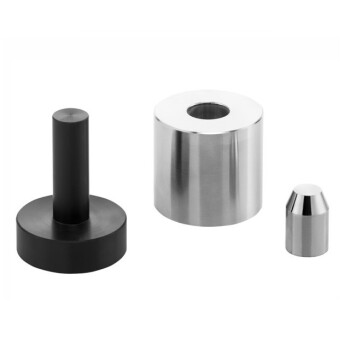
Laboratory hydraulic presses and precision molds are the fundamental enablers of solid-state battery (SSB) performance, serving as the only reliable method to overcome the physical limitations of solid materials. Unlike liquid electrolytes that naturally wet electrodes, solid-state components require immense, uniform mechanical pressure to force anode powders and electrolytes into atomic-level contact, effectively eliminating the voids and pores that kill battery efficiency.
The primary challenge in solid-state battery assembly is overcoming interfacial impedance caused by poor contact between solid layers. Hydraulic presses and precision molds solve this by applying the stable, high-pressure force required to densify materials and create a seamless, low-resistance interface.
The Critical Role of Pressure in Interface Engineering
Eliminating Porosity
In a solid-state system, any air gap serves as an insulator that blocks ion flow. A laboratory hydraulic press utilizes a pressure-holding process to apply extreme uniaxial force—often ranging from 250 MPa to 500 MPa. This forces active material particles and solid electrolyte layers into intimate contact, physically squeezing out porosity.
Reducing Contact Resistance
High-entropy alloy anodes and solid electrolytes are naturally rigid. Without sufficient pressure, these materials suffer from high interfacial contact resistance. The hydraulic press overcomes this by creating a tight solid-solid bond, ensuring that charge transfer is not impeded by physical separation at the grain boundaries.
Enhancing Ionic Conductivity
The foundation of efficient ion transport is a fully densified material. High-pressure preparation compresses electrolyte powders into high-density pellets, significantly reducing grain boundary resistance. This creates a continuous pathway for ions to travel, directly improving the electrochemical performance of the cell.
The Necessity of Precision Molds
Ensuring Uniform Stress Distribution
Applying high pressure is useless if the force is not applied evenly. Precision molds ensure that the mechanical stress is distributed uniformly across the entire surface area of the sample. This prevents pressure gradients that leads to density variations or structural weaknesses within the pellet.
Preventing Structural Defects
Uneven pressure often leads to the formation of cracks in the "green body" (the compacted powder). By using high-precision dies (such as standardized carbide molds), researchers prevent the degradation of structural integrity. This ensures the electrode and electrolyte layers remain tightly integrated without delaminating during the pressing process.
Guaranteeing Data Reproducibility
Scientific validity relies on the ability to replicate results. Precision molds provide a defined geometric space, allowing for the creation of pellets with specific thicknesses and densities under standardized conditions. This accuracy is vital for calculating theoretical vs. actual density and ensuring that performance tests reflect the material's properties, not assembly errors.
Understanding the Trade-offs
The Risk of Over-Densification
While high density is generally desired, excessive pressure can lead to diminishing returns or damage. If the pressure exceeds the material's mechanical limits, it may crush the current collector or deform the active material structure, paradoxically harming the battery's cycle life.
Geometric Limitations
Precision molds typically produce small-scale, pellet-type cells (e.g., 13mm diameter). While excellent for material characterization and interface study, these setups do not perfectly mimic the mechanics of larger, pouch-cell formats where pressure distribution becomes more complex.
Making the Right Choice for Your Goal
To maximize the effectiveness of your assembly process, align your equipment usage with your specific research objectives:
- If your primary focus is Ion Transport: Prioritize higher pressure ranges (300-500 MPa) to maximize densification and minimize grain boundary resistance within the electrolyte.
- If your primary focus is Cycle Life: Focus on the precision of the mold to ensure uniform stress distribution, preventing micro-cracks that propagate during repeated charge/discharge cycles.
By controlling the physical assembly environment with this level of precision, you transform raw powders into a unified electrochemical system capable of high performance.
Summary Table:
| Parameter | Role in SSB Assembly | Key Benefit |
|---|---|---|
| Pressure Range | 250 - 500 MPa | Eliminates porosity and air gaps |
| Force Application | Uniaxial Pressing | Enhances atomic-level contact |
| Mold Precision | Uniform Stress Distribution | Prevents structural defects and cracks |
| Densification | Powder Compaction | Maximizes ionic conductivity |
Elevate Your Battery Research with KINTEK Precision Solutions
At KINTEK, we understand that the future of energy depends on the structural integrity of your solid-state materials. As specialists in comprehensive laboratory pressing solutions, we provide the high-pressure precision needed to eliminate interfacial resistance and maximize ionic conductivity.
Whether you are performing initial material characterization or scaling up prototype development, our diverse range of equipment is designed for your success:
- Manual & Automatic Presses: For versatile and repeatable uniaxial force.
- Heated & Multifunctional Models: To explore temperature-dependent densification.
- Glovebox-Compatible Systems: Ensuring high-purity environments for moisture-sensitive SSB materials.
- Cold & Warm Isostatic Presses (CIP/WIP): Perfect for complex battery research requiring uniform multi-directional pressure.
Ready to transform your battery assembly process? Contact our experts today to find the perfect press and precision mold for your laboratory needs.
References
- Junjie Wang. Advantages of High-Entropy Alloy Anodes over Conventional Anodes for Enhanced Interfacial Stability and Electrochemical Performance in Solid-State Batteries. DOI: 10.54254/2755-2721/2025.gl27344
This article is also based on technical information from Kintek Solution Knowledge Base .
Related Products
- Warm Isostatic Press for Solid State Battery Research Warm Isostatic Press
- Laboratory Hydraulic Press Lab Pellet Press Button Battery Press
- Laboratory Hydraulic Press 2T Lab Pellet Press for KBR FTIR
- Laboratory Hydraulic Pellet Press for XRF KBR FTIR Lab Press
- Automatic Laboratory Hydraulic Press for XRF and KBR Pellet Pressing
People Also Ask
- Why must composite cathodes be sealed in vacuum lamination bags for WIP? Ensure Battery Stability and Density
- What is the function of elastic molds in warm isostatic pressing? Achieve Uniform Density in Composite Particles
- How do sacrificial volume materials (SVM) maintain microchannels in isostatic pressing? Ensure Structural Integrity
- What is the function of hydraulic pressure in warm isostatic pressing? Achieve Uniform Material Density
- How does Warm Isostatic Pressing differ from traditional pressing methods? Unlock Uniform Density for Complex Parts