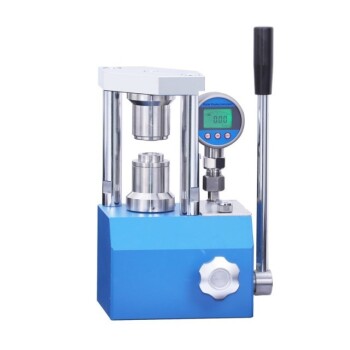
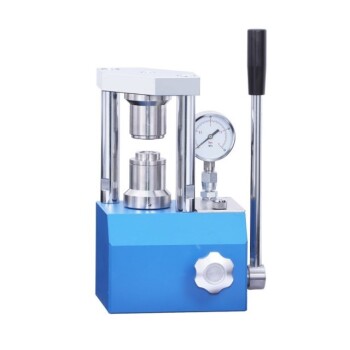
Laboratory press and coin cell sealing machines are essential because they provide the uniform and controllable pressure required to establish tight physical contact between ZCPSE electrolytes and the battery electrodes. Without this precise mechanical application, high interfacial resistance will distort the electrochemical data, preventing an accurate evaluation of the material's true charge-discharge characteristics.
Reliable battery performance evaluation depends on isolating the material's properties from assembly defects. Sealing machines and laboratory presses eliminate physical gaps at the material interface, ensuring that test results reflect the chemistry of the ZCPSE electrolyte rather than poor connectivity.
The Critical Role of Interface Mechanics
Overcoming the Physical Contact Barrier
In battery configurations using ZCPSE electrolytes, the materials do not naturally wet the surface like liquid electrolytes. A laboratory press or sealing machine applies the mechanical force necessary to bridge the gap between the electrolyte and the electrodes (lithium metal anode and cathode). This pressure forces the materials into intimate physical contact, creating a seamless interface.
Reducing Interface Resistance
The primary adversary in evaluating these cells is interface contact resistance. If the contact is loose or uneven, the resistance spikes, impeding the flow of ions. By applying controlled pressure, the machine minimizes this resistance, allowing for efficient ion transport across the ZCPSE-electrode boundary.
Facilitating Ion Transport
High-quality sealing equipment ensures that the interface remains stable during the electrochemical process. This stability is required for lithium ions to move freely between the cathode and anode. Without this mechanical aid, the "bottleneck" at the interface would artificially throttle the battery's performance.
Ensuring Data Integrity
Reflecting True Charge-Discharge Characteristics
The ultimate goal of performance evaluation is to understand how the ZCPSE electrolyte behaves electrochemically. If the cell is not sealed under uniform pressure, the resulting data will reflect the poor assembly rather than the material's capability. Proper sealing ensures the recorded cycle stability and rate performance are accurate attributes of the ZCPSE itself.
Eliminating Experimental Variables
Using a precision machine removes the variability of manual assembly. It ensures that pressure is applied uniformly across the entire surface of the coin cell (e.g., CR2025). This consistency is vital for researchers to compare different batches of materials confident that the assembly process is not skewing the results.
Understanding the Trade-offs
The Risk of Excessive or Uneven Pressure
While pressure is vital, it must be "controllable" as highlighted in the primary reference. If a machine is not calibrated correctly, excessive pressure could damage the separator or the internal structure of the porous electrodes. Conversely, uneven pressure distribution can lead to localized "hot spots" of current density, causing premature cell failure that mimics material instability.
Equipment Precision vs. Cost
High-precision laboratory presses and sealing machines are investments. However, relying on lower-grade or manual sealing tools introduces significant inconsistency. The trade-off for the cost of the equipment is the guarantee of reproducible, publication-quality data that accurately characterizes solid-solid or polymer-solid interfaces.
Making the Right Choice for Your Goal
To maximize the value of your ZCPSE electrolyte evaluations, consider your specific testing objectives:
- If your primary focus is Fundamental Material Research: Prioritize machines with highly granular pressure controls to minimize interface resistance and isolate the intrinsic electrochemical properties of the ZCPSE.
- If your primary focus is Cycle Life Testing: Ensure your sealing equipment guarantees uniform pressure distribution to prevent mechanical delamination over long-term charge-discharge cycles.
Ultimately, the laboratory press is not just a packaging tool; it is a critical instrument for interface engineering that validates the true performance potential of your battery chemistry.
Summary Table:
| Feature | Impact on ZCPSE Battery Evaluation |
|---|---|
| Interface Contact | Bridges gaps between electrolyte and electrodes for seamless contact. |
| Resistance Control | Minimizes interfacial resistance to facilitate efficient ion transport. |
| Data Integrity | Ensures results reflect material chemistry, not assembly defects. |
| Uniform Pressure | Prevents localized current hotspots and mechanical delamination. |
| Consistency | Eliminates manual assembly variables for reproducible research. |
Elevate Your Battery Research with KINTEK Precision
Don't let poor interface contact compromise your ZCPSE electrolyte data. KINTEK specializes in comprehensive laboratory pressing solutions designed for the rigorous demands of energy storage research.
Whether you require manual, automatic, heated, or multifunctional models, or specialized glovebox-compatible and isostatic presses, our equipment ensures the uniform pressure necessary to unlock the true potential of your battery chemistry. Join leading researchers who trust KINTEK for reliable, publication-quality results.
Ready to optimize your cell assembly? Contact KINTEK today for a customized solution!
References
- Manxi Wang, Yuming Chen. In Situ‐Engineered MOF/Polymer Hybrid Electrolyte With 3D Continuous Ion Channels for High‐Voltage and Thermal‐Resistant Lithium Metal Batteries. DOI: 10.1002/idm2.70005
This article is also based on technical information from Kintek Solution Knowledge Base .
Related Products
- Button Battery Sealing Press Machine for Lab
- Button Battery Sealing Machine for Button Batteries
- Manual Button Battery Sealing Machine for Battery Sealing
- Lab Button Battery Tablet Press Sealing Mold
- Lab Button Battery Disassembly and Sealing Mold
People Also Ask
- Why use standardized CR2032 components & high-precision presses? Ensure reliability in lithium metal battery research.
- Why is a laboratory battery sealing press essential for desolvation energy testing? Ensure Reliable Kinetic Data
- Why is a laboratory hydraulic press or battery sealing machine essential? Ensure Coin Cell Data Integrity
- How do laboratory battery sealing machines ensure performance consistency? Master Your Lithium and LFP Battery Assembly
- What role does a laboratory sealing press play in thermal analysis of solid dispersion films? Ensure Data Integrity