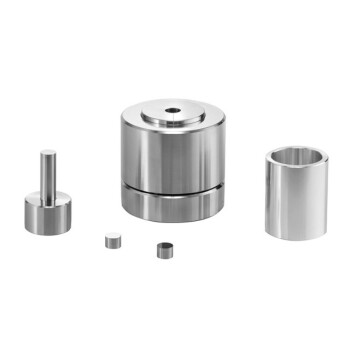
Split molds and filter paper serve as essential containment mechanisms in water soaking experiments designed to simulate extreme flooding environments. The split mold provides necessary lateral support to hold the soil structure in place, while the filter paper allows water to permeate the sample without permitting the soil particles to wash away or disintegrate.
In experiments involving modified soil samples that may become extremely soft, these tools work in tandem to preserve the specimen's geometric shape during immersion. This structural preservation is critical for successfully measuring the loss of unconfined compressive strength after the soaking period.
The Mechanics of Sample Preservation
Providing Lateral Stability
In a soaking experiment, particularly one simulating extreme flooding, a soil sample is subjected to conditions that can rapidly compromise its structural integrity.
The Role of Split Molds
The split mold acts as an external skeleton for the sample. It offers temporary lateral support, preventing the soil column from slumping or collapsing under its own weight before the testing phase begins or while the sample stabilizes.
Managing Permeability and Containment
To simulate flooding accurately, water must be able to enter the sample freely. However, the flow of water can also cause erosion or total disintegration of the soil matrix.
The Role of Filter Paper
Filter paper wrapping solves this dual challenge. It is permeable, allowing for free water penetration into the core of the sample. Simultaneously, it acts as a physical barrier that retains soil particles, preventing mass loss even if the modified soil becomes extremely soft.
Ensuring Data Validity
Maintaining Geometric Shape
For mechanical testing to be valid, the test subject must conform to specific dimensions. The primary reference highlights that this setup ensures the soil sample maintains its basic geometric shape throughout a 48-hour period of full immersion.
Enabling Strength Assessment
The ultimate goal of these experiments is often to assess unconfined compressive strength loss. If the sample were to disintegrate or lose its shape during soaking, this assessment would be impossible. The mold and paper ensure a testable specimen remains at the end of the experiment.
Understanding Experimental Trade-offs
Balancing Support and Exposure
While these tools are necessary for handling soft soils, they introduce artificial elements to the environment. The filter paper must be selected carefully to ensure it allows water inflow without acting as a significant reinforcing layer that artificially boosts the soil's apparent strength.
Dependency on Setup Precision
The effectiveness of this method relies on the "temporary" nature of the support and the correct application of the wrapping. Improper use could lead to uneven saturation or insufficient support, potentially skewing the strength loss data derived after the 48-hour window.
Making the Right Choice for Your Experiment
Optimizing Experimental Design
- If your primary focus is preventing sample loss: Utilize filter paper wrapping to retain particle integrity without blocking the saturation process.
- If your primary focus is structural measurement: Use split molds to maintain the sample's geometric dimensions, ensuring the final unconfined compressive strength test is geometrically valid.
Proper confinement ensures that you are measuring the soil's properties, not the failure of your preparation method.
Summary Table:
| Component | Primary Function | Benefit to Experiment |
|---|---|---|
| Split Mold | Lateral Support | Prevents slumping and maintains geometric shape |
| Filter Paper | Selective Permeability | Allows water saturation while preventing soil erosion |
| Full Immersion | Environment Simulation | Mimics extreme flooding conditions for 48 hours |
| Testing Goal | Strength Assessment | Enables accurate measurement of compressive strength loss |
Elevate Your Soil Research with KINTEK Precision
Ensure the accuracy of your material testing with laboratory equipment designed for extreme precision. KINTEK specializes in comprehensive laboratory pressing solutions, offering a versatile range of manual, automatic, heated, multifunctional, and glovebox-compatible models, alongside cold and warm isostatic presses ideal for battery research and geotechnical applications.
Don't let sample disintegration compromise your data. Partner with KINTEK to achieve superior sample preparation and structural integrity.
Contact Our Experts Today to find the perfect press for your research requirements!
References
- Mary Ann Adajar, Vince Patrick Sy. Shear Strength and Durability of Expansive Soil Treated with Recycled Gypsum and Rice Husk Ash. DOI: 10.3390/app14093540
This article is also based on technical information from Kintek Solution Knowledge Base .
Related Products
- Infrared Heating Quantitative Flat Plate Mold for Precise Temperature Control
- Lab Cylindrical Press Mold with Scale
- Lab Polygon Press Mold
- Lab Double Plate Heating Mold for Laboratory Use
- Lab Cylindrical Press Mold for Laboratory Use
People Also Ask
- How do precision temperature-controlled heating plates function in electrolyte thermal stability storage experiments?
- What is the importance of a precision temperature-controlled heating module? Ensure Aluminum-Cadmium Thermal Stability
- How does heating platen precision affect rubber specimens? Achieve uniform density and reliable testing results.
- How are thin polymer films produced for spectroscopic analysis? Expert Guide to Heat and Low-Pressure Methods
- What accessories and field services can be used to optimize the capabilities of presses? Maximize Your Lab Performance