
The pellets produced by a KBr press are ideal because they standardize the optical path of the sample, creating a flat, uniform cylinder that allows for precise transmission spectroscopy. By compressing the sample within a Potassium Bromide (KBr) matrix, the press creates a transparent medium that minimizes light scattering and interference, ensuring the resulting spectral data represents the sample's molecular structure rather than physical irregularities.
The Core Value of KBr Pellets
While modern techniques like ATR exist, the KBr pellet remains the gold standard for quantitative analysis because it transforms a rough powder into a refined optical element. This process grants the analyst total control over sample concentration and pathlength, resulting in superior reproducibility and signal clarity.
The Physics of Precision
To understand why this method is preferred for critical analysis, one must look at how the physical properties of the pellet interact with the FTIR instrument.
Optical Transparency
The primary requirement for FTIR is that the medium holding the sample must not absorb infrared light. KBr is chosen specifically for its high transparency to infrared radiation.
When compressed correctly, the KBr matrix becomes invisible to the instrument. This ensures that any absorption detected is solely due to the sample itself, eliminating matrix interference.
Uniform Geometry
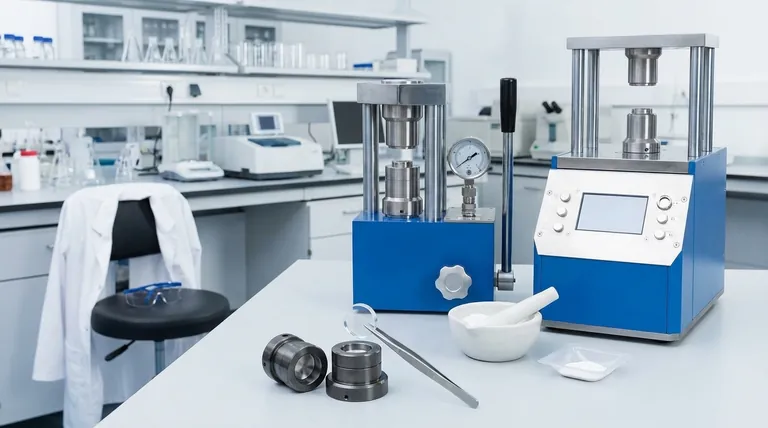
The KBr pellet press applies uniform force via a hydraulic mechanism to a specific die set. This produces a cylindrical pellet with flat ends and uniform thickness, typically around 2 mm.
This geometric precision is critical. If a sample varies in thickness, the infrared light passes through different pathlengths, distorting the data. A pressed pellet ensures the light travels through a consistent amount of material every time.
Controlled Dilution
FTIR instruments are highly sensitive; a pure solid sample would block the signal entirely (saturation). The KBr pellet method allows you to dilute the sample at a precise ratio, typically 1 part sample to 100 parts KBr.
This places the concentration exactly within the detection range of the instrument. Thoroughly mixing the sample with KBr in a mortar before pressing ensures the analyte is evenly distributed throughout the disc.
Achieving Reproducibility
For scientists conducting comparative studies or quantitative analysis, results must be repeatable.
Consistency Between Scans
Because the die sets and press pressures are standardized, you can produce pellets that are nearly identical from batch to batch. This uniformity is vital when comparing spectra over time or between different samples.
Signal Integrity
The high pressure of the press creates a solid, durable disc. Unlike loose powders or uneven films, a solid pellet maintains its structure during analysis, preventing physical shifts that could introduce noise to the spectrum.
Understanding the Trade-offs
While KBr pellets offer high-quality data, the references highlight specific challenges that users must navigate to ensure success.
Sensitivity to Preparation
Creating a clear pellet is a skill. References note that if a pellet is too thick or opaque, the data will be compromised.
This opacity usually indicates that the amount of powder used needs adjustment. Achieving the "glass-like" transparency required for optimal transmission often requires trial and error with sample quantities.
Comparison to Modern Techniques
Solid analysis in KBr is considered a "classic" technique. References acknowledge that ATR (Attenuated Total Reflectance) is now a dominant, more modern technique.
While KBr offers advantages in transmission and varying pathlengths, ATR often requires less preparation. The choice involves balancing the need for the rigorous transmission data KBr provides against the speed of newer methods.
Making the Right Choice for Your Goal
The KBr pellet press is not just a preparation tool; it is a gateway to high-fidelity data. Use the following guide to determine if this method suits your current project.
- If your primary focus is Quantitative Analysis: Use KBr pellets, as the uniform thickness and defined concentration ratio provide the precision needed for exact measurements.
- If your primary focus is Comparative Studies: Use KBr pellets to ensure that physical variations in the sample do not skew the comparison between different batches.
- If your primary focus is Speed: Consider if the "classic" nature of KBr preparation is necessary, or if a modern technique like ATR might suffice for qualitative checks.
Ultimately, the KBr pellet press is the ideal choice when accuracy, transparency, and geometric uniformity are non-negotiable requirements for your spectral analysis.
Summary Table:
| Feature | Benefit for FTIR Analysis |
|---|---|
| Optical Transparency | KBr matrix is IR-transparent, eliminating interference for clear sample data. |
| Uniform Geometry | Flat, consistent thickness ensures precise pathlength for reliable measurements. |
| Controlled Dilution | Precise sample-to-KBr ratio (e.g., 1:100) optimizes concentration for instrument detection. |
| High Reproducibility | Standardized press and dies produce identical pellets for comparative studies. |
Ready to achieve laboratory-grade precision in your FTIR analysis?
KINTEK's range of automatic lab presses, including our specialized KBr pellet presses, are engineered to deliver the uniform, transparent pellets essential for accurate and reproducible spectral data. Whether your focus is quantitative analysis or comparative studies, our robust and reliable equipment ensures your results are never compromised by sample preparation.
Contact us today using the form below to discuss how a KINTEK press can enhance your lab's capabilities and streamline your workflow. Let's build the perfect solution for your laboratory needs together.
Visual Guide

Related Products
- Laboratory Hydraulic Press 2T Lab Pellet Press for KBR FTIR
- XRF KBR Plastic Ring Lab Powder Pellet Pressing Mold for FTIR
- XRF KBR Steel Ring Lab Powder Pellet Pressing Mold for FTIR
- Laboratory Hydraulic Pellet Press for XRF KBR FTIR Lab Press
- Automatic Laboratory Hydraulic Press for XRF and KBR Pellet Pressing
People Also Ask
- What is the role of a laboratory pressure machine and KBr in FTIR? Master Sample Preparation for Flame Retardants
- What is the role of a laboratory hydraulic press in high-loading NCM811 cathode prep for solid-state batteries?
- What role does a laboratory hydraulic press play in reaction pellets? Optimizing Lunar Soil and Metal Fuel Density
- Why is a laboratory hydraulic press necessary for sample preparation? Precise Pelleting for Spiro Heterocyclic Analysis
- Why is uniform encapsulation pressure necessary for lithium-metal battery assembly? Achieve Flawless In-Situ Results



















