
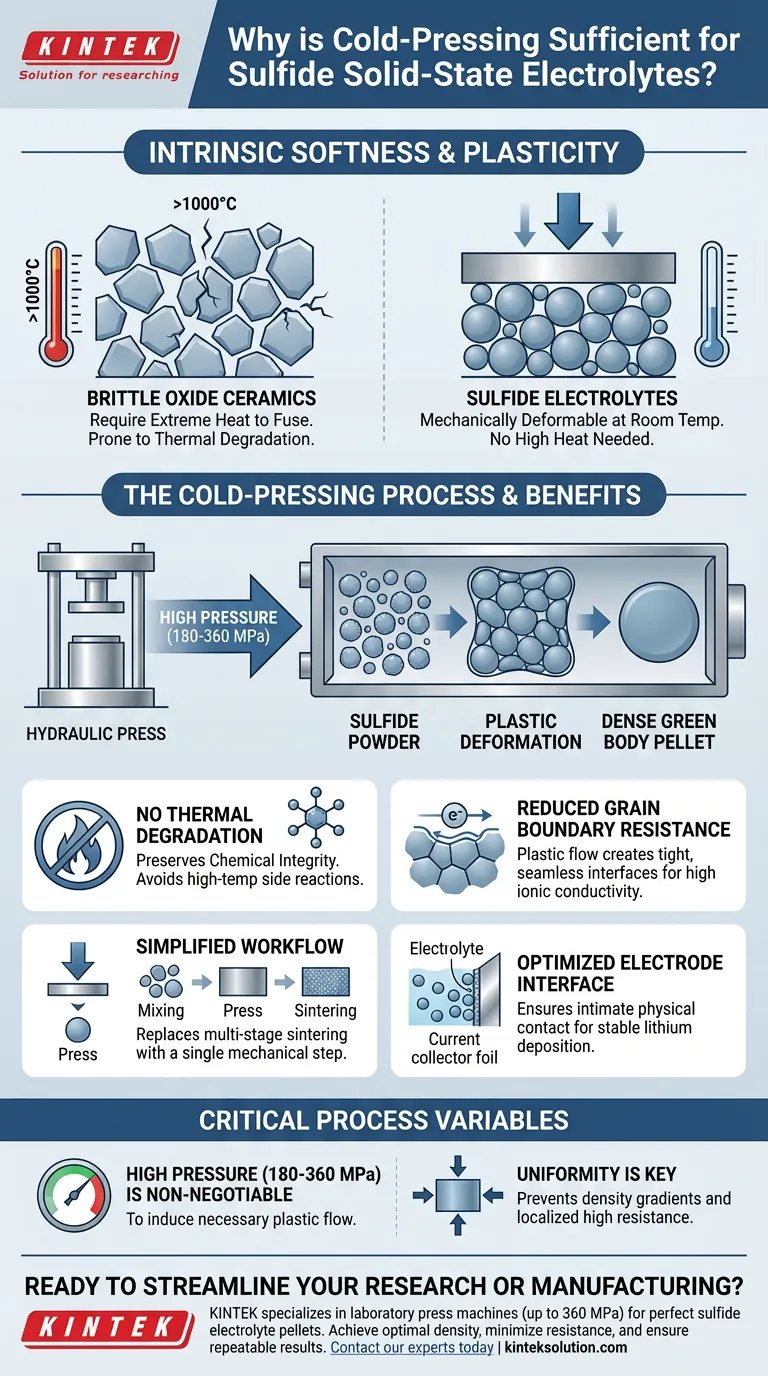
The sufficiency of cold-pressing for sulfide electrolytes stems directly from their unique mechanical properties: intrinsic softness and plasticity. Unlike brittle oxide ceramics that require extreme heat to fuse, sulfide powders can be mechanically deformed at room temperature. This allows simple hydraulic pressure to compact the material into a dense, highly conductive pellet, effectively bypassing complex thermal processing.
By leveraging the high ductility of sulfide materials, cold pressing creates continuous ion-conduction pathways through mechanical force alone. This eliminates the need for energy-intensive sintering, preventing the chemical side reactions often caused by high-temperature treatments.
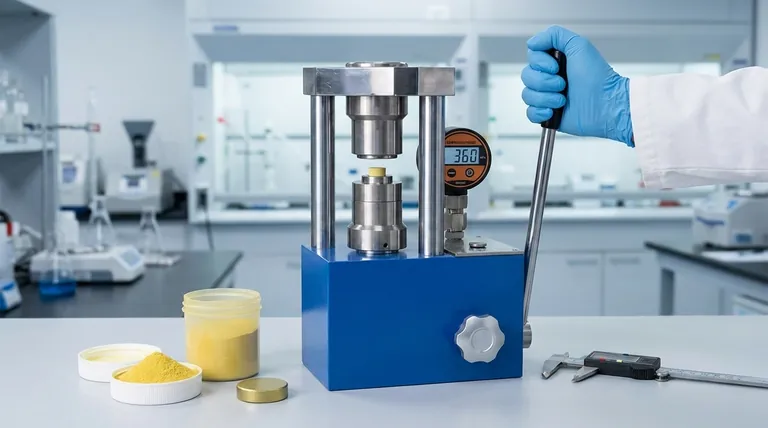
The Mechanics of Plastic Deformation
Achieving High Density Without Heat
The fundamental reason cold pressing works lies in the material's response to stress. Sulfide electrolytes are significantly softer than their oxide counterparts.
When pressure—typically between 180 and 360 MPa—is applied, the sulfide particles do not merely pack closer together; they undergo plastic deformation. The particles physically change shape to fill voids, resulting in a dense, cohesive pellet (often called a "green body" in ceramics, but functionally complete here).
Reducing Grain Boundary Resistance
For a solid-state battery to function, lithium ions must move easily from one particle to the next. Gaps between particles create high resistance.
Because the sulfide particles deform under pressure, they create tight, seamless interfaces with their neighbors. This "intimate contact" drastically lowers grain boundary resistance, creating the continuous pathways necessary for high ionic conductivity.
Operational and Chemical Advantages
Simplifying the Manufacturing Workflow
In traditional ceramic processing (such as with garnet electrolytes), pressing is just a preliminary step followed by sintering at temperatures exceeding 1000°C.
For sulfides, cold pressing is often the final consolidation step. This removal of the sintering phase significantly reduces energy consumption and equipment complexity. It transforms the workflow from a multi-stage thermal process into a straightforward mechanical one.
Avoiding Thermal Degradation
Sulfide materials can be chemically unstable at high temperatures.
By relying on room-temperature densification, manufacturers avoid the risk of thermally induced side reactions that could alter the material's stoichiometry. This ensures the chemical integrity of the electrolyte is preserved from the powder stage to the final pellet.
Optimizing the Electrode Interface
Enhancing Electrode Contact
The benefits of plasticity extend beyond the electrolyte itself to its interaction with other battery components.
When preparing anode-free batteries or testing setups, cold pressing ensures intimate physical contact between the electrolyte and the current collector or lithium foil. This reduces interfacial resistance, which is critical for stable lithium deposition and stripping cycles.
Ensuring Measurement Accuracy
For researchers, the uniformity of this contact is paramount.
Using a laboratory press to apply constant, uniform pressure ensures that measurements of ionic conductivity are accurate and repeatable. Without this mechanical densification, data would be skewed by poor contact rather than reflecting the material's true properties.
Critical Process Variables (The Trade-offs)
The Necessity of High Pressure
While heat is not required, significant force is non-negotiable.
Mere loose compaction is insufficient; pressures in the 180–360 MPa range are required to induce the necessary plastic flow. Insufficient pressure will result in voids, high resistance, and poor structural integrity.
Uniformity is Key
The pressure must be applied uniformly across the entire surface area.
Uneven pressure distribution leads to density gradients within the pellet. This can cause localized areas of high resistance, which may lead to uneven lithium plating or dendrite formation during battery operation.
Making the Right Choice for Your Goal
Depending on your specific manufacturing or research objectives, how you apply this process will vary.
- If your primary focus is manufacturing efficiency: Leverage cold pressing to completely eliminate sintering steps, thereby reducing energy costs and processing time.
- If your primary focus is maximizing ionic conductivity: Ensure your hydraulic press is capable of delivering at least 360 MPa to maximize particle deformation and minimize grain boundary resistance.
- If your primary focus is cycle stability: Prioritize the uniformity of pressure application to ensure seamless contact between the electrolyte and the current collectors/electrodes.
Cold pressing is not merely a shortcut; it is a mechanically superior method for processing sulfides that aligns perfectly with the material's intrinsic physical characteristics.
Summary Table:
| Key Factor | Why It Matters for Cold Pressing |
|---|---|
| Material Softness | Enables plastic deformation of particles at room temperature under pressure. |
| Pressure Range | 180-360 MPa is required to achieve dense, void-free pellets. |
| Grain Boundary Resistance | Plastic flow creates seamless interfaces, enabling high ionic conductivity. |
| Thermal Stability | Avoids high-temperature degradation, preserving chemical integrity. |
| Process Simplicity | Replaces multi-stage sintering with a single mechanical step. |
Ready to streamline your solid-state battery research or manufacturing?
KINTEK specializes in laboratory press machines, including automatic and heated lab presses, designed to deliver the precise, uniform high pressure (up to 360 MPa) required for perfect sulfide electrolyte pellets. Our equipment helps researchers and manufacturers achieve optimal density, minimize interfacial resistance, and ensure accurate, repeatable results—all without the complexity and cost of thermal processing.
Contact our experts today to find the perfect lab press for your specific sulfide electrolyte application and enhance your efficiency.
Visual Guide
Related Products
- Electric Lab Cold Isostatic Press CIP Machine
- Manual Cold Isostatic Pressing CIP Machine Pellet Press
- Electric Split Lab Cold Isostatic Pressing CIP Machine
- Warm Isostatic Press for Solid State Battery Research Warm Isostatic Press
- Automatic Laboratory Hydraulic Press for XRF and KBR Pellet Pressing
People Also Ask
- What role do electric lab cold isostatic presses play in industrial contexts? Bridge R&D and Manufacturing with Precision
- What are the applications of electric lab cold isostatic presses in research settings? Advance Material R&D with High-Pressure CIPs
- How does electrical Cold Isostatic Pressing (CIP) contribute to cost savings? Unlock Efficiency and Reduce Expenses
- What are some research applications of electric lab CIPs? Unlock Uniform Powder Densification for Advanced Materials
- What are the characteristics of standard off-the-shelf electric lab CIP solutions? Achieve Immediate, Cost-Effective Processing




