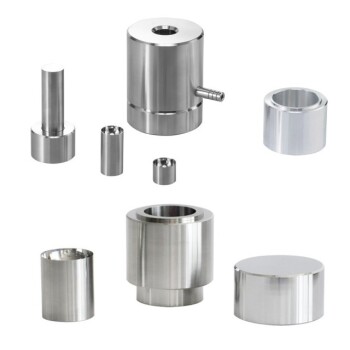
A cylindrical mold with a double-plunger structure is primarily utilized to achieve uniform internal density within Compressed Stabilized Earth Cylinders (CSECs). This configuration allows for the simultaneous application of pressure from both the top and bottom of the sample. By doing so, it effectively counteracts the friction that naturally occurs between the earth mixture and the mold walls during the compaction process.
Core Takeaway In static compaction, friction between the material and the mold creates density gradients that compromise test results. The double-plunger system neutralizes this issue by compressing from both ends, ensuring the specimen has a consistent density throughout and yielding reliable, reproducible data.
The Mechanics of Effective Compaction
To understand why the double-plunger system is necessary, one must look at the interaction between the soil mixture and the containment vessel.
Overcoming Wall Friction
When pressure is applied to a stabilized earth mixture, the material naturally pushes against the sides of the cylindrical mold.
This contact creates significant friction. In a standard single-plunger setup, this friction resists the downward force, causing the material closest to the moving plunger to be denser than the material at the bottom.
The Double-Plunger Solution
The double-plunger structure addresses this resistance by applying compressive force from both ends simultaneously.
This dual-action approach ensures that the compactive effort is distributed evenly across the entire height of the cylinder. It minimizes the "dead zones" where friction would otherwise prevent adequate compaction.
Implications for Specimen Quality
The physical configuration of the mold directly correlates to the integrity of the data collected from the CSEC.
Achieving Structural Homogeneity
The primary goal of preparing CSECs is to create a sample that is homogeneous, or uniform, in its internal structure.
A double-plunger mold ensures that the internal density is consistent from the top of the cylinder to the bottom. This uniformity is vital for accurately characterizing the mechanical properties of the stabilized earth.
Enhancing Test Consistency
When internal density varies due to mold friction, test results become erratic and unreliable.
By removing the variable of uneven density, the double-plunger method significantly improves the consistency of test results. This allows researchers and engineers to trust that variations in data are due to the material itself, not artifacts of the preparation method.
Common Pitfalls in Sample Preparation
While the double-plunger method is superior, it is important to understand the risks associated with ignoring friction dynamics.
The Risk of Density Gradients
A common mistake in earth cylinder preparation is underestimating the impact of wall friction, particularly in taller samples.
If a single-plunger or static mold is used, the resulting cylinder will likely suffer from a density gradient. This means the top half may be structurally sound while the bottom half is porous and weak.
Compromised Data Integrity
Testing a sample with uneven density leads to premature failure at the weaker end.
This results in an underestimation of the material's true strength. Relying on such data can lead to incorrect engineering judgments regarding the stabilized earth's load-bearing capacity.
Making the Right Choice for Your Goal
Selecting the correct mold configuration is a critical step in experimental design for stabilized earth.
- If your primary focus is Data Reliability: Utilize the double-plunger structure to eliminate density variations that introduce noise into your test results.
- If your primary focus is Material Characterization: Ensure simultaneous top-and-bottom compaction to produce a homogeneous specimen that accurately reflects the material's true properties.
By controlling friction through simultaneous dual-end compaction, you transform a variable process into a standardized, scientifically valid procedure.
Summary Table:
| Feature | Single-Plunger Method | Double-Plunger Method |
|---|---|---|
| Pressure Source | Top surface only | Simultaneous Top and Bottom |
| Wall Friction | Creates significant resistance | Effectively neutralized |
| Density Distribution | Gradients (Denser at top) | Uniform / Homogeneous |
| Data Reliability | High risk of erratic results | High consistency and accuracy |
| Structural Integrity | Weak zones at the bottom | Consistent strength throughout |
Elevate Your Material Research with KINTEK Precision
Don't let density gradients compromise your research outcomes. KINTEK specializes in comprehensive laboratory pressing solutions, offering a versatile range of manual, automatic, and multifunctional models designed to deliver the uniform compaction your samples require. Whether you are conducting advanced battery research or stabilizing earth materials, our heated and glovebox-compatible presses—along with our specialized cold and warm isostatic systems—ensure structural homogeneity every time.
Ready to achieve superior consistency in your lab? Contact KINTEK today to find the perfect pressing solution!
References
- Robert Hillyard, Brett Story. Prediction of Performance of Compressed Earthen Construction Using Compressed Stabilized Earthen Cylinders (CSECs). DOI: 10.3390/buildings15111767
This article is also based on technical information from Kintek Solution Knowledge Base .
Related Products
- Lab Cylindrical Press Mold with Scale
- Lab Cylindrical Press Mold for Laboratory Use
- Cylindrical Lab Electric Heating Press Mold for Laboratory Use
- Assemble Lab Cylindrical Press Mold for Laboratory Use
- Lab Double Plate Heating Mold for Laboratory Use
People Also Ask
- What is the purpose of incorporating cartridge heaters into a lab press mold for MLCC block compression? Optimize Results
- What is the function of a pressing tool in thermoplastic panels? Master Precision Shaping & Fusion Bonding
- Why is precise cooling management of the lab press mold necessary? Protect Core Integrity in Thermoforming
- Why is a standardized cylindrical mold necessary when testing electrode materials? Ensure Data Precision & Consistency
- What is the technical significance of specific cylindrical molds in aluminum foaming? Achieve Near-Net-Shape Precision