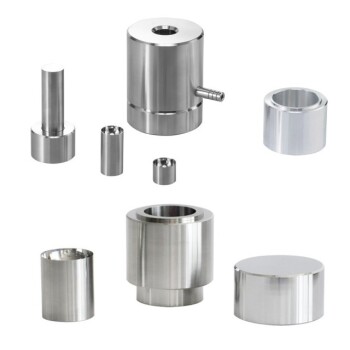
The high-performance laboratory molding press acts as the physical foundation for the chemical success of in-situ electrolyte formation. It provides the critical uniform stress distribution necessary to position active material particles in their optimal kinetic locations before the reaction begins. This precise mechanical arrangement ensures that the conductive phases generated during the reaction perfectly fill electrode pores, enabling the battery to function.
Core Takeaway In-situ electrolyte formation replaces expensive pre-mixed powders with reaction-generated lithium salts. A high-performance press is the key enabler of this process, utilizing mechanical uniformity to ensure these generated salts create a seamless, high-conductivity network within the electrode structure.
The Mechanics of In-Situ Formation
Optimizing Kinetic Positioning
The primary role of the molding press in this specific technology path is not merely compaction, but precise particle arrangement. By applying a strictly uniform stress distribution, the press forces active material particles into specific positions.
These positions are described as "optimal kinetic locations." This mechanical setup is the prerequisite for the chemical reaction that follows, ensuring that the reactants are aligned correctly to facilitate the in-situ process.
Facilitating Perfect Pore Filling
Once the active materials are kinetically positioned, the chemical reaction generates conductive phases, such as LiCl or LiBH4. Because of the initial precision pressing, these generated phases can effectively navigate the electrode structure.
The result is the perfect filling of electrode pores. This creates a composite electrode structure where the solid electrolyte fills the voids between active materials, establishing a robust pathway for ion transport.
Overcoming Traditional Fabrication Hurdles
Eliminating Expensive Pre-Mixing
Traditional solid-state battery manufacturing often relies on mixing active materials with expensive solid-state electrolyte powders. The in-situ technology path disrupts this by utilizing lithium salts generated from the reaction of the active material itself.
The laboratory press makes this cost-saving measure possible. It replaces the need for an expensive supply chain with a high-precision mechanical process, allowing researchers to build effective electrodes using raw active materials.
Constructing High-Performance Composites
The ultimate goal of solid-state research is to achieve a balance of power and energy. The structures formed through this press-assisted in-situ method possess both high ionic conductivity and high capacity.
Without the uniform stress provided by the press, the generated conductive phases would likely distribute unevenly. This would result in isolated active materials, lower capacity, and significantly reduced ionic conductivity.
Understanding the Trade-offs
Uniformity vs. Raw Force
A common pitfall is prioritizing the magnitude of pressure over the uniformity of its distribution. In the context of in-situ formation, raw force is secondary to stress homogeneity.
If a press applies high pressure but does so unevenly, the active material particles will not align kinetically. This leads to incomplete pore filling during the reaction phase, regardless of how much force was applied.
The Risk of Macroscopic Unevenness
While the primary goal is chemical alignment, physical consistency remains a concern. Any macroscopic unevenness resulting from a lower-quality press can lead to non-uniform current density.
Although this is a general issue in battery research, in the in-situ path, it is doubly critical. Unevenness disrupts the formation reaction itself, potentially leaving parts of the electrode without the necessary conductive phases (LiCl/LiBH4), rendering sections of the battery inactive.
Making the Right Choice for Your Goal
The selection of a laboratory press dictates the ceiling of your research success. To maximize the results of in-situ electrolyte formation, consider your specific objectives:
- If your primary focus is Ionic Conductivity: Ensure your press guarantees absolute stress uniformity to facilitate perfect pore filling by the generated conductive phases.
- If your primary focus is Cost Efficiency: Leverage the press's precision to maximize the utility of the in-situ reaction, eliminating the need to revert to expensive pre-mixed electrolyte powders.
By converting mechanical precision into chemical efficiency, the right molding press turns raw potential into a viable, high-capacity energy storage solution.
Summary Table:
| Key Feature | Role in In-Situ Formation | Impact on Battery Performance |
|---|---|---|
| Uniform Stress Distribution | Ensures optimal kinetic positioning of active material particles. | Maximizes ionic conductivity and prevents inactive zones. |
| Precise Particle Alignment | Creates the mechanical foundation for the chemical reaction. | Enables perfect pore filling by generated LiCl or LiBH4. |
| Elimination of Pre-mixing | Replaces expensive powders with reaction-generated salts. | Reduces manufacturing costs while maintaining high capacity. |
| Homogeneous Compaction | Prevents macroscopic unevenness and current density issues. | Enhances overall structural integrity and cycle life. |
Elevate Your Solid-State Battery Research with KINTEK
Precision in mechanical pressing is the bridge to chemical excellence in in-situ electrolyte formation. KINTEK specializes in comprehensive laboratory pressing solutions designed to meet the rigorous demands of battery innovation.
Whether you require manual, automatic, heated, multifunctional, or glovebox-compatible models, our range of cold and warm isostatic presses ensures the uniform stress distribution critical for your next breakthrough.
Ready to transform your electrode fabrication? Contact our technical experts today to find the perfect pressing solution for your lab's specific research goals.
References
- Atsushi Inoishi. High-Capacity Anodes for All-Solid-State Lithium Batteries Using In-Situ Formed Solid Electrolyte. DOI: 10.5109/7395773
This article is also based on technical information from Kintek Solution Knowledge Base .
Related Products
- Lab Infrared Press Mold for Laboratory Applications
- Special Shape Lab Press Mold for Laboratory Applications
- Lab Round Bidirectional Press Mold
- Assemble Square Lab Press Mold for Laboratory Use
- Carbide Lab Press Mold for Laboratory Sample Preparation
People Also Ask
- What is the purpose of incorporating cartridge heaters into a lab press mold for MLCC block compression? Optimize Results
- What is the function of a pressing tool in thermoplastic panels? Master Precision Shaping & Fusion Bonding
- Why is precise cooling management of the lab press mold necessary? Protect Core Integrity in Thermoforming
- What challenges are associated with recycling textiles, and how do laboratory presses help? Overcome Recycling Hurdles with Precision Tools
- What are the common applications for laboratory presses? Expert Guide to Sample Prep, R&D, and Quality Control