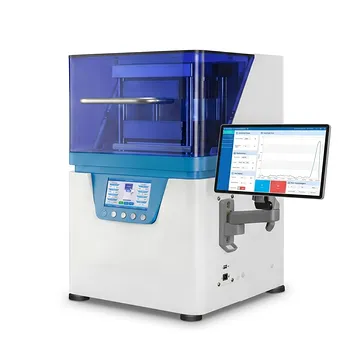
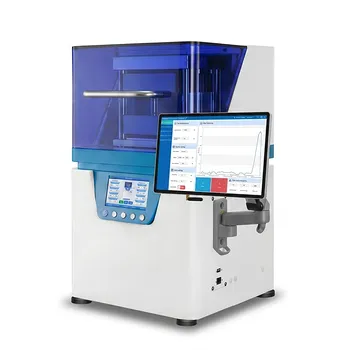
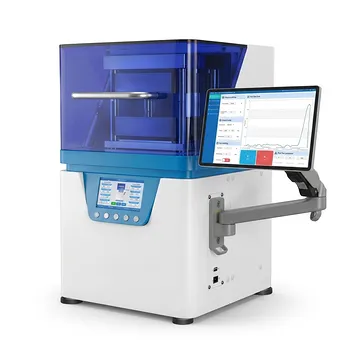
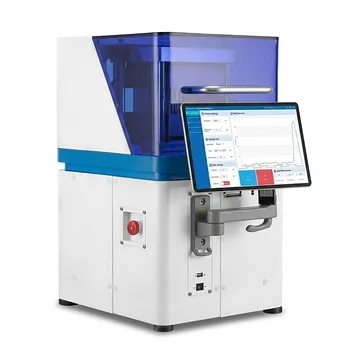
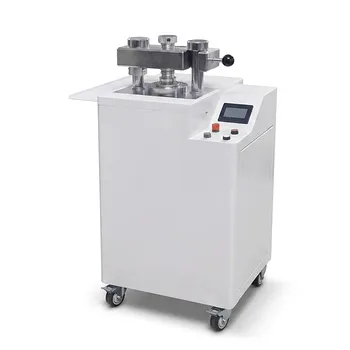
The necessity of a high-precision laboratory hydraulic press lies in its ability to simultaneously provide the extreme thermal and mechanical forces required to fuse discrete rubber particles. It provides a constant high temperature (e.g., 180 °C) and high pressure (e.g., 4.9 MPa) that forces modified recycled rubber powder into intimate contact, enabling the chemical bonds of reactive sintering to form. This controlled environment is the only way to eliminate interfacial gaps and ensure the resulting material achieves the necessary density and mechanical strength.
Core Takeaway: A high-precision laboratory hydraulic press acts as a specialized reactor that uses stable, synchronized heat and pressure to transform recycled rubber powder into a dense, cross-linked solid while eliminating internal defects and dimensional variability.
Facilitating Particle Coalescence and Dense Microstructures
Elimination of Interfacial Gaps
High-precision pressure is required to force recycled rubber particles into intimate physical contact. Without sufficient and stable pressure, microscopic gaps remain between the powder granules, leading to a porous and weak final product.
Overcoming Thermal Thresholds
The press allows the material to reach the reaction temperature while staying below or compensating for decomposition temperatures. This delicate balance ensures that the chemical sintering occurs effectively before the rubber begins to degrade.
Achievement of Uniform Density
By maintaining a constant pressure output, the hydraulic press eliminates density gradients within the specimen. This ensures that every part of the rubber sheet has the same physical properties, which is essential for accurate material characterization.
Driving Chemical Transformation (Reactive Sintering)
Synchronized Heat and Pressure
Reactive sintering is not just a thermal process; it requires the simultaneous application of energy. The heat triggers the chemical cross-linking, while the pressure holds the molecular chains in close enough proximity for those bonds to form across particle boundaries.
Facilitating Molecular Networking
The press provides the environment for interfacial cross-linking, where compatibilizers and rubber chains create a cohesive network. This networking effect "locks" the micro-morphology in place, significantly enhancing the material's dynamic modulus and tensile strength.
Expulsion of Internal Air
As the rubber mixture begins to flow under heat, the high pressure facilitates the expulsion of trapped air. Removing these internal air bubbles is critical to preventing structural defects and ensuring the specimen does not fail prematurely during mechanical testing.
Ensuring Specimen Standardization and Repeatability
Precise Geometric Control
High-precision presses allow for strict control over the final thickness of the specimen (e.g., 2 mm sheets or 0.5 mm glue layers). This dimensional consistency is vital because even minor fluctuations in thickness can lead to significant errors in shear strength or tensile data.
Eliminating Test Variability
A precision press ensures that every specimen produced is a standardized baseline sample. By removing variables like internal air pockets or uneven density, researchers can be confident that their test results reflect the material's true properties rather than manufacturing flaws.
Repeatability of Results
The ability to precisely replicate pressure and temperature settings across multiple batches is the hallmark of a high-precision press. This repeatability is what allows for valid comparisons between different rubber modifications or sintering durations.
Understanding the Trade-offs and Pitfalls
The Risk of Pressure Instability
If a press cannot maintain stable pressure, the rubber may experience "spring-back" or internal micro-cracks. This results in a specimen that appears solid but contains hidden structural weaknesses that compromise its integrity.
Temperature Fluctuations and Scorching
Inaccurate temperature control can lead to uneven vulcanization. If the temperature is too low, the core of the specimen remains unsintered; if it is too high or spikes, the surface of the recycled rubber may "scorch" or degrade before the reaction is complete.
Dimensional Creep
Lower-quality presses may experience displacement drift during the curing cycle. This results in specimens with uneven thickness, making it impossible to calculate accurate stress and strain values during subsequent laboratory analysis.
How to Apply This to Your Project
Recommendations Based on Your Goal
- If your primary focus is maximizing mechanical strength: Ensure the press can maintain a constant pressure of at least 4.9 MPa to guarantee the total elimination of interfacial gaps between particles.
- If your primary focus is chemical research and cross-linking: Prioritize a press with high-precision heated platens (±1 °C) to ensure the reactive sintering occurs uniformly without degrading the elastomer.
- If your primary focus is standardized material testing: Utilize a press with precise displacement control and standardized molds to ensure all specimens have identical geometric dimensions for repeatable results.
By mastering the variables of heat and pressure through a high-precision hydraulic press, you ensure that the reactive sintering process produces a high-performance material rather than a mere collection of compressed particles.
Summary Table:
| Key Feature | Impact on Specimen | Research Benefit |
|---|---|---|
| Pressure Stability | Eliminates interfacial gaps and air bubbles | Ensures uniform density and structural integrity |
| Thermal Precision | Facilitates synchronized chemical cross-linking | Prevents material scorching and degradation |
| Geometric Control | Maintains strict thickness (e.g., 2mm sheets) | Ensures specimen standardization and repeatability |
| Reactive Sintering | Drives molecular networking between particles | Enhances mechanical strength and dynamic modulus |
Optimize Your Material Synthesis with KINTEK
Precision is the difference between a collection of particles and a high-performance solid. KINTEK specializes in comprehensive laboratory pressing solutions designed to meet the rigorous demands of reactive sintering, elastomer studies, and battery research.
Our extensive portfolio includes:
- Manual & Automatic Presses: For consistent, repeatable force application.
- Heated & Multifunctional Models: Essential for synchronized thermal-mechanical processing.
- Specialized Solutions: Glovebox-compatible models, plus cold and warm isostatic presses.
Don't let equipment variability compromise your research data. Ensure your specimens meet the highest standards of density and strength. Contact KINTEK today to find your perfect pressing solution!
References
- Łukasz Zedler, Krzysztof Formela. Reactive Sintering of Ground Tire Rubber (GTR) Modified by a Trans-Polyoctenamer Rubber and Curing Additives. DOI: 10.3390/polym12123018
This article is also based on technical information from Kintek Solution Knowledge Base .
Related Products
- Automatic Hydraulic Hot Press with Large Plate and Precision Temperature Control for Advanced Material Sample Preparation and Industrial Research
- Automatic Heated Hydraulic Lab Press with Programmable Touch Screen Controls and Precision Temperature Regulation
- Automatic High Temperature Heated Hydraulic Press Machine with Heated Plates for Lab
- 24T 30T 60T Heated Hydraulic Lab Press Machine with Hot Plates for Laboratory
- Laboratory Hydraulic Press 2T Lab Pellet Press for KBR FTIR
People Also Ask
- What are the specific features and applications of hydraulic hot press machines? Precision Solutions for Modern Labs
- How does an automatic hydraulic press operate? Achieve Precision and Consistency in Lab Pelleting
- What are the advantages and common applications of an automatic hydraulic press? Elevate Your Lab's Precision
- What is the technical significance of setting a precise dwell time? Achieve Peak Material Density and Stability
- When is an automatic hydraulic press more suitable than a manual press? Scale Your Lab with Precision & Speed