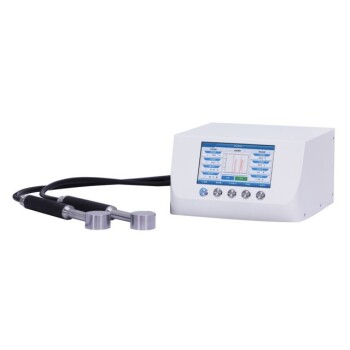
A high-precision furnace is critical because it creates the specific thermal stability required for oriented recrystallization. At 300°C, this precise environment ensures that lithium melts and reacts fully with a Gallium-Based Alloy to form a vital Li2Ga template, which guides the subsequent crystal growth.
The process is not merely about melting lithium; it is about controlling an interface reaction. Precision heating guarantees the formation of a perfect Li2Ga template, without which the lithium atoms cannot align into the desired <110> single-crystal structure during cooling.
The Role of Thermal Stability in Reaction Kinetics
To understand the necessity of high-precision equipment, we must look at the specific chemical reactions occurring at the interface layer.
Melting and Interface Reaction
At the target temperature of 300°C, the lithium sheet melts onto the LLZTO-GC surface. A standard furnace might overshoot or fluctuate, but a high-precision unit maintains the exact energy required to drive the reaction between the lithium and the Gallium-Based Alloy in the interface layer.
Formation of the Template
This stable reaction produces a specific compound known as a Li2Ga template. This template serves as the atomic "blueprint" for the lithium. The uniformity of this template is directly dependent on the stability of the thermal environment during the heating phase.
Controlling Crystal Alignment
The ultimate goal of this heat treatment is to dictate the physical structure of the lithium as it solidifies.
The Lattice Arrangement
During the cooling phase following the 300°C treatment, lithium atoms begin to settle. Because a stable Li2Ga template was formed, the lithium atoms arrange themselves according to the template's crystal lattice.
Achieving the <110> Orientation
This guided atomic arrangement allows for oriented recrystallization. Instead of forming a random, disordered structure, the material produces a specific <110> oriented single-crystal lithium structure. This orientation is essential for the material's final performance characteristics.
Understanding the Trade-offs
While high-precision furnaces are more expensive and complex to operate than standard heating elements, the trade-off is structural integrity.
Risks of Temperature Fluctuations
If the temperature deviates significantly from 300°C, the reaction with the Gallium-Based Alloy may be incomplete or inconsistent. This can result in a patchy Li2Ga template.
Consequences for Crystallinity
Without a uniform template, the lithium atoms will not receive the correct cues for alignment during cooling. This results in polycrystalline defects or random orientations rather than the intended single-crystal structure.
Making the Right Choice for Your Goal
When designing a heat treatment protocol for single-crystal lithium, your equipment choice dictates your structural success.
- If your primary focus is structural purity: Prioritize furnace stability to ensure the complete and uniform formation of the Li2Ga template.
- If your primary focus is reproducible alignment: Ensure your cooling phase controls are just as precise as your heating controls to guarantee <110> orientation.
Precision in the thermal environment is the only way to successfully force atoms to align into a high-performance single-crystal state.
Summary Table:
| Feature | Impact on Lithium Heat Treatment |
|---|---|
| Target Temperature | 300°C (Precise melting & reaction point) |
| Interface Layer | Formation of uniform Li2Ga template |
| Reaction Kinetics | Controlled energy for Gallium-Based Alloy reaction |
| Final Structure | Oriented <110> single-crystal lithium |
| Risk of Fluctuation | Polycrystalline defects and random atomic alignment |
Elevate Your Battery Research with KINTEK Precision
Achieving the perfect <110> single-crystal structure requires more than just heat; it requires absolute thermal stability. KINTEK specializes in comprehensive laboratory pressing and thermal solutions, offering a range of manual, automatic, and heated models specifically designed for sensitive materials research.
Whether you are working with solid-state electrolytes or advanced lithium-metal anodes, our high-precision furnaces and isostatic presses provide the uniform environment necessary for oriented recrystallization. Contact KINTEK today to discover how our glovebox-compatible and multifunctional solutions can guarantee the structural integrity of your next-generation battery components.
References
- Qidong Li, Yan‐Bing He. Single-crystal orientation lithium for ultra-stable all-solid-state batteries. DOI: 10.1093/nsr/nwaf540
This article is also based on technical information from Kintek Solution Knowledge Base .
Related Products
- Infrared Heating Quantitative Flat Plate Mold for Precise Temperature Control
- Automatic High Temperature Heated Hydraulic Press Machine with Heated Plates for Lab
People Also Ask
- How do precision temperature-controlled heating plates function in electrolyte thermal stability storage experiments?
- What is the importance of a precision temperature-controlled heating module? Ensure Aluminum-Cadmium Thermal Stability
- How does heating platen precision affect rubber specimens? Achieve uniform density and reliable testing results.
- How are thin polymer films produced for spectroscopic analysis? Expert Guide to Heat and Low-Pressure Methods
- What accessories and field services can be used to optimize the capabilities of presses? Maximize Your Lab Performance