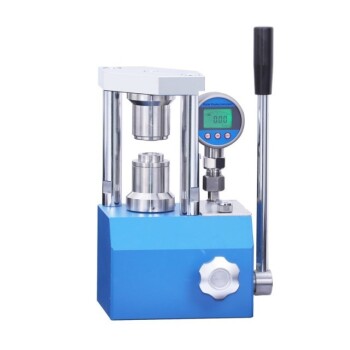
A high-pressure gas confining system is indispensable for replicating the deep reservoir environment within a laboratory setting. It is specifically required to apply controlled confining pressures—typically up to 45 MPa—to simulate the immense formation stress that sandstone experiences underground. Without this system, researchers cannot accurately trigger the closure of compliant pores and microcracks, rendering measurements of the rock’s acoustic and elastic properties unrepresentative of its true in-situ behavior.
By precisely regulating pressure, this system forces the rock sample to transition from a relaxed surface state to a stressed formation state. This effectively "resets" the rock's microstructure, ensuring that experimental data regarding elastic moduli and acoustic transmission reflects the actual geological reality rather than the artifacts of depressurization.
Replicating In-Situ Stress Conditions
Simulating Deep Reservoirs
Sandstone samples extracted from the earth undergo stress relaxation, causing them to expand slightly and develop micro-defects.
To study these samples accurately, you must reintroduce the stress they experienced at depth. A high-pressure gas confining system enables the application of confining pressures up to 45 MPa, effectively simulating the overburden stress of deep reservoirs.
Independent Pressure Controls
Advanced gas-medium apparatuses allow for the separation of confining pressure and pore pressure.
This independent control is critical for simulating deep crustal stress conditions. It allows researchers to manipulate the external stress on the rock matrix while separately managing the fluid pressure within the pores, creating a realistic model of the subsurface environment.
The Mechanics of Pore Structure Changes
Closing Compliant Pores
One of the primary functions of this system is the gradual closure of compliant pores and microcracks.
At surface pressure, these micro-voids remain open, making the rock appear "softer" or more porous than it actually is underground. High-pressure confinement mechanically forces these voids to close, altering the rock's internal architecture.
Observing Microstructural Impacts
Once the microcracks are closed, the "stiff" porosity remains.
This allows researchers to observe how specific changes in pore microstructure impact the rock's behavior. By eliminating the noise caused by surface-induced cracks, you can isolate the true physical characteristics of the sandstone matrix.
Enhancing Measurement Precision
Accurate Acoustic Properties
Acoustic waves travel differently through cracked rock versus compressed rock.
By using a gas confining system to stabilize the rock's structure, researchers can measure acoustic properties that align with seismic data collected from the field.
Reliable Elastic Moduli
The elasticity of sandstone changes significantly under pressure.
Simulating formation stress ensures that the calculated elastic moduli (stiffness) are accurate. This is vital for engineering applications, such as predicting how a reservoir will compact during depletion.
Simultaneous Testing Capabilities
High-end systems facilitate complex, multi-physics experiments.
Because the system provides a stable, controlled environment, researchers can perform simultaneous forced-oscillation experiments and permeability measurements. This maximizes the data yield from a single sample under consistent in-situ conditions.
Understanding the Operational Trade-offs
Complexity of Setup
Achieving precise gas confinement requires sophisticated plumbing and safety protocols.
Unlike simpler hydraulic presses, a gas-medium system involves an independent pore-fluid delivery system and high-pressure seals. This increases the complexity of the experimental setup and requires rigorous maintenance to prevent leaks.
Data Validity vs. Effort
The process of gradual pressurization is time-consuming.
However, the trade-off is necessary. Skipping this step produces data that is easier to acquire but technically invalid for deep-subsurface modeling. You are trading speed for the physical fidelity of your measurements.
Making the Right Choice for Your Goal
Depending on the specific objectives of your rock physics program, the role of this system shifts slightly.
- If your primary focus is Seismic Calibration: The system is essential to close microcracks so that lab-measured acoustic velocities match field seismic logs.
- If your primary focus is Reservoir Engineering: You need the system to determine accurate elastic moduli at 45 MPa to predict reservoir compaction and subsidence.
- If your primary focus is Transport Properties: The system is required to measure permeability under true effective stress, ensuring fluid flow models are realistic.
Ultimately, the high-pressure gas confining system bridges the gap between a loose sample on a lab bench and the solid rock formation deep underground.
Summary Table:
| Feature | Laboratory Requirement | Impact on Measurement Quality |
|---|---|---|
| Confining Pressure | Up to 45 MPa | Replicates overburden stress of deep reservoirs |
| Pore Management | Independent Pore Fluid Control | Simulates crustal stress & fluid flow realistically |
| Microstructure | Closure of Compliant Pores | Eliminates depressurization artifacts/micro-voids |
| Data Accuracy | Seismic & Elastic Calibration | Aligns lab results with field-scale seismic logs |
| Experiment Type | Multi-physics Capability | Allows simultaneous permeability & acoustic testing |
Elevate Your Geotechnical Research with KINTEK
Precision in rock physics starts with the right pressure environment. KINTEK specializes in comprehensive laboratory pressing solutions, offering a versatile range of manual, automatic, heated, multifunctional, and glovebox-compatible models, alongside high-performance cold and warm isostatic presses.
Our equipment is engineered to help researchers:
- Achieve precise in-situ stress simulation for battery and geological research.
- Ensure stable, repeatable high-pressure environments up to 45 MPa and beyond.
- Enhance the reliability of acoustic, elastic, and transport property measurements.
Don't let surface-level artifacts compromise your data. Contact KINTEK today to find the perfect pressing solution tailored to your laboratory's specific needs.
References
- Yanxiao He, P D Shi. Experimental investigation of pore-filling substitution effect on frequency-dependent elastic moduli of Berea sandstone. DOI: 10.1093/gji/ggae195
This article is also based on technical information from Kintek Solution Knowledge Base .
Related Products
- Laboratory Hydraulic Press Lab Pellet Press Machine for Glove Box
- Manual Laboratory Hydraulic Press Lab Pellet Press
- Automatic High Temperature Heated Hydraulic Press Machine with Heated Plates for Lab
- Heated Hydraulic Press Machine with Heated Plates for Vacuum Box Laboratory Hot Press
- Split Automatic Heated Hydraulic Press Machine with Heated Plates
People Also Ask
- How does a laboratory hydraulic press contribute to the preparation of Li3-3xScxSb samples? Optimize Ionic Conductivity
- What is the function of a laboratory hydraulic press in FT-IR of curcumin-coated MWCNTs? Achieve Optical Clarity.
- Why is a laboratory hydraulic press required for compression molding boron-siloxane? Solve High-Loading Density Challenges
- What role does a laboratory hydraulic press play in reaction pellets? Optimizing Lunar Soil and Metal Fuel Density
- What role does a laboratory hydraulic press play in the preparation of piezoelectric ceramic discs for DC-PG? | KINTEK