
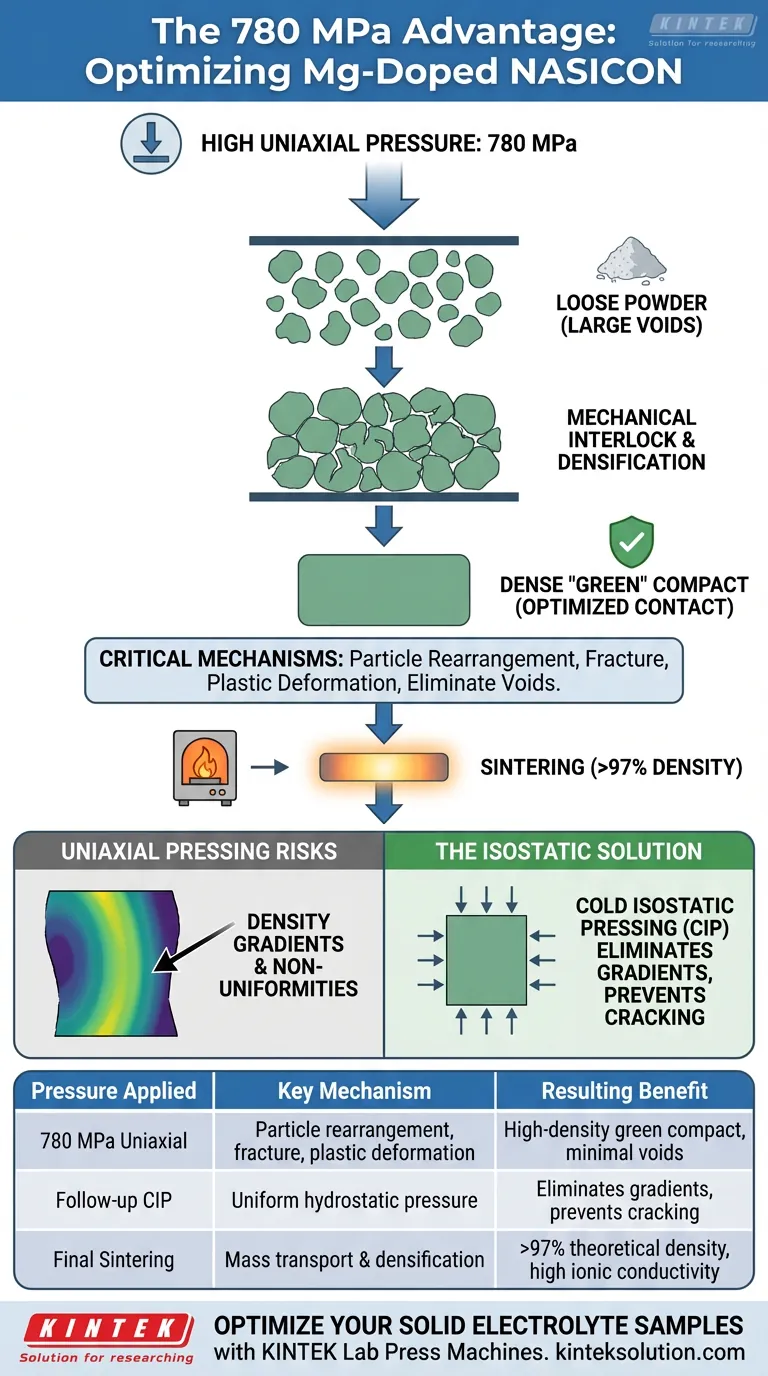
Applying a high uniaxial pressure of 780 MPa is fundamentally required to force Mg-doped NASICON powder particles to mechanically interlock and densify prior to thermal treatment. This specific pressure threshold triggers critical physical mechanisms—particle rearrangement, fracture, and plastic deformation—that eliminate large voids and create a cohesive "green" compact with the high packing density necessary for successful sintering.
The application of 780 MPa serves as a critical microstructural foundation, maximizing the initial packing density of the powder to ensure tight particle-to-particle contact. This mechanical densification is the prerequisite for achieving a final sintered density greater than 97% of the theoretical value, which directly dictates the material's ionic conductivity and mechanical strength.
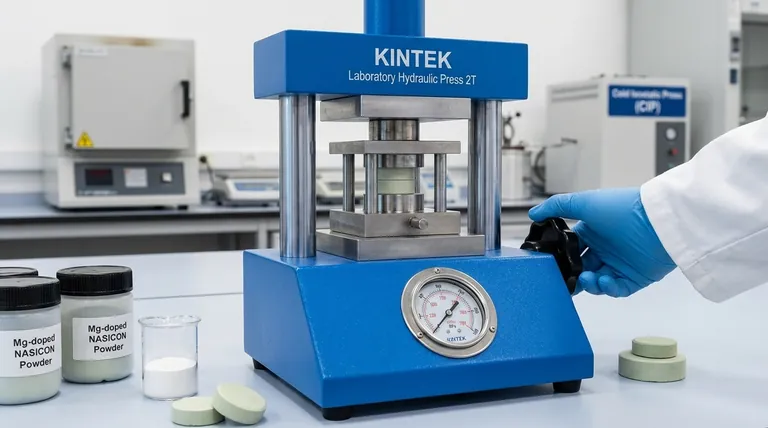
The Physical Mechanisms of Compaction
Maximizing Packing Density
To create a high-performance ceramic, you must minimize empty space before heat is ever applied.
At 780 MPa, the external force overcomes inter-particle friction. This causes the powder particles to rearrange into a significantly tighter configuration, filling the gaps that naturally exist in loose powder.
Particle Fracture and Deformation
Simple rearrangement is often insufficient for hard ceramic powders.
The intense pressure of 780 MPa forces individual particles to undergo plastic deformation or fracture. This shape change allows particles to fit together more intimately, further reducing porosity.
Eliminating Voids
The primary enemy of ionic conductivity in NASICON electrolytes is porosity.
High-pressure pressing effectively crushes and eliminates large voids between particles. This results in a dense green compact (the pressed but unfired object) with optimized solid-to-solid contact points.
The Foundation for Sintering
Creating a Robust Microstructure
The quality of the final ceramic is determined by the quality of the green body.
By establishing tight particle contact through high pressure, you reduce the diffusion distance required during the sintering process. This facilitates efficient mass transport, allowing the material to densify fully during heat treatment.
Achieving High Final Density
For solid electrolytes like NASICON, performance relies on material continuity.
A high-density green body is essential to achieve a final sintered density greater than 97% of the theoretical maximum. Without this initial mechanical compaction, the final sample would likely remain porous and exhibit poor ionic conductivity.
Understanding the Trade-offs
The Risk of Density Gradients
While uniaxial pressing at 780 MPa achieves high density, it applies force from only one direction.
This can introduce density gradients and non-uniformities within the green body. Friction between the powder and the die walls often results in outer edges being less dense than the center.
The Necessity of Isostatic Processing
To correct these gradients, reliance on uniaxial pressure alone is often insufficient for high-performance applications.
References suggest that after the initial 780 MPa uniaxial stage, the sample should be processed in a cold isostatic press (CIP). By applying uniform hydrostatic pressure, the CIP eliminates gradients, ensuring even shrinkage and preventing cracking or warping during the final sinter.
Making the Right Choice for Your Goal
To achieve the best results with Mg-doped NASICON, align your processing steps with your performance requirements.
- If your primary focus is Maximum Ionic Conductivity: You must combine the 780 MPa uniaxial step with cold isostatic pressing to achieve the >97% density required for optimal ion transport.
- If your primary focus is Structural Integrity: You should prioritize the high-pressure step to eliminate voids, as this prevents the formation of cracks and defects during high-temperature annealing.
Mastering the initial pressure regime is the single most effective way to guarantee the reliability and performance of your final solid electrolyte.
Summary Table:
| Pressure Applied | Key Mechanism | Resulting Benefit |
|---|---|---|
| 780 MPa Uniaxial | Particle rearrangement, fracture, and plastic deformation | High-density green compact with minimal voids |
| Follow-up Cold Isostatic Pressing (CIP) | Uniform hydrostatic pressure | Eliminates density gradients, prevents cracking during sintering |
| Final Sintering | Mass transport and densification | >97% theoretical density, high ionic conductivity |
Ready to optimize your solid electrolyte samples with precise pressure control? KINTEK specializes in lab press machines—including automatic lab presses, isostatic presses, and heated lab presses—designed to meet the exacting demands of materials research. Whether you're preparing NASICON, other ceramics, or advanced materials, our equipment ensures the uniform pressure and reliability needed for reproducible, high-performance results. Contact us today to discuss how our solutions can enhance your laboratory's capabilities!
Visual Guide
Related Products
- Lab Polygon Press Mold
- Special Shape Lab Press Mold for Laboratory Applications
- Automatic High Temperature Heated Hydraulic Press Machine with Heated Plates for Lab
- Automatic Laboratory Hydraulic Press for XRF and KBR Pellet Pressing
- Warm Isostatic Press for Solid State Battery Research Warm Isostatic Press
People Also Ask
- What is the purpose of incorporating cartridge heaters into a lab press mold for MLCC block compression? Optimize Results
- How do the design and geometric precision of pressing molds and mandrels affect the quality of PTFE composite samples?
- What role do precision positioning and pressure molds play in single-lap joints? Ensure 100% Data Integrity
- What are the requirements for pressing molds when using SSCG? Key Materials for Complex Single Crystal Production
- How do industrial-grade pressure molds affect zinc metal pouch cells? Maximize Energy Density & Performance



















