
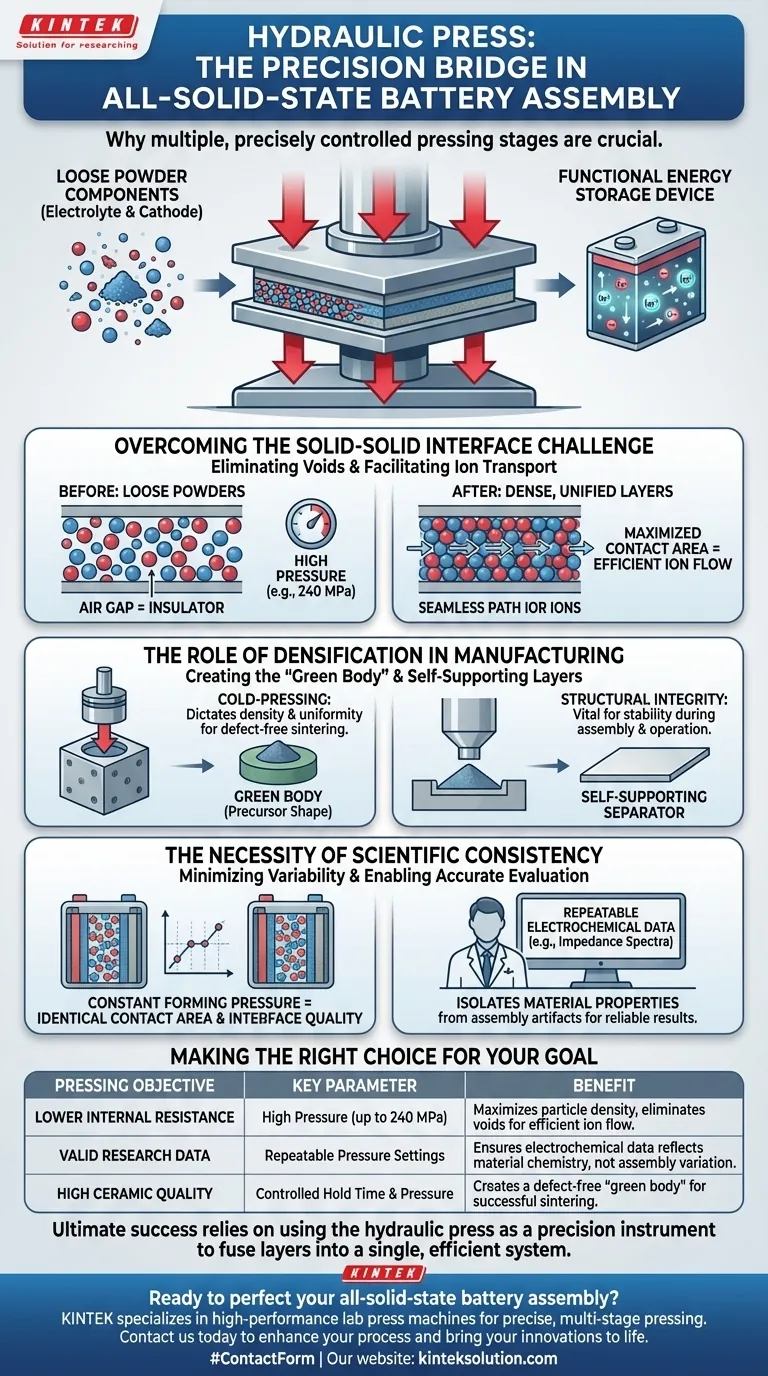
A hydraulic press serves as the fundamental mechanical bridge between loose powder components and a functional energy storage device.
In the assembly of all-solid-state batteries, this tool is used to apply high, precise pressure—often reaching 240 MPa—to compact electrolyte and cathode powders into dense, unified layers. Unlike liquid electrolytes that naturally fill gaps, solid materials require this force to eliminate microscopic voids and establish the tight, seamless physical contact necessary for low internal resistance and efficient ion transport.
The central challenge in solid-state battery assembly is overcoming the lack of intrinsic "wetting" between material layers. A hydraulic press solves this by mechanically forcing particles into intimate contact, ensuring that the interface is determined by material properties rather than physical gaps.
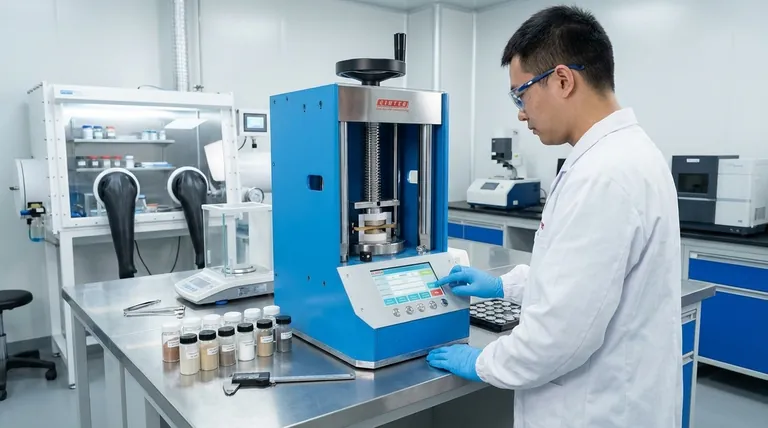
Overcoming the Solid-Solid Interface Challenge
Eliminating Voids Between Particles
In a solid-state system, any air gap acts as an insulator that blocks energy flow. Applying high pressure compacts the composite powders into high-density pellets.
This mechanical densification significantly reduces voids between particles. By removing these gaps, you maximize the active contact area, which is critical for lowering the contact resistance at solid-solid interfaces.
Facilitating Seamless Ion Transport
Efficient battery operation relies on ions moving smoothly across multiple layers. A hydraulic press ensures that the cathode composite material and the electrolyte separator form a tight, physical bond.
Without this "intimate contact," the battery's total internal resistance rises dramatically. The press applies controlled force (e.g., 1.5 to 2 tons) to ensure the structure acts as a cohesive unit rather than separate, disconnected layers.
The Role of Densification in Manufacturing
Creating the 'Green Body'
Before high-temperature sintering can occur, powders must be formed into a shape with initial mechanical strength, known as a 'green body.'
The hydraulic press performs this cold-pressing step within a die. The magnitude of the pressure and the duration of the hold time directly dictate the density and uniformity of this precursor, which is a prerequisite for creating a defect-free final ceramic pellet.
Forming Self-Supporting Layers
The pressing process allows for the transformation of loose electrolyte powder into a self-supporting separator. This structural integrity is vital for the mechanical stability of the cell during subsequent assembly stages and operation.
The Necessity of Scientific Consistency
Minimizing Interfacial Variability
Consistency is the bedrock of reliable data. Maintaining a constant forming pressure ensures that the contact area and interface quality remain identical from one battery cell to another.
By locking in this variable, you minimize fluctuations in interfacial resistance. This is a major performance-limiting factor that, if left uncontrolled, can skew results and mask the true performance of the materials.
Enabling Accurate Material Evaluation
Researchers rely on repeatable electrochemical data, such as impedance spectra and cycling performance.
Precise hydraulic control allows for the isolation of material properties from assembly artifacts. This reliability is indispensable for accurately evaluating how specific materials perform, rather than measuring the inconsistencies of the assembly process.
Understanding the Trade-offs
The Consequence of Pressure Variation
While pressure is beneficial, it must be perfectly uniform. If the pressure applied to the 'green body' varies, the resulting density will be inconsistent.
This lack of uniformity can lead to defects after sintering. Consequently, the hydraulic press must not just apply force, but do so with extreme precision to avoid introducing structural weaknesses into the ceramic.
Balancing Pressure and Integrity
Achieving high density requires significant force (up to 240 MPa), but this must be balanced against the material's limits. The process relies on "controlled" pressure stages; indiscriminate force could potentially damage the structural integrity of the composite layers or the die itself.
Making the Right Choice for Your Goal
To optimize your assembly process, consider your primary objective:
- If your primary focus is lowering internal resistance: Prioritize high-pressure stages (up to 240 MPa) to maximize particle density and eliminate void space at the interface.
- If your primary focus is valid research data: Focus on the repeatability of the pressure settings to ensure that impedance and cycling metrics reflect material chemistry, not assembly variation.
- If your primary focus is ceramic quality: strictly control the hold time and pressure magnitude during the 'green body' formation to ensure defect-free sintering.
Ultimate success in all-solid-state battery assembly relies on using the hydraulic press not just as a hammer, but as a precision instrument to mechanically fuse distinct layers into a single, efficient electrochemical system.
Summary Table:
| Pressing Objective | Key Parameter | Benefit |
|---|---|---|
| Lower Internal Resistance | High Pressure (up to 240 MPa) | Maximizes particle density, eliminates voids for efficient ion flow. |
| Valid Research Data | Repeatable Pressure Settings | Ensures electrochemical data reflects material chemistry, not assembly variation. |
| High Ceramic Quality | Controlled Hold Time & Pressure | Creates a defect-free 'green body' for successful sintering. |
Ready to perfect your all-solid-state battery assembly?
KINTEK specializes in high-performance lab press machines, including automatic and heated lab presses designed for the precise, multi-stage pressing required in advanced battery research and development. Our equipment ensures the consistency and control you need to eliminate interfacial resistance and achieve reliable results.
Contact us today to discuss how our solutions can enhance your process and bring your energy storage innovations to life.
Visual Guide
Related Products
- Warm Isostatic Press for Solid State Battery Research Warm Isostatic Press
- Laboratory Hydraulic Press Lab Pellet Press Button Battery Press
- Lab Button Battery Tablet Press Sealing Mold
- Automatic Laboratory Hydraulic Press for XRF and KBR Pellet Pressing
- Laboratory Hydraulic Pellet Press for XRF KBR FTIR Lab Press
People Also Ask
- Why must composite cathodes be sealed in vacuum lamination bags for WIP? Ensure Battery Stability and Density
- How do sacrificial volume materials (SVM) maintain microchannels in isostatic pressing? Ensure Structural Integrity
- What is the function of elastic molds in warm isostatic pressing? Achieve Uniform Density in Composite Particles
- What is the significance of temperature control in Warm Isostatic Pressing? Unlock Uniform Densification and Process Stability
- What is the mechanism of a Warm Isostatic Press (WIP) on cheese? Master Cold Pasteurization for Superior Safety



















