
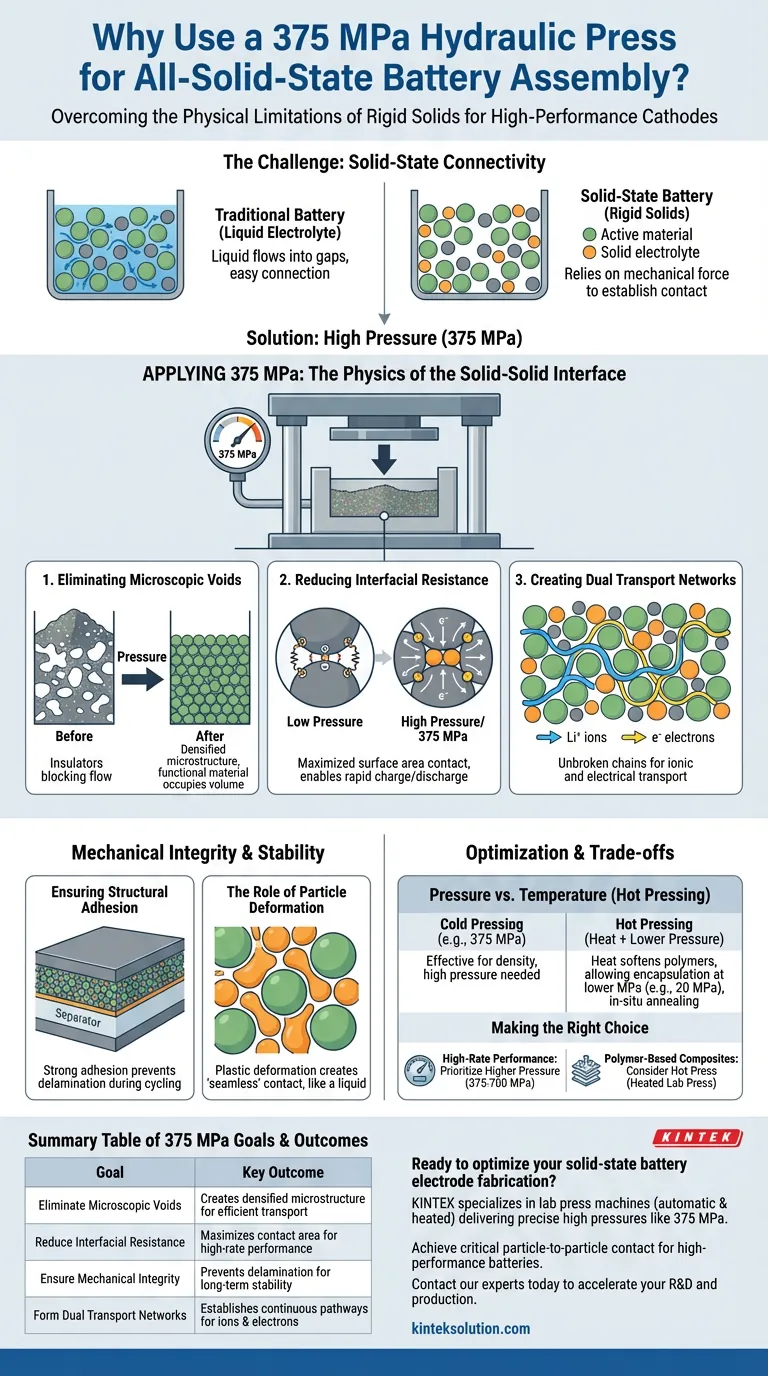
Applying 375 MPa of pressure is a fundamental manufacturing step required to overcome the physical limitations of solid-state materials. Unlike traditional batteries where a liquid electrolyte flows into microscopic gaps, solid-state batteries rely entirely on mechanical force to establish connectivity. This specific pressure is used to densify the cathode composite—typically a mixture of active materials like NCM622, conductive carbon, and solid electrolyte particles—to eliminate voids and force the materials into intimate, physical contact.
The primary challenge in all-solid-state batteries is establishing a continuous conductive pathway through rigid solids. High hydraulic pressure bridges the gaps between particles to significantly reduce interfacial resistance, creating the efficient ion and electron transport networks required for high-rate performance.
The Physics of the Solid-Solid Interface
Eliminating Microscopic Voids
In a loose powder mixture, air pockets exist between particles. In an electrochemical cell, these voids act as insulators, blocking the flow of ions and electrons.
Applying 375 MPa compacts the NCM622 active material and Li6PS5Cl solid electrolyte particles, effectively crushing these voids. This results in a "densified microstructure" where the volume is occupied almost entirely by functional material rather than empty space.
Reducing Interfacial Resistance
The performance of a solid-state battery is dictated by how easily lithium ions can move from the cathode material into the electrolyte.
This movement occurs at the interface—the exact point where the two solid particles touch. Without high pressure, these contact points are sparse and weak, leading to high impedance. The hydraulic press maximizes the surface area contact between solids, significantly lowering this resistance and enabling rapid charge and discharge.
Creating Dual Transport Networks
A functioning cathode needs two distinct pathways: one for lithium ions and one for electrons.
The compression process forces the conductive carbon black and the solid electrolyte particles to form continuous, unbroken chains throughout the electrode. This ensures that every particle of active material is electrically connected and has a pathway for ionic transport.
Mechanical Integrity and Stability
Ensuring Structural Adhesion
Beyond electrical performance, the cathode composite must be mechanically stable to survive the lifespan of the battery.
High-pressure fabrication ensures the cathode layer adheres strongly to the solid electrolyte separator. This prevents delamination (layer separation) which can occur during battery cycling as materials expand and contract.
The Role of Particle Deformation
At pressures like 375 MPa (and up to 700 MPa in some configurations), the solid electrolyte particles undergo plastic deformation.
They physically change shape to flow around the harder active material particles. This deformation creates a "seamless" contact similar to how a liquid would behave, maximizing the active area available for chemical reactions.
Understanding the Trade-offs
Pressure vs. Temperature (Hot Pressing)
While 375 MPa is effective for cold pressing, it is not the only method to achieve density. Introducing heat can alter the pressure requirements.
Hot pressing utilizes the synergy of heat and pressure. For composites containing polymers (like PEO), heat softens the material, allowing it to "wet" and encapsulate active particles at significantly lower pressures (e.g., 20 MPa).
Material Vulnerability
The application of pressure must be calibrated to the specific materials used.
While 375 MPa is optimal for the NCM622/Li6PS5Cl composite mentioned, excessive pressure on brittle materials can cause particle cracking, while insufficient pressure results in poor connectivity. Furthermore, utilizing heated presses can act as an in-situ annealing treatment, improving the crystallinity and conductivity of the electrolyte, a benefit that cold hydraulic pressing alone does not provide.
Making the Right Choice for Your Goal
The specific parameters for pressing depend heavily on your material composition and performance targets.
- If your primary focus is high-rate performance: Prioritize higher pressures (such as 375–700 MPa) to maximize particle contact and minimize interfacial impedance for rapid ion transport.
- If your primary focus is processing polymer-based composites: Consider utilizing a hot press (heated lab press) to facilitate plastic flow and particle encapsulation at lower mechanical pressures.
Ultimately, the goal of the hydraulic press is to transform a loose mixture of powders into a single, cohesive, and highly conductive electrochemical unit.
Summary Table:
| Goal of 375 MPa Pressure | Key Outcome |
|---|---|
| Eliminate Microscopic Voids | Creates a densified microstructure for efficient ion/electron transport |
| Reduce Interfacial Resistance | Maximizes particle contact area, lowering impedance for high-rate performance |
| Ensure Mechanical Integrity | Prevents delamination during battery cycling for long-term stability |
| Form Dual Transport Networks | Establishes continuous pathways for both ions and electrons throughout the electrode |
Ready to optimize your solid-state battery electrode fabrication? KINTEK specializes in lab press machines, including automatic lab presses and heated lab presses, designed to deliver the precise high pressures (like 375 MPa) required for densifying cathode composites. Our equipment helps you achieve the critical particle-to-particle contact needed for low interfacial resistance and high-performance batteries. Contact our experts today to discuss how our presses can accelerate your R&D and production.
Visual Guide
Related Products
- Automatic Laboratory Hydraulic Press for XRF and KBR Pellet Pressing
- Laboratory Hydraulic Press Lab Pellet Press Machine for Glove Box
- Laboratory Hydraulic Press 2T Lab Pellet Press for KBR FTIR
- Laboratory Hydraulic Pellet Press for XRF KBR FTIR Lab Press
- Manual Laboratory Hydraulic Pellet Press Lab Hydraulic Press
People Also Ask
- Why is pressing powder into a pellet critical before sintering? Ensure Dense, Conductive Solid-State Electrolytes
- What is the role of a laboratory pressure machine and KBr in FTIR? Master Sample Preparation for Flame Retardants
- What are the advantages of using a laboratory automatic hydraulic press for HEA green compact forming?
- What are the advantages of using a lab automatic hydraulic press for HEA green body molding? Ensure Material Integrity
- How does an automatic laboratory hydraulic press improve KBr pellet preparation? Achieve Precision IR Spectroscopy



















