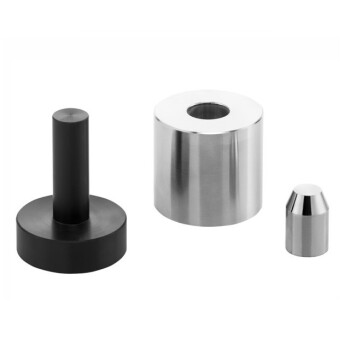
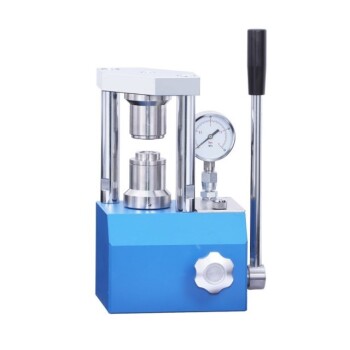
High pressure is the catalyst that transforms loose powder into a unified electrochemical system. A lab press machine capable of providing 360 MPa is necessary to induce plastic deformation in solid electrolyte particles. This extreme force physically crushes the particles into a new shape, forcing them to fill gaps and eliminate voids that would otherwise block the flow of ions.
Core Insight In solid-state batteries, materials do not flow like liquids to create contact; they must be mechanically forced together. Applying 360 MPa ensures that solid electrolyte particles deform plastically to create a void-free interface with the active material (such as MoS2), which is the absolute prerequisite for low impedance and efficient ion transport.
The Mechanics of Densification
Overcoming Particle Rigidity
Unlike liquid electrolytes, which naturally wet surfaces and fill pores, solid electrolytes are rigid. They resist conforming to the electrode materials.
Without significant external force, these particles merely touch at specific points. This leaves large "macroscopic voids" or air gaps between them.
Inducing Plastic Deformation
The specific magnitude of 360 MPa is critical because it exceeds the yield strength of many solid electrolyte materials.
At this pressure, the particles stop behaving like rigid solids and undergo plastic deformation. They permanently change shape, flattening and spreading out to occupy the empty spaces around them.
Eliminating Macroscopic Voids
The primary goal of this deformation is the total elimination of empty space within the electrode layer.
By forcing the electrolyte to fill these gaps, the press creates a dense, continuous pellet. This continuity is essential for the battery to function as a single cohesive unit rather than a collection of loose dust.
Impact on Electrochemical Performance
Creating Tight Interfacial Contact
For a solid-state battery to work, the active material (e.g., MoS2) and the electrolyte must be in intimate physical contact.
The 360 MPa molding process forces the electrolyte to press tightly against the active material surfaces. This maximizes the active surface area available for chemical reactions.
Reducing Interfacial Impedance
Gaps and voids act as insulators, creating high resistance (impedance) to the flow of energy.
By eliminating these voids through high-pressure molding, you significantly reduce interfacial impedance. This lowers the barrier for charge transfer, making the battery more efficient.
Ensuring Efficient Ion Transport
Ions require a continuous pathway to move between the cathode and anode.
The dense, void-free structure created by the lab press ensures these pathways are unbroken. This allows for smooth, rapid ion transport, which directly translates to better battery performance.
Understanding the Trade-offs
The Risk of Over-Pressurization
While high pressure is necessary for contact, there is an upper limit to what materials can withstand.
Excessive pressure can induce unwanted phase changes in certain materials or propagate cracks within the electrode structure. It is vital to find the specific pressure window—like 360 MPa—that densifies the material without destroying its crystal structure.
Balancing Density and Integrity
High pressure reduces porosity, which is generally good for conductivity, but it must be applied uniformly.
If the pressure is not uniform, it can lead to density gradients where some areas are highly conductive and others are resistive. This inconsistency can lead to localized hotspots or uneven degradation during battery cycling.
Making the Right Choice for Your Goal
To achieve optimal results in solid-state battery fabrication, align your pressing parameters with your specific material requirements:
- If your primary focus is maximizing ionic conductivity: Prioritize pressures high enough (e.g., 360 MPa) to induce plastic deformation and eliminate all macroscopic voids.
- If your primary focus is preserving material structure: Monitor the pressure carefully to ensure you do not exceed the threshold where phase changes or particle crushing occur.
Ultimately, the 360 MPa molding step is not just about compaction; it is about engineering the microscopic architecture required for ion flow.
Summary Table:
| Mechanism | Impact of 360 MPa Pressure | Goal for Battery Performance |
|---|---|---|
| Particle Deformation | Induces plastic deformation in rigid electrolyte particles | Creates a dense, continuous solid pellet |
| Void Management | Eliminates macroscopic air gaps and voids | Removes insulators that block energy flow |
| Interface Quality | Forces intimate contact with active materials (e.g., MoS2) | Minimizes interfacial impedance |
| Conductivity | Establishes unbroken pathways for ions | Enables rapid and efficient ion transport |
Elevate Your Battery Research with KINTEK Laboratory Solutions
Precision at 360 MPa is just the beginning. KINTEK specializes in comprehensive laboratory pressing solutions, offering a versatile range of manual, automatic, heated, multifunctional, and glovebox-compatible models, alongside advanced cold and warm isostatic presses.
Whether you are refining electrolyte density or optimizing interfacial contact, our equipment is engineered to provide the uniform pressure control necessary for groundbreaking battery innovation.
Ready to optimize your molding process?
Contact KINTEK today for expert guidance and specialized equipment.
References
- Kazuto Fujiwara, Hiroshi Inoue. Unveiling the Capacity Boosting Mechanism of the MoS<sub>2</sub> Electrode by Focusing on the Under Potential Deposition in All‐Solid‐State Batteries Prepared by One‐Pot One‐Step Liquid Phase Mixing. DOI: 10.1002/adsu.202500426
This article is also based on technical information from Kintek Solution Knowledge Base .
Related Products
- Warm Isostatic Press for Solid State Battery Research Warm Isostatic Press
- Button Battery Sealing Press Machine for Lab
- Laboratory Hydraulic Press Lab Pellet Press Button Battery Press
- Lab Infrared Press Mold for Laboratory Applications
- Automatic Laboratory Hydraulic Press Lab Pellet Press Machine
People Also Ask
- Why must composite cathodes be sealed in vacuum lamination bags for WIP? Ensure Battery Stability and Density
- What is the function of elastic molds in warm isostatic pressing? Achieve Uniform Density in Composite Particles
- How do sacrificial volume materials (SVM) maintain microchannels in isostatic pressing? Ensure Structural Integrity
- What are the advantages of using a Warm Isostatic Press (WIP) for batteries? Achieve Superior Interface Contact
- What is the role of the flexible material in warm isostatic pressing? Key to Uniform Density & Precision