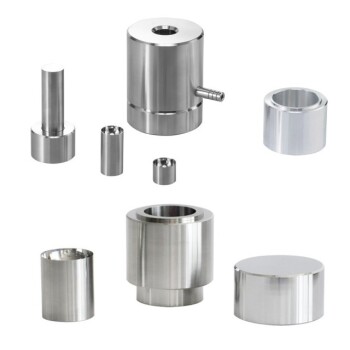
A lab press or precision loading tool is required to maximize the packing density of molybdenum carbide powder within the zirconia rotor used for testing. By compacting the sample tightly and uniformly, you significantly increase the number of nuclei in the detection volume, resulting in higher signal gain and the improved signal-to-noise ratio necessary for high-resolution analysis.
By mechanically increasing the bulk density of the sample, you transform a loose powder into a tightly packed mass that fully utilizes the limited volume of the rotor. This process is essential for detecting faint signals from trace structural elements that would otherwise be lost in background noise.
Maximizing Signal in Ultra-High Field Environments
The Physics of Packing Density
Solid-state NMR relies on detecting magnetic resonance from atomic nuclei. The strength of the received signal is directly proportional to the number of nuclei present within the coil's detection range.
Loose powder contains significant void space (air), which dilutes the sample mass. Using a lab press eliminates these voids, packing more molybdenum carbide into the same physical volume.
Achieving High Signal-to-Noise Ratio (SNR)
In ultra-high field environments, such as 9.40 T, maximizing signal capture is paramount. A densified sample provides a stronger aggregate signal against the baseline electronic noise of the instrument.
This improved SNR is not merely cosmetic; it is a functional requirement for interpreting complex spectral data.
Unveiling Trace Local Structures
Detecting Fine Structural Details
Molybdenum carbide samples often contain subtle, specific atomic configurations that are difficult to resolve. The primary reference highlights the need to identify -Al-OH-Mo- structures.
these trace local structures generate very weak signals compared to the bulk material. Without the signal gain provided by high-density packing, these fine details would likely remain invisible.
Ensuring Experimental Consistency
Uniformity Within the Rotor
Ideally, a sample must be packed not just tightly, but uniformly. Uneven packing can lead to magnetic susceptibility gradients that broaden spectral lines and reduce resolution.
Precision loading tools apply force evenly, ensuring the density is consistent throughout the length of the rotor.
Reproducibility of Results
Hand-packing powders introduces human error and variability between samples. A precision press allows for specific, controlled pressure application.
This ensures that any changes observed in the NMR spectrum are due to actual material differences, rather than inconsistencies in how the sample was loaded.
Understanding the Trade-offs
Risk of Rotor Damage
While density is desirable, zirconia rotors are brittle ceramics. There is a physical limit to how much pressure they can withstand before cracking or shattering.
Sample Distortion
In rare cases, excessive mechanical pressure can alter the physical properties of sensitive "green bodies." You must balance the need for high density with the structural limits of both your sample container and the material itself.
Making the Right Choice for Your Goal
To determine how aggressively you should densify your sample, consider your specific analytical objectives:
- If your primary focus is identifying trace structures (like -Al-OH-Mo-): You must prioritize maximum density using a precision press to ensure sufficient signal-to-noise ratio.
- If your primary focus is comparing multiple batches: You should use a machine with precise pressure control to ensure every sample has identical bulk density for valid comparisons.
By treating sample loading as a precision engineering step rather than a manual chore, you ensure your NMR data reflects the true nature of your material.
Summary Table:
| Factor | Loose Powder Packing | Precision Lab Press Packing |
|---|---|---|
| Nuclei Density | Low (High air void volume) | High (Maximum mass per volume) |
| Signal Strength | Weak/Faint | Strong/Enhanced |
| Spectral Resolution | Lower (Susceptibility gradients) | Higher (Uniform density) |
| Reproducibility | Low (Manual variability) | High (Controlled pressure) |
| Trace Detection | Often undetectable | Visible (e.g., -Al-OH-Mo structures) |
Elevate Your NMR Research with KINTEK Precision Solutions
Unlock the full potential of your solid-state NMR analysis. KINTEK specializes in comprehensive laboratory pressing solutions designed for precision and reliability. Whether you are densifying sensitive powders like molybdenum carbide or developing advanced materials, our range of manual, automatic, heated, and glovebox-compatible models provides the exact pressure control you need to maximize signal gain without risking rotor damage.
From high-performance battery research to trace structural analysis, our cold and warm isostatic presses ensure experimental consistency and reproducibility.
Ready to achieve superior sample density? Contact KINTEK today to find the perfect loading solution for your laboratory!
References
- Zhi‐Gang Chen, Yi Cui. Termination-acidity tailoring of molybdenum carbides for alkaline hydrogen evolution reaction. DOI: 10.1038/s41467-025-55854-6
This article is also based on technical information from Kintek Solution Knowledge Base .
Related Products
- Carbide Lab Press Mold for Laboratory Sample Preparation
- Lab Round Bidirectional Press Mold
- Lab Infrared Press Mold for Laboratory Applications
- Assemble Square Lab Press Mold for Laboratory Use
- Lab Polygon Press Mold
People Also Ask
- What is the purpose of incorporating cartridge heaters into a lab press mold for MLCC block compression? Optimize Results
- What is the function of a pressing tool in thermoplastic panels? Master Precision Shaping & Fusion Bonding
- Why is precise cooling management of the lab press mold necessary? Protect Core Integrity in Thermoforming
- How does the geometry of laboratory molds influence mycelium-based composites? Optimize Density and Strength
- What is the significance of standardized molds in lab presses? Ensure Precise Seal Material Evaluation