
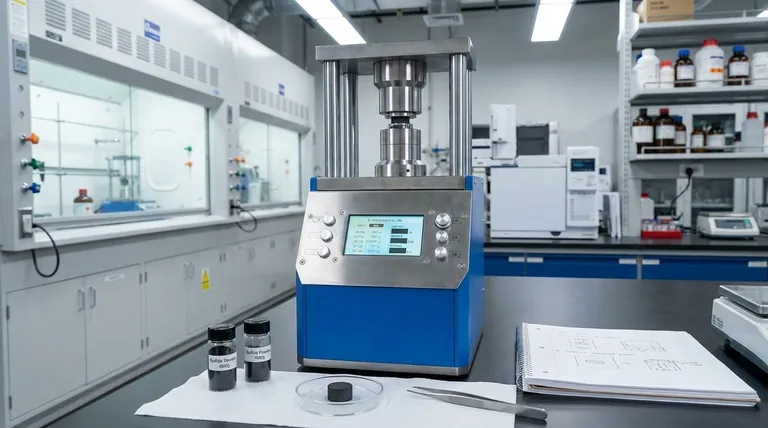
A laboratory press is the standard tool for this application because it provides the precise, high-magnitude uniaxial pressure necessary to transform loose sulfide powders into dense, conductive solids. This cold-pressing process is the only reliable method to overcome the inherent brittleness of sulfide materials, creating mechanically stable pellets with the low porosity required for effective lithium-ion transport.
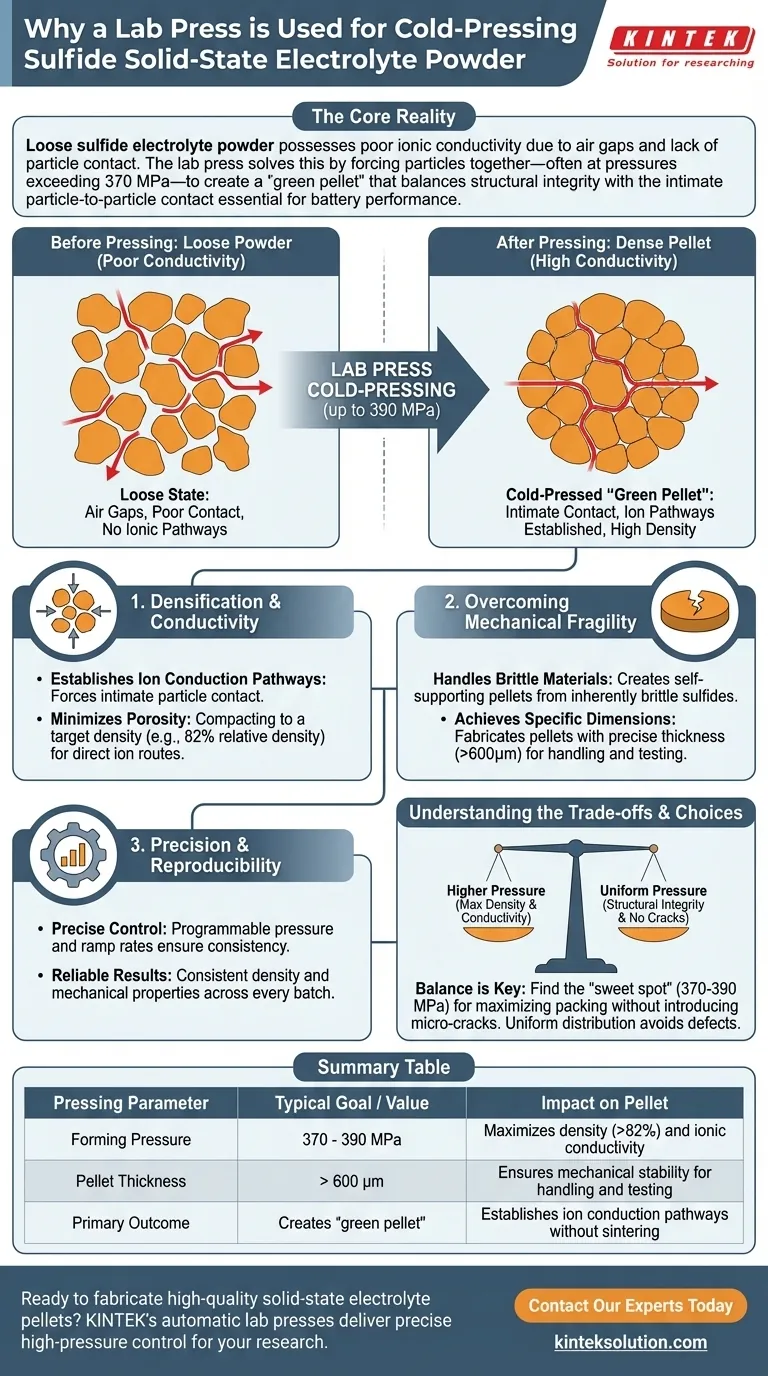
The Core Reality Loose sulfide electrolyte powder possesses poor ionic conductivity due to air gaps and lack of particle contact. The lab press solves this by forcing particles together—often at pressures exceeding 370 MPa—to create a "green pellet" that balances structural integrity with the intimate particle-to-particle contact essential for battery performance.
The Physics of Densification
Establishing Ion Conduction Pathways
The primary function of the lab press is to force intimate contact between individual electrolyte particles. In a loose powder state, ions cannot easily jump from one particle to another.
Applying significant forming pressure eliminates these gaps. This contact is a fundamental prerequisite for establishing effective ion conduction pathways throughout the material.
Minimizing Porosity
To achieve high ionic conductivity, the electrolyte pellet must be as dense as possible. A lab press can compact powder to a target density, such as 82% relative density, by applying pressures up to 390 MPa.
This densification creates a high-quality component with minimal internal porosity. Reducing voids ensures that lithium ions have a direct, efficient route through the material, directly influencing the final electrochemical performance.
Overcoming Mechanical Fragility
Handling Inherently Brittle Materials
Sulfide solid-state electrolytes are inherently brittle materials. Without high-pressure compaction, they lack the cohesion to hold a shape.
Cold pressing allows researchers to fabricate self-supporting pellets. These pellets have sufficient mechanical strength to be handled, transferred, and assembled into test cells without disintegrating.
Achieving Specific Dimensions
Research often dictates precise physical dimensions for valid testing. A lab press allows for the fabrication of pellets with specific thicknesses, such as those greater than 600μm.
This geometric control is vital for creating consistent separators or thick pellets used in impedance spectroscopy and other electrochemical performance tests.
Why a Laboratory-Grade Press?
Precision and Reproducibility
A laboratory press is distinct from generic pressing tools because of its ability to offer precise control over pressure and, in some cases, temperature.
This precision leads to high reproducibility. Researchers can trust that the pellet created today has the exact same density and mechanical properties as a pellet created next week, ensuring consistent and reliable experimental results.
Efficiency and Versatility
These machines are designed for the high adjustability required in experimental settings. They allow for the quick preparation of different sample types and batch production.
This capability translates to significant savings in time and cost for sample preparation, allowing researchers to focus on analysis rather than fabrication.
Understanding the Trade-offs
The "Green Pellet" Challenge
While the press creates a solid object, it is often technically a "green pellet"—a compacted body that has not yet been sintered (though sulfides are often used just as cold-pressed).
If the pressure is applied unevenly, the pellet may suffer from uneven shrinkage, cracking, or deformation. A uniform distribution of pressure is critical to avoid these structural defects, which would otherwise sever ion pathways.
Balancing Density and Integrity
There is a functional limit to pressing. While higher pressure generally equals higher density, excessive force on extremely brittle materials can sometimes introduce micro-cracks.
The goal is to find the "sweet spot" (e.g., around 370-390 MPa for materials like Li6PS5Cl) that maximizes packing density without damaging the structural integrity of the resulting separator.
Making the Right Choice for Your Goal
When configuring your pressing protocol, consider your primary research objective:
- If your primary focus is Ionic Conductivity: Prioritize higher pressures (up to 390 MPa) to maximize packing density and minimize inter-particle voids.
- If your primary focus is Mechanical Assembly: Ensure the press can deliver stable, uniform pressure to create self-supporting pellets that are thick enough (>600μm) to withstand handling.
- If your primary focus is Reproducibility: Utilize the press's programmable features to strictly control pressure ramp rates and dwell times across every sample batch.
Ultimately, the lab press acts as the bridge between raw chemical potential and measurable electrochemical performance by turning loose powder into a functional, conductive component.
Summary Table:
| Pressing Parameter | Typical Goal / Value | Impact on Pellet |
|---|---|---|
| Forming Pressure | 370 - 390 MPa | Maximizes density (>82%) and ionic conductivity |
| Pellet Thickness | > 600 μm | Ensures mechanical stability for handling and testing |
| Primary Outcome | Creates a "green pellet" | Establishes ion conduction pathways without sintering |
Ready to fabricate high-quality solid-state electrolyte pellets with precision and reproducibility?
KINTEK's automatic lab presses deliver the precise, high-pressure control (up to 390 MPa) you need to transform brittle sulfide powders into dense, mechanically stable pellets for accurate electrochemical testing. Our heated lab presses and isostatic presses are trusted by laboratories worldwide for R&D in next-generation batteries.
Contact our experts today to find the perfect lab press for your solid-state electrolyte research and accelerate your development timeline.
Visual Guide
References
- Dabing Li, Li‐Zhen Fan. Challenges and Developments of High Energy Density Anode Materials in Sulfide‐Based Solid‐State Batteries. DOI: 10.1002/celc.202200923
This article is also based on technical information from Kintek Solution Knowledge Base .
Related Products
- 24T 30T 60T Heated Hydraulic Lab Press Machine with Hot Plates for Laboratory
- Manual Heated Hydraulic Lab Press with Integrated Hot Plates Hydraulic Press Machine
- Laboratory Hydraulic Pellet Press for XRF KBR FTIR Lab Press
- Lab Infrared Press Mold for Laboratory Applications
- Laboratory Hydraulic Press Lab Pellet Press Machine for Glove Box
People Also Ask
- Function of a Laboratory Hydraulic Press with Heated Platens in SSE? Enhance Battery Density & Conductivity
- Why is a laboratory hydraulic press with heating plates required for PLA/TEC films? Achieve Precise Sample Integrity
- What role does a laboratory heated hydraulic press play in LTCC? Essential for High-Density Ceramic Lamination
- What is the primary function of a laboratory heated hydraulic press? Mastering Thermoplastic Carbon Fiber Composites
- What is the critical role of a laboratory heated hydraulic press? Mastering PVC Sample Prep for Testing



















