
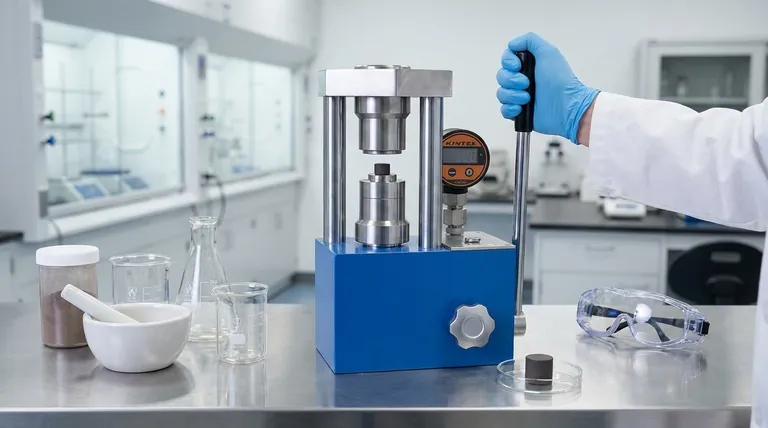
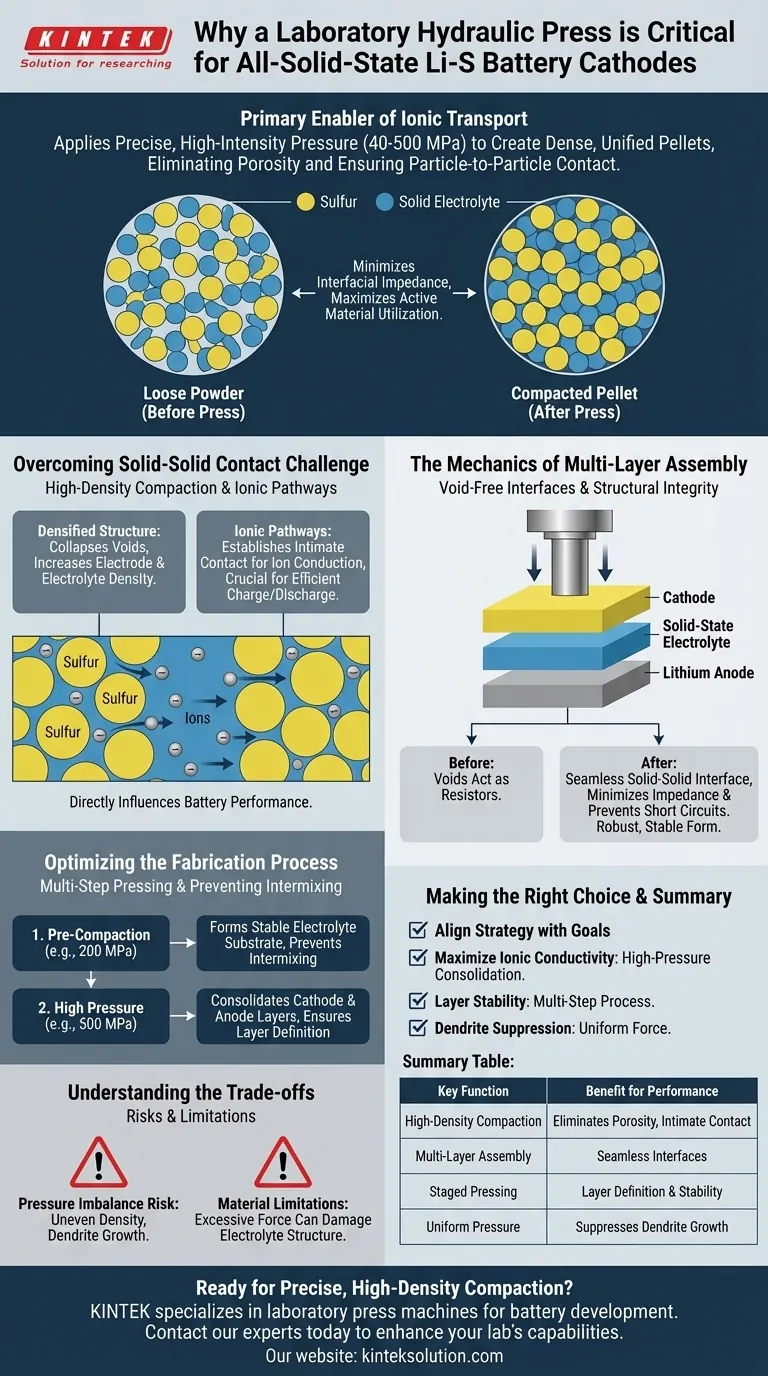
A laboratory hydraulic press is the primary enabler of ionic transport in all-solid-state systems where no liquid electrolyte exists to bridge the gaps between particles. By applying precise, high-intensity pressure—often ranging from 40 to 500 MPa—the press forces sulfur active materials and solid electrolytes into a dense, unified pellet. This mechanical compaction eliminates internal porosity, ensuring the intimate particle-to-particle contact required for the battery to function.
In the absence of liquid electrolytes, the performance of a solid-state lithium-sulfur battery is defined by the quality of its solid interfaces. A hydraulic press transforms loose, non-conductive powders into a cohesive electrochemical system by minimizing interfacial impedance and maximizing active material utilization.
Overcoming the Solid-Solid Contact Challenge
The Necessity of High-Density Compaction
In a standard battery, liquid electrolytes flow into porous areas to transport ions. In an all-solid-state lithium-sulfur battery, you are working with mixed cathode powders that naturally contain voids and air gaps.
A hydraulic press creates a highly densified structure by mechanically collapsing these voids. This compaction increases the overall density of the electrode and electrolyte pellets, which is physically required to create a continuous medium for ion movement.
Establishing Ionic Pathways
Ionic conductivity in solid-state batteries relies entirely on physical contact points. If a sulfur particle does not physically touch a solid electrolyte particle, it is electrochemically isolated.
Applying pressure generates intimate solid-solid contact between the constituent particles. This maximizes the ion conduction pathways throughout the cathode pellet, directly influencing the battery's ability to charge and discharge efficiently.
The Mechanics of Multi-Layer Assembly
Creating Void-Free Interfaces
Beyond the cathode pellet itself, the press is essential for integrating the cathode with the separator and anode. Voids between these layers act as resistors, significantly impeding performance.
A hydraulic press applies uniform external stack pressure to press the cathode material firmly against the solid-state electrolyte and lithium metal anode. This creates a seamless solid-solid interface, which is fundamental for minimizing interfacial impedance and preventing internal short circuits.
Structural Integrity and Stability
The resulting pellet must be mechanically stable to survive handling and cycling. A laboratory press consolidates the powders into a robust form that maintains its shape.
This stability is critical for enabling stable electrochemical measurements. A loosely packed pellet would suffer from fluctuating contact resistance, rendering any data collected during testing unreliable.
Optimizing the Fabrication Process
The Multi-Step Pressing Protocol
Effective fabrication often requires a tiered pressure strategy rather than a single crush. References suggest a specific sequence is often necessary for bilayer or multilayer structures.
Operators typically apply a lower pre-compaction pressure (e.g., 200 MPa) to form the electrolyte into a stable substrate. This is followed by a significantly higher pressure (e.g., 500 MPa) once the cathode and anode are added.
Preventing Component Intermixing
This staged application of pressure is not merely about density; it is about layer definition.
By pre-compacting the first layer, you create a flat, defined surface. This prevents the intermixing or delamination of the cathode and electrolyte materials during the final high-pressure consolidation or subsequent sintering steps.
Understanding the Trade-offs
The Risk of Pressure Imbalance
While high pressure is necessary, it must be precise and uniform.
If the pressure is applied unevenly, it can lead to variations in density across the pellet. This inconsistency causes uneven current density during operation, which can promote the growth of lithium dendrites—microscopic spikes that can penetrate the electrolyte and cause battery failure.
Material Limitations
There is a functional limit to how much pressure specific materials can withstand before degrading.
While pressures up to 500 MPa are cited for materials like Li6PS5Cl, excessive force beyond the material's yield point could damage the structural integrity of the solid electrolyte particles themselves. The goal is compaction, not crushing the crystallites to the point of reducing their intrinsic conductivity.
Making the Right Choice for Your Research
To achieve the best results with your laboratory hydraulic press, align your pressing strategy with your specific fabrication goals:
- If your primary focus is maximizing Ionic Conductivity: Prioritize high-pressure consolidation (up to 500 MPa) to eliminate porosity and maximize particle-to-particle contact area.
- If your primary focus is Layer Stability and Definition: Utilize a multi-step process with lower pre-compaction pressure to create flat substrates before adding subsequent layers.
- If your primary focus is Dendrite Suppression: Ensure your press delivers highly uniform force to create a perfectly flat, dense interface that discourages localized current hotspots.
Ultimately, the hydraulic press is not just a shaping tool; it is the instrument that mechanically forces the necessary electrochemical bridges into existence.
Summary Table:
| Key Function | Benefit for Battery Performance |
|---|---|
| High-Density Compaction (40-500 MPa) | Eliminates porosity, ensures intimate particle contact for ion transport |
| Multi-Layer Assembly | Creates seamless, void-free interfaces between cathode, electrolyte, and anode |
| Staged Pressing Protocol | Prevents material intermixing, ensures layer definition and stability |
| Uniform Pressure Application | Suppresses dendrite growth by preventing localized current hotspots |
Ready to achieve precise, high-density compaction for your solid-state battery research?
KINTEK specializes in laboratory press machines, including automatic lab presses and isostatic presses, designed to meet the exacting demands of battery development. Our equipment delivers the uniform, high-pressure compaction essential for creating reliable, high-performance all-solid-state lithium-sulfur batteries.
Contact our experts today to discuss how a KINTEK hydraulic press can enhance your lab's capabilities and accelerate your research.
Visual Guide
Related Products
- Laboratory Hydraulic Press Lab Pellet Press Button Battery Press
- Laboratory Hydraulic Press 2T Lab Pellet Press for KBR FTIR
- Laboratory Hydraulic Press Lab Pellet Press Machine for Glove Box
- 24T 30T 60T Heated Hydraulic Lab Press Machine with Hot Plates for Laboratory
- Automatic Laboratory Hydraulic Press Lab Pellet Press Machine
People Also Ask
- How is a laboratory hydraulic press used for HAP composite gels? Master Mineral Substrate Standardization
- What role does a laboratory hydraulic press play in the preparation of piezoelectric ceramic discs for DC-PG? | KINTEK
- What role does a laboratory hydraulic press play in reaction pellets? Optimizing Lunar Soil and Metal Fuel Density
- Why is a laboratory hydraulic press required for PBAT and PLA sample preparation? Achieve Flawless Characterization
- What role does a laboratory hydraulic press play in the assembly of all-solid-state battery test cells? Expert Guide



















