
A laboratory hydraulic press serves as the critical bridge between raw material synthesis and the creation of a functional solid-state battery component. It applies precise, uniform pressure to transform loose Li1.3Al0.3Ti1.7(PO4)3 (LATP) powder into a coherent "green body" with defined shape and initial density. Without this step, the material would lack the mechanical integrity and particle proximity required to become a highly conductive ceramic electrolyte.
Core Insight: The hydraulic press is not merely a shaping tool; it is a densification instrument. Its primary function is to minimize internal voids and maximize particle contact before heat treatment, which is the single most important factor in determining the final ionic conductivity and structural stability of the LATP pellet.
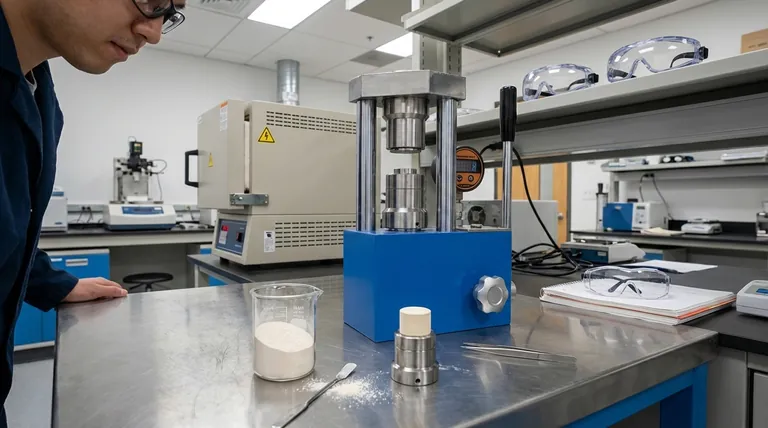
The Mechanics of Green Body Formation
Creating Handling Strength
The immediate purpose of the press is to consolidate loose LATP powder into a solid pellet, known technically as a green body.
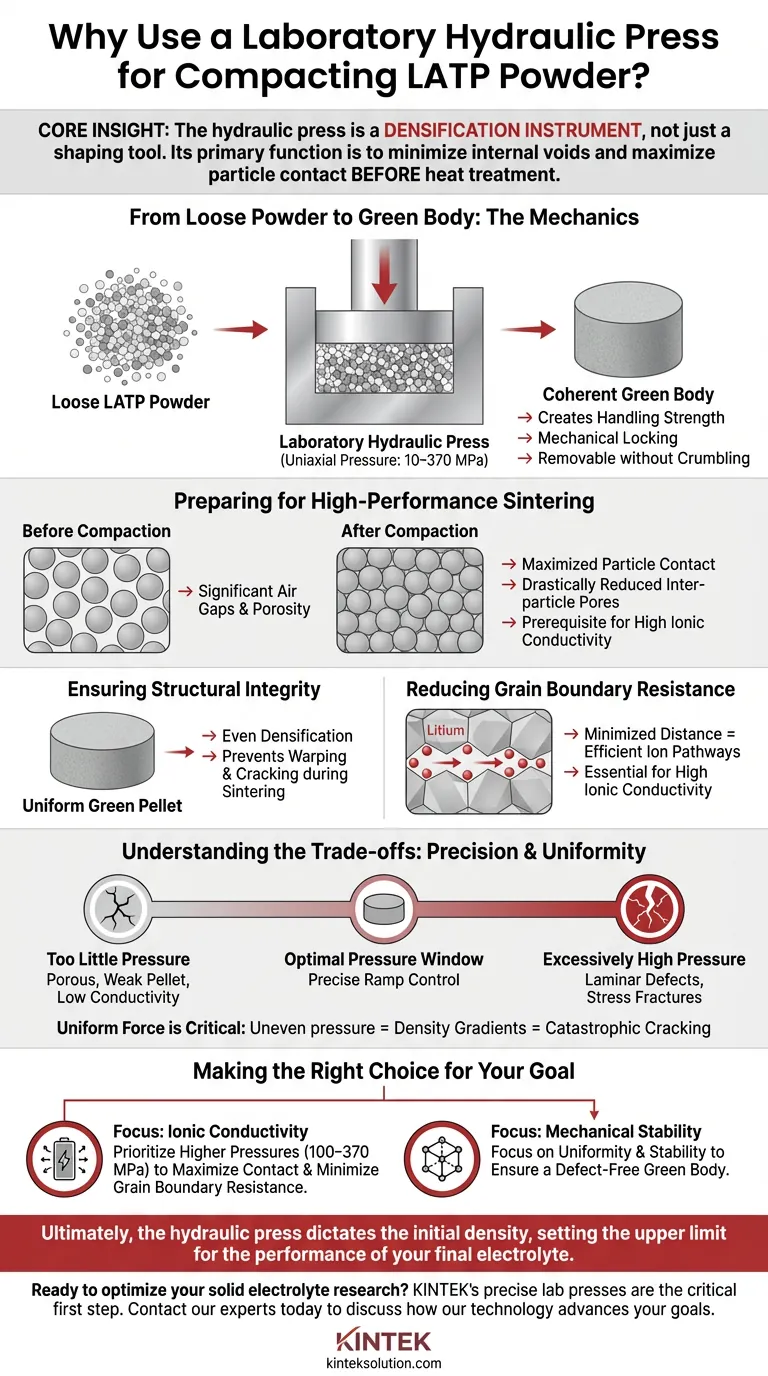
By applying uniaxial pressure, often ranging from 10 to 370 MPa, the press mechanically locks the powder particles together.
This imparts sufficient mechanical strength to the pellet, allowing it to be removed from the mold and handled without crumbling during transfer to a sintering furnace.
Minimizing Internal Porosity
LATP powders naturally contain significant air gaps and voids between particles.
The hydraulic press forces these particles into intimate physical contact, drastically reducing the volume of these inter-particle pores.
This physical compaction is a prerequisite for high performance; a porous electrolyte cannot effectively conduct ions.
Preparing for High-Performance Sintering
Ensuring Structural Integrity
The quality of the final ceramic is determined by the quality of the green body produced by the press.
A uniformly compressed green pellet helps prevent common defects during the high-temperature sintering phase, such as uneven shrinkage, warping, or cracking.
If the initial packing density is inconsistent, the material will densify unevenly under heat, leading to mechanical failure.
Reducing Grain Boundary Resistance
For an all-solid-state battery to function, lithium ions must move freely between crystal grains.
High-pressure compaction minimizes the distance between these grains, creating efficient pathways for ion transport.
This reduction in "grain boundary resistance" is essential for achieving the high ionic conductivity that makes LATP a viable electrolyte candidate.
Understanding the Trade-offs
The Necessity of Uniformity
While high pressure is beneficial, the application of that pressure must be highly controlled.
A laboratory press must deliver uniform force; if the pressure distribution is uneven, density gradients will form within the pellet.
These gradients create internal stress points that often result in catastrophic cracking during the sintering process.
Pressure Precision
There is a specific window of optimal pressure for every LATP synthesis.
Too little pressure results in a porous, mechanically weak pellet that yields low conductivity.
However, excessively high pressure without proper ramp control can introduce laminar defects or stress fractures in the green body itself.
Making the Right Choice for Your Goal
The way you utilize the hydraulic press should align with your specific research objectives.
- If your primary focus is Ionic Conductivity: Prioritize higher pressures (typically 100–370 MPa) to maximize particle contact and minimize grain boundary resistance.
- If your primary focus is Mechanical Stability: Focus on the uniformity and stability of the pressure application to ensure a defect-free green body that will not crack during sintering.
Ultimately, the laboratory hydraulic press dictates the initial density of your material, setting the upper limit for the performance of your final electrolyte.
Summary Table:
| Function | Benefit for LATP Pellet | Key Consideration |
|---|---|---|
| Green Body Formation | Creates a solid, handleable pellet from loose powder. | Pressure range: 10-370 MPa. |
| Porosity Reduction | Maximizes particle contact, a prerequisite for high ionic conductivity. | Ensures uniform pressure to avoid density gradients. |
| Sintering Preparation | Produces a defect-free green body that sinters evenly without cracking. | Pressure must be precise; too little or too much can cause failure. |
Ready to optimize your solid electrolyte research? The precise, uniform pressure from a KINTEK lab press is the critical first step in creating high-performance LATP pellets with superior ionic conductivity and mechanical integrity. Our automatic lab presses, isostatic presses, and heated lab presses are engineered to meet the exacting demands of battery materials development. Contact our experts today to discuss how our press technology can advance your laboratory's goals.
Visual Guide
Related Products
- Automatic Laboratory Hydraulic Press Lab Pellet Press Machine
- Manual Laboratory Hydraulic Press Lab Pellet Press
- Manual Laboratory Hydraulic Pellet Press Lab Hydraulic Press
- Laboratory Hydraulic Press Lab Pellet Press Button Battery Press
- Laboratory Hydraulic Press Lab Pellet Press Machine for Glove Box
People Also Ask
- What is the primary purpose of a manual lab hydraulic pellet press? Ensure Accurate Sample Prep for XRF and FTIR
- What is the primary purpose of manual lab hydraulic pellet presses? Achieve High-Precision Sample Preparation for Spectroscopy
- Why are high-precision automatic hydraulic presses required for Martian ISRU? Ensure Reliable Regolith Forming
- How does an automatic laboratory hydraulic press improve KBr pellet preparation? Achieve Precision IR Spectroscopy
- What are the advantages of using an automatic laboratory hydraulic press? Enhance Precision in Sample Preparation



















