
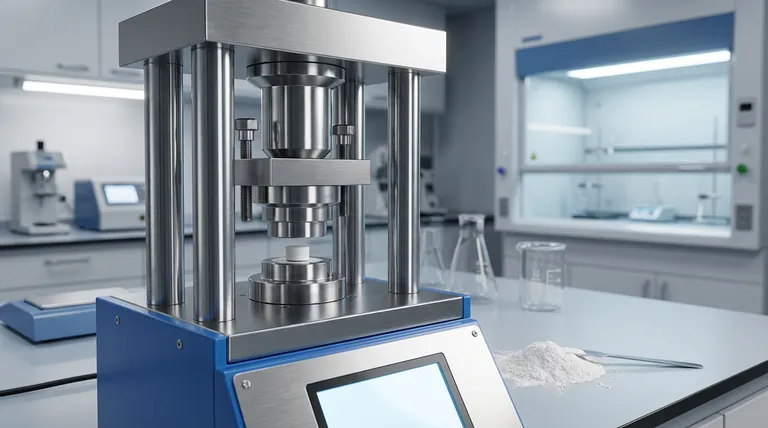
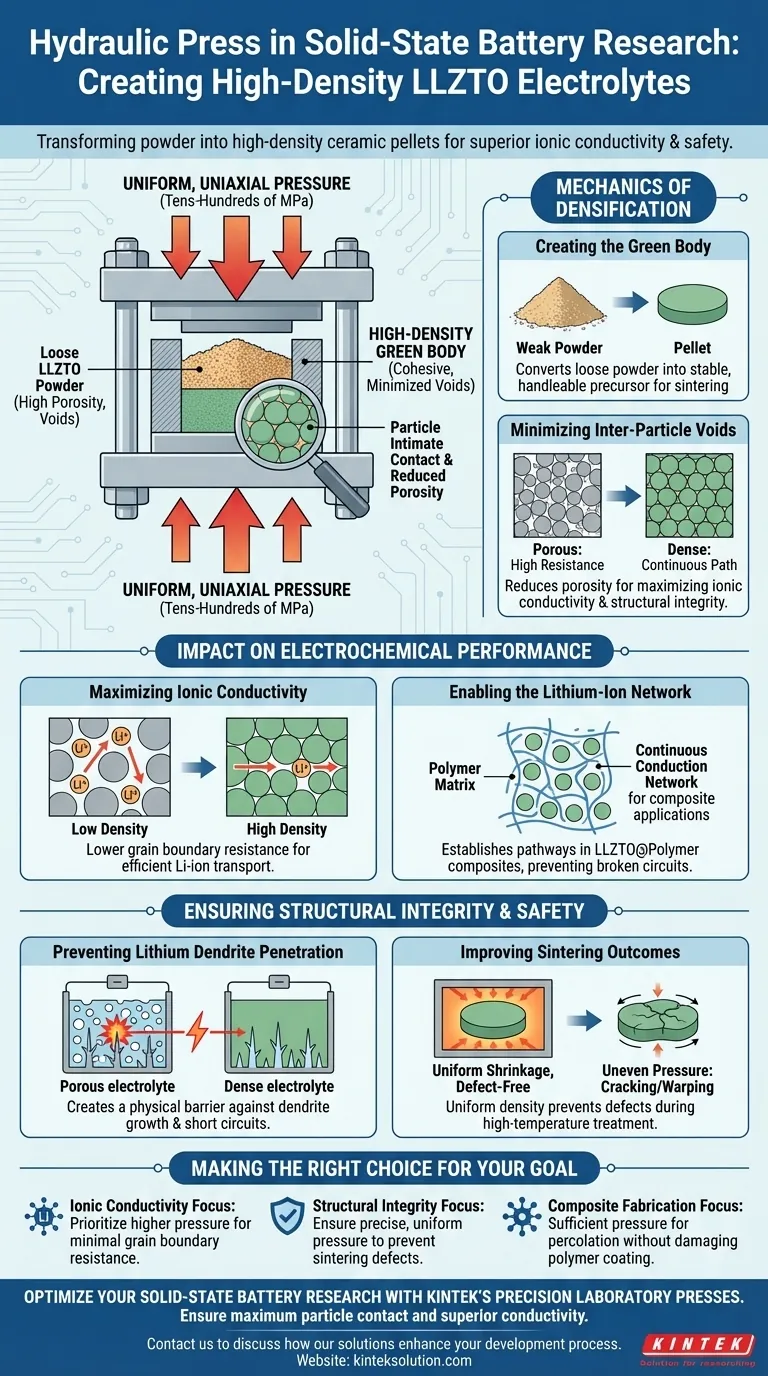
The primary function of a laboratory hydraulic press in this context is to transform loose LLZTO powder into a cohesive, high-density solid known as a "green body." By applying uniform, uniaxial pressure—often ranging from tens to hundreds of megapascals—the press mechanically forces particles into intimate contact. This compaction is the critical prerequisite for eliminating voids and ensuring the material achieves the density required to function as a solid-state electrolyte.
Core Takeaway Achieving high ionic conductivity in solid-state batteries is impossible without first maximizing physical density. The hydraulic press serves as the foundational density-engineering tool, creating a tightly packed structure that minimizes resistance and prevents structural failure during subsequent processing.
The Mechanics of Densification
Creating the Green Body
Before a ceramic can be sintered (heated), it must be formed into a specific shape with sufficient structural integrity. The hydraulic press compacts loose powder into a green pellet that is strong enough to be handled.
This step is essential for the powder metallurgy route. It converts a difficult-to-process powder into a stable precursor ready for high-temperature treatment.
Minimizing Inter-Particle Voids
Loose powder contains significant amounts of empty space (porosity) between particles. The press applies massive force to mechanically reduce these voids.
By forcing grains into intimate physical contact, the press creates a continuous path for materials. This reduction in porosity is vital for both sintered ceramics and non-sintered polymer composites.
Impact on Electrochemical Performance
Maximizing Ionic Conductivity
The ultimate goal of an LLZTO electrolyte is to transport lithium ions efficiently. High compaction density directly correlates to lower grain boundary resistance.
If the particles are not pressed tightly together, ions cannot easily jump from one grain to the next. The hydraulic press ensures the particle-to-particle connectivity required for the material's intrinsic conductivity to be realized.
Enabling the Lithium-Ion Network
In specific applications like LLZTO@Polymer composites, the press may be the final forming step. Here, pressure forces polymer-coated particles together to form a continuous conduction network.
Without this mechanical force, the conduction pathways would be broken by air gaps, severely degrading the battery's electrochemical performance.
Ensuring Structural Integrity and Safety
Preventing Lithium Dendrite Penetration
A dense microstructure is a safety requirement, not just a performance metric. High relative density creates a physical barrier against lithium dendrites.
If the pellet is porous due to poor pressing, dendrites can grow through the voids, causing short circuits.
Improving Sintering Outcomes
The quality of the final sintered ceramic is determined by the quality of the green body. A uniform, dense green pellet undergoes better shrinkage during sintering.
If the initial pressing is uneven or too loose, the pellet is prone to cracking, warping, or deformation when heated. The press ensures the uniformity needed to produce a defect-free final ceramic sheet.
Understanding the Trade-offs
The Necessity of Uniformity
Applying pressure is not enough; the pressure must be uniform across the entire die.
Non-uniform pressure leads to density gradients within the pellet. During sintering, these gradients cause differential shrinkage, which inevitably results in warping or catastrophic cracking of the electrolyte.
The Limits of "Green Strength"
While the press creates a cohesive shape, the resulting "green body" is mechanically stable but not yet a finished ceramic.
It possesses initial strength sufficient for handling, but it lacks the chemical bonding of the final product. It must still undergo sintering (for pure ceramics) to achieve its full mechanical robustness.
Making the Right Choice for Your Goal
To maximize the effectiveness of your hydraulic pressing stage, align your process with your specific research objectives:
- If your primary focus is Ionic Conductivity: Prioritize higher pressures (within material limits) to minimize grain boundary resistance and maximize particle contact.
- If your primary focus is Structural Integrity: Focus on the precision and uniformity of the pressure application to prevent cracking and deformation during sintering.
- If your primary focus is Composite Fabrication: Ensure the pressure is sufficient to establish a continuous percolation network without damaging the polymer coating.
The hydraulic press is not merely a shaping tool; it is the instrument that defines the ultimate density, efficiency, and safety of your solid-state battery architecture.
Summary Table:
| Key Function | Benefit for LLZTO Pellets |
|---|---|
| Creates a 'Green Body' | Forms a stable, handleable precursor for sintering. |
| Minimizes Inter-Particle Voids | Reduces porosity to maximize ionic conductivity. |
| Ensures Uniform Density | Prevents cracking and warping during sintering. |
| Enhances Safety | Creates a dense barrier against lithium dendrite penetration. |
Ready to optimize your solid-state battery research?
KINTEK's precision laboratory presses—including automatic, isostatic, and heated models—are engineered to deliver the uniform, high-pressure compaction essential for creating high-density LLZTO electrolyte pellets. By ensuring maximum particle contact and minimal voids, our presses help you achieve the superior ionic conductivity and structural integrity your research demands.
Contact us today using the form below to discuss how our lab press solutions can enhance your battery development process. #ContactForm
Visual Guide
Related Products
- Laboratory Hydraulic Press Lab Pellet Press Button Battery Press
- Laboratory Hydraulic Press 2T Lab Pellet Press for KBR FTIR
- Laboratory Hydraulic Press Lab Pellet Press Machine for Glove Box
- 24T 30T 60T Heated Hydraulic Lab Press Machine with Hot Plates for Laboratory
- Automatic Laboratory Hydraulic Press Lab Pellet Press Machine
People Also Ask
- How is a laboratory hydraulic press used for HAP composite gels? Master Mineral Substrate Standardization
- What role does a laboratory hydraulic press play in the preparation of piezoelectric ceramic discs for DC-PG? | KINTEK
- What role does a laboratory hydraulic press play in reaction pellets? Optimizing Lunar Soil and Metal Fuel Density
- Why is a laboratory hydraulic press required for PBAT and PLA sample preparation? Achieve Flawless Characterization
- What role does a laboratory hydraulic press play in the assembly of all-solid-state battery test cells? Expert Guide



















