
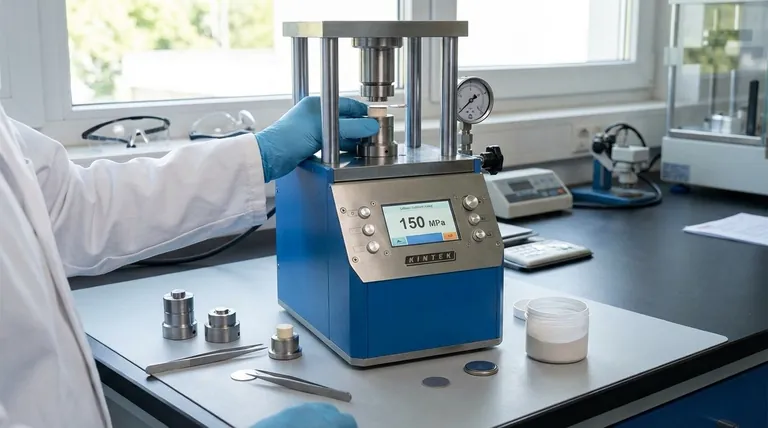
The requirement for a precise 150 MPa pressure arises from the need to mechanically bond two materials with vastly different physical properties without destroying the more fragile component.
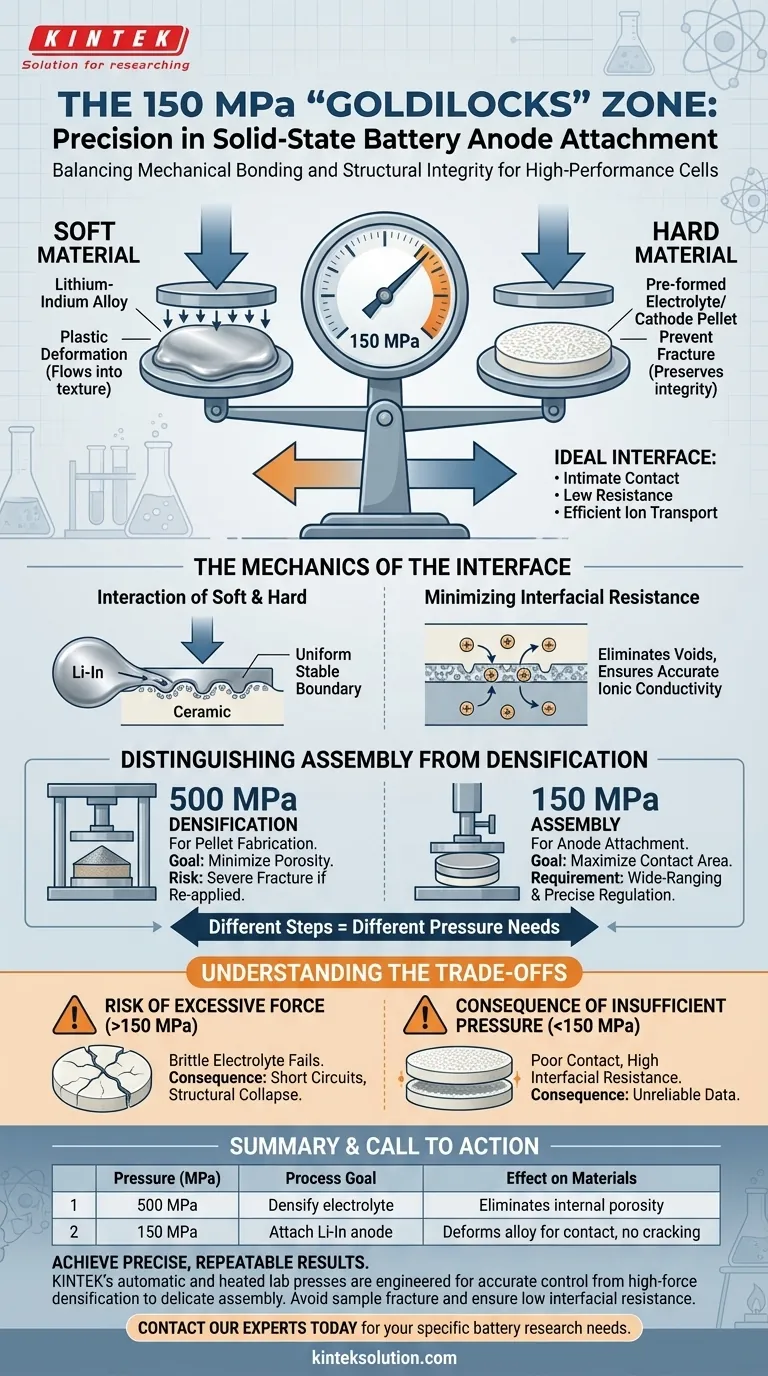
This specific pressure level creates a "Goldilocks" zone: it is high enough to plastically deform the soft lithium-indium alloy so it flows into the surface texture of the electrolyte, yet low enough to prevent the hard, brittle ceramic pellet from cracking under stress.
Core Takeaway Successful solid-state battery assembly relies on differentiating between densification and attachment. While forming the electrolyte pellet requires extreme pressure (e.g., 500 MPa), attaching the anode requires a moderated 150 MPa to maximize contact area while preserving the structural integrity of the ceramic layer.
The Mechanics of the Interface
The Interaction Between Soft and Hard Materials
The attachment process involves pressing a soft metallic anode (lithium-indium) onto a pre-formed, hard ceramic electrolyte.
Because the anode is malleable, the 150 MPa pressure forces the metal to conform to the microscopic irregularities of the ceramic surface.
This creates a uniform and stable physical boundary, which is critical for the battery's operation.
Minimizing Interfacial Resistance
The primary goal of applying this pressure is to ensure intimate physical contact between the layers.
Gaps or voids at this interface act as barriers to ion movement, leading to high resistance and poor performance.
By eliminating these voids, you create an efficient pathway for ion transport, which allows for accurate measurement of ionic conductivity and cycling stability.
Distinguishing Assembly from Densification
Why 500 MPa is Too High for This Step
It is vital to distinguish this attachment step from the initial pellet fabrication.
Creating the electrolyte pellet itself often requires high pressures, such as 500 MPa, to densify the powder and minimize internal porosity.
However, once that brittle ceramic pellet is formed, re-applying such extreme force during anode attachment poses a severe risk of fracture.
The Role of Precision Equipment
Because the requirements shift dramatically between steps—from 500 MPa for densification to 150 MPa for assembly—the laboratory press used must offer wide-ranging and precise regulation.
The equipment must be capable of holding the lower 150 MPa target accurately to ensure repeatability without overshooting and damaging the sample.
Understanding the Trade-offs
The Risk of Excessive Force
If the pressure exceeds 150 MPa during this stage, the brittle electrolyte component is likely to crack or shatter.
Mechanical failure of the electrolyte compromises the separator function, potentially leading to short circuits or structural collapse of the cell.
The Consequence of Insufficient Pressure
Conversely, applying significantly less than 150 MPa will fail to deform the lithium-indium alloy sufficiently.
This results in poor contact patches and high interfacial resistance, rendering the resulting data on conductivity or battery performance unreliable.
Making the Right Choice for Your Goal
To ensure the success of your solid-state cell fabrication, you must match the pressure magnitude to the specific stage of assembly.
- If your primary focus is densifying the electrolyte powder: Apply high pressure (e.g., 500 MPa) to eliminate voids and reduce grain boundary resistance within the pellet.
- If your primary focus is attaching the anode: Reduce pressure to a precise 150 MPa to ensure low-resistance contact without fracturing the pre-formed ceramic.
Precision in pressure regulation is not just a procedural detail; it is the determining factor between a high-performance cell and a fractured sample.
Summary Table:
| Pressure (MPa) | Process Goal | Effect on Materials |
|---|---|---|
| 500 MPa | Densify electrolyte powder | Eliminates internal porosity in the ceramic pellet |
| 150 MPa | Attach lithium-indium anode | Deforms soft alloy for maximum contact without cracking the brittle pellet |
Achieve precise, repeatable results in your solid-state battery assembly.
Fabricating reliable test cells requires a lab press capable of accurate pressure control across a wide range, from high-force densification (500 MPa) to delicate assembly (150 MPa). KINTEK's automatic and heated lab presses are engineered for this level of precision, helping researchers like you avoid sample fracture and ensure low interfacial resistance for trustworthy electrochemical data.
Ready to enhance your lab's capabilities? Contact our experts today to find the perfect press for your specific battery research needs.
Visual Guide
Related Products
- Warm Isostatic Press for Solid State Battery Research Warm Isostatic Press
- Lab Infrared Press Mold for Laboratory Applications
- Carbide Lab Press Mold for Laboratory Sample Preparation
- Laboratory Hydraulic Press Lab Pellet Press Button Battery Press
- Button Battery Sealing Press Machine for Lab
People Also Ask
- Why must composite cathodes be sealed in vacuum lamination bags for WIP? Ensure Battery Stability and Density
- What is the function of elastic molds in warm isostatic pressing? Achieve Uniform Density in Composite Particles
- How do sacrificial volume materials (SVM) maintain microchannels in isostatic pressing? Ensure Structural Integrity
- What is the process involved in warm isostatic pressing? Mastering Uniform Density with WIP Technology
- What are the advantages of using a Warm Isostatic Press (WIP) for batteries? Achieve Superior Interface Contact









