
A multi-step pressing process is the fundamental requirement for overcoming the physical limitations of solid-solid interfaces in all-solid-state sodium-ion batteries. By applying varying pressures using a lab press, you decouple the densification of the electrolyte from the bonding of the electrodes. This ensures that the electrolyte layer achieves high internal density—critical for blocking dendrites—while subsequently creating an intimate, low-resistance connection with the cathode and anode that a single pressing step cannot reliably achieve.
Core Insight
In the absence of a liquid electrolyte to "wet" surfaces and fill gaps, mechanical force is the only variable that allows ions to move between layers. A multi-step process allows you to optimize the internal density of individual components first, and then optimize the interfacial contact between them, minimizing the impedance that typically kills solid-state battery performance.
The Physics of Solid-State Interfaces
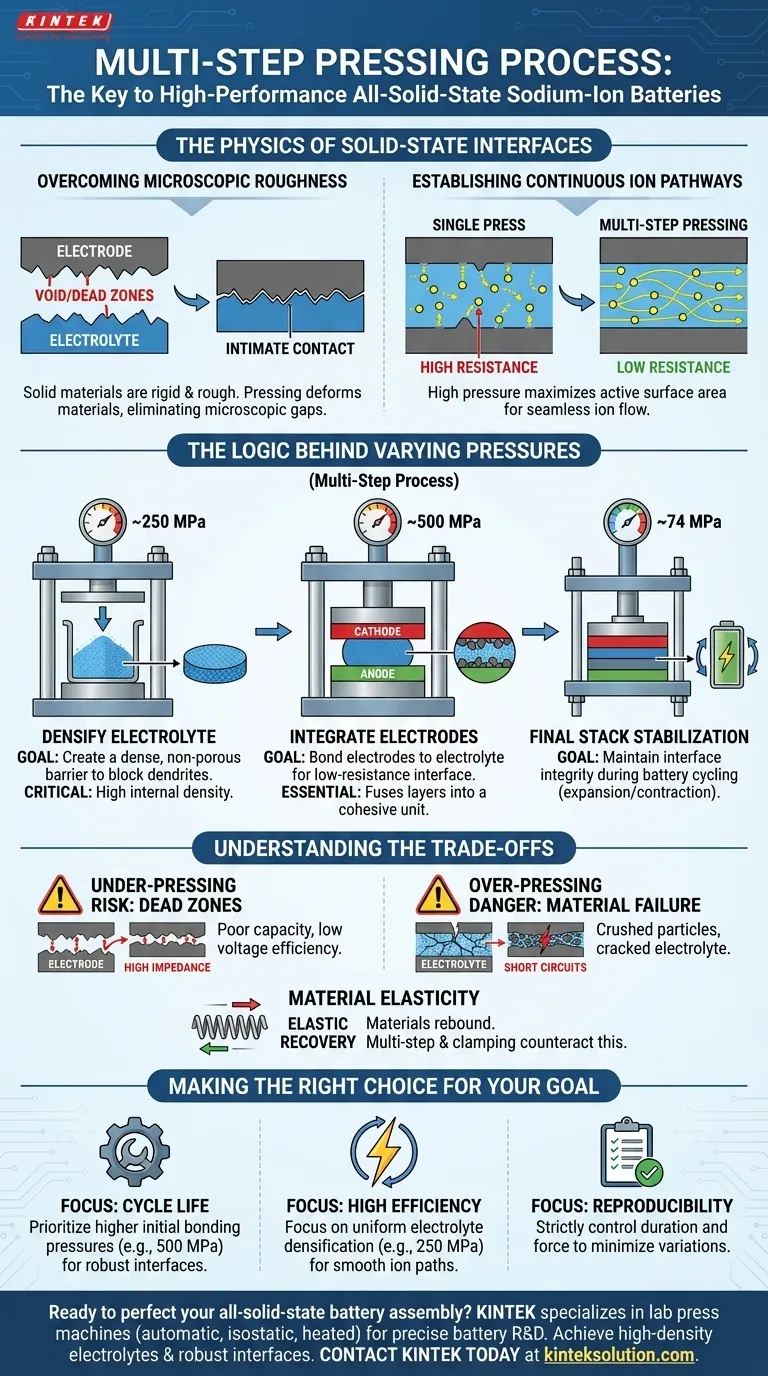
Overcoming Microscopic Roughness
Unlike liquid electrolytes, solid materials have rigid, rough surfaces on a microscopic level. When two solid layers are simply placed together, they only touch at the highest peaks of their surface topography.
These gaps create voids where ions cannot travel, leading to massive interfacial resistance. Pressing is required to plastically deform these materials, forcing them to interlock and eliminating microscopic gaps.
Establishing Continuous Ion Pathways
The primary goal of assembly is to create a seamless "highway" for sodium ions. If the layers are not pressed firmly enough, the contact points are sparse, restricting the flow of ions.
By applying high pressure, you maximize the active surface area where the cathode, electrolyte, and anode meet. This direct physical contact is the prerequisite for reducing interfacial impedance and enabling high-rate electrochemical performance.
The Logic Behind Varying Pressures
Step 1: Densifying the Electrolyte
The first stage of pressing typically targets the solid electrolyte layer alone. For example, applying a pressure of approximately 250 MPa ensures the electrolyte powder is compacted into a dense, non-porous pellet.
High density in this layer is non-negotiable. It creates the structural integrity required to handle the cell and acts as a physical barrier to prevent short circuits between the anode and cathode.
Step 2: Integrating the Electrodes
Once the electrolyte is densified, the electrode materials (such as the cathode) are added. A second, often higher pressure (e.g., 500 MPa) is applied to bond this new layer to the existing electrolyte pellet.
This varying pressure strategy is essential because it fuses the distinct layers into a single, cohesive unit. It ensures the electrode particles embed slightly into the electrolyte surface, creating a robust interface that can withstand the volume changes inherent in battery cycling.
Step 3: Final Stack Stabilization
After the initial fabrication, a lower, constant stacking pressure (e.g., around 74 MPa) is often maintained. This ensures that the interfaces remain void-free even as the materials expand and contract during operation.
Understanding the Trade-offs
The Risk of Under-Pressing
If the pressure is too low during any stage, "dead zones" will remain at the interface. These voids drive up internal resistance, causing the battery to suffer from poor capacity and low voltage efficiency.
The Danger of Over-Pressing
While high pressure is necessary, excessive force can be destructive. It can crush the active material particles or cause the electrolyte pellet to crack, leading to immediate cell failure or short circuits.
Material Elasticity
Solid materials often exhibit "elastic recovery," meaning they try to bounce back to their original shape after the press is released. A multi-step process helps mitigate this by progressively stabilizing the structure, but external clamping pressure is often still required during testing to counteract this rebound.
Making the Right Choice for Your Goal
To optimize your sodium-ion battery assembly, align your pressing protocol with your specific performance targets:
- If your primary focus is Cycle Life: Prioritize higher initial bonding pressures (e.g., 500 MPa) to ensure the interface is robust enough to survive repeated expansion and contraction.
- If your primary focus is High Efficiency: Focus on the uniformity of the electrolyte densification step (e.g., 250 MPa) to ensure the smoothest possible ion path with zero porosity.
- If your primary focus is Reproducibility: strictly control the duration of the pressure application, not just the force, to minimize variations in elastic recovery between batches.
Achieving the optimal all-solid-state battery is not just about chemistry; it is about the precise mechanical engineering of the interface.
Summary Table:
| Pressing Step | Typical Pressure | Primary Goal |
|---|---|---|
| Step 1: Densify Electrolyte | ~250 MPa | Create a dense, non-porous electrolyte layer to block dendrites. |
| Step 2: Integrate Electrodes | ~500 MPa | Bond electrodes to the electrolyte, creating an intimate, low-resistance interface. |
| Step 3: Final Stack Stabilization | ~74 MPa | Maintain interface integrity during battery cycling to counteract material expansion/contraction. |
Ready to perfect your all-solid-state battery assembly? KINTEK specializes in lab press machines (automatic lab press, isostatic press, heated lab press, etc.), serving the precise needs of battery research and development laboratories. Our equipment delivers the controlled, multi-step pressing processes essential for achieving high-density electrolytes and robust electrode interfaces. Let us help you enhance your battery's cycle life, efficiency, and reproducibility. Contact KINTEK today to discuss your specific requirements!
Visual Guide
Related Products
- 24T 30T 60T Heated Hydraulic Lab Press Machine with Hot Plates for Laboratory
- Manual Heated Hydraulic Lab Press with Integrated Hot Plates Hydraulic Press Machine
- Laboratory Hydraulic Pellet Press for XRF KBR FTIR Lab Press
- Lab Infrared Press Mold for Laboratory Applications
- Laboratory Hydraulic Press Lab Pellet Press Machine for Glove Box
People Also Ask
- Function of a Laboratory Hydraulic Press with Heated Platens in SSE? Enhance Battery Density & Conductivity
- Why is a laboratory hydraulic press with heating plates required for PLA/TEC films? Achieve Precise Sample Integrity
- What role does a laboratory heated hydraulic press play in LTCC? Essential for High-Density Ceramic Lamination
- What is the primary function of a laboratory heated hydraulic press? Mastering Thermoplastic Carbon Fiber Composites
- Why is a laboratory heated hydraulic press utilized during the lamination stage of NASICON green tapes?



















