
Ideally, solid-state battery components would fuse naturally, but in reality, the rigidity of solid materials creates microscopic gaps that block energy flow. A multi-step uniaxial pressing process is required for Li8/7Ti2/7V4/7O2 cathodes to forcefully eliminate these voids and mechanically interlock the cathode with the solid electrolyte, ensuring the continuous pathways necessary for lithium ions to move.
The Core Takeaway
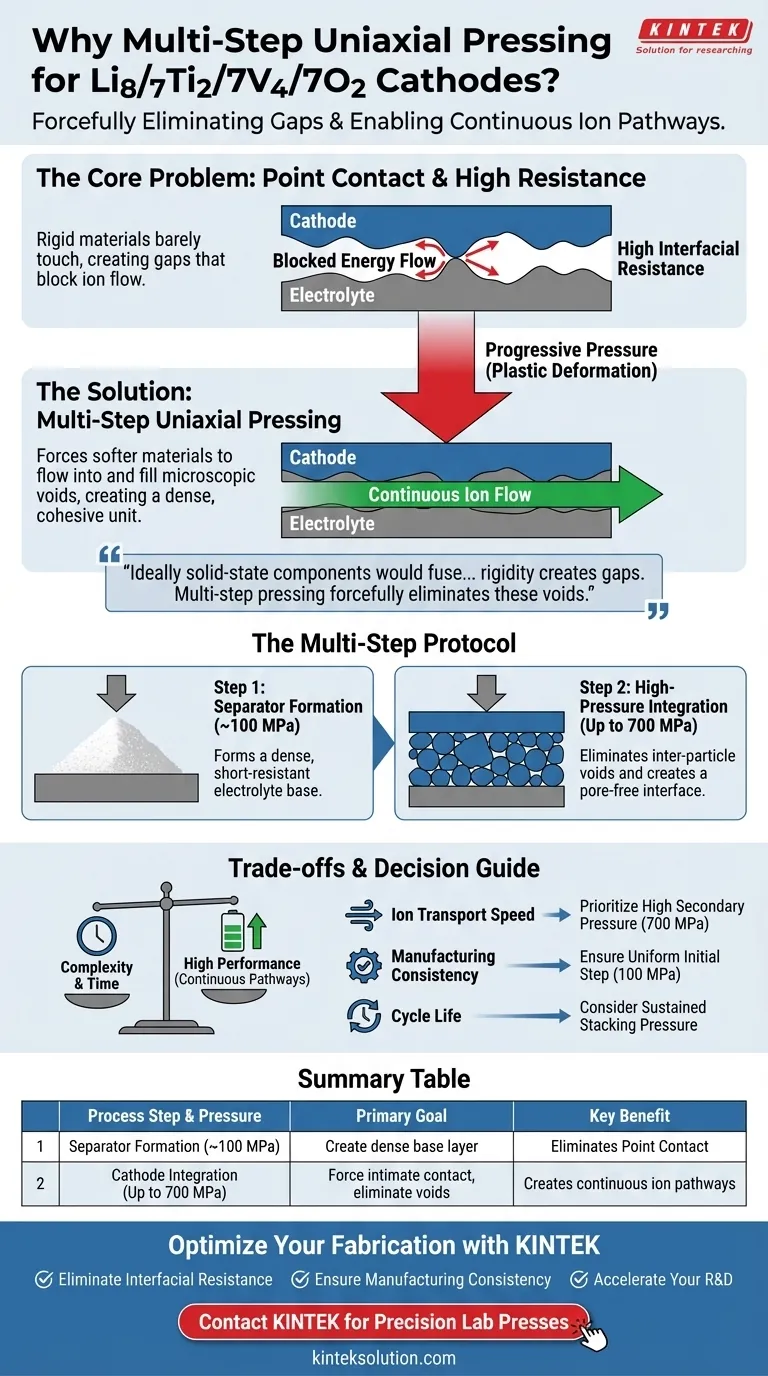
Solid-state batteries suffer from "point contacts," where rigid surfaces barely touch, causing massive resistance. Multi-step pressing applies progressively higher pressure (up to 700 MPa) to plastically deform these materials, turning a loose stack of powders into a single, dense, and cohesive unit optimized for ion transport.

Overcoming the "Point Contact" Limitation
The fundamental challenge in fabricating all-solid-state batteries is that solid components do not wet each other like liquid electrolytes do.
The Problem with Rigid Components
Unlike liquids, solid electrolytes and metal electrodes are rigid. When simply placed together, they only touch at microscopic high points, a phenomenon known as "point contact."
The Consequence of Poor Contact
These limited contact points lead to extremely high interfacial resistance. If the layers are not physically forced together, ions cannot traverse the gap between the cathode and the electrolyte, rendering the battery inefficient or non-functional.
The Role of Plastic Deformation
To solve this, controlled mechanical pressure is used to induce plastic deformation. This forces softer materials to physically flow into and fill the microscopic voids on the electrolyte's surface, dramatically increasing the active contact area.
The Logic of the Multi-Step Protocol
A single pressing step is often insufficient to achieve the varying density requirements of the different layers. The multi-step process allows for the independent optimization of the electrolyte separator and the cathode interface.
Step 1: Forming the Separator
The process typically begins by pressing the sulfide solid-state electrolyte powder (such as Li6PS5Cl) into a dense layer at a moderate pressure, often around 100 MPa. This creates a base separator layer that is sufficiently dense to prevent electrical shorts but remains receptive to the next layer.
Step 2: High-Pressure Integration
The cathode composite is then added, and a much higher pressure—sometimes up to 700 MPa—is applied. This extreme pressure is critical for creating a tight, intimate solid-solid interface between the cathode active material and the electrolyte particles.
Eliminating Voids
This high-pressure final step eliminates inter-particle voids and microscopic gaps caused by surface roughness. By compacting the entire structure, the process creates a pore-free, dense microstructure essential for creating efficient lithium-ion transport pathways.
Understanding the Trade-offs
While high pressure is necessary, understanding the balance of force is critical for successful fabrication.
Complexity vs. Performance
Implementing a multi-step uniaxial pressing process adds complexity and time to the manufacturing workflow compared to simple stacking. However, skipping this steps leads to poor interfacial contact and high internal resistance, which negates the benefits of using advanced cathode materials.
Pressure Management
The pressure must be sufficient to close gaps but controlled enough to maintain the structural integrity of the layers. For example, while 700 MPa creates excellent contact, lower "stacking pressures" (around 74 MPa) are sometimes used to maintain contact during operation without over-compressing the assembly.
Making the Right Choice for Your Project
To maximize the performance of your Li8/7Ti2/7V4/7O2 cathode, align your pressing strategy with your specific performance metrics.
- If your primary focus is Ion Transport Speed: Prioritize higher secondary pressures (up to 700 MPa) to maximize particle-to-particle contact and minimize interfacial resistance.
- If your primary focus is Manufacturing Consistency: Ensure the initial electrolyte pressing step (approx. 100 MPa) is uniform to provide a flat, stable foundation for the cathode layer.
- If your primary focus is Cycle Life: Consider applying a sustained stacking pressure during assembly to prevent the formation of voids over time due to material expansion and contraction.
Ultimately, the multi-step pressing process is not just a shaping technique; it is the primary activation mechanism that allows a solid-state battery to function as a unified electrochemical system.
Summary Table:
| Process Step | Typical Pressure | Primary Goal |
|---|---|---|
| Separator Formation | ~100 MPa | Create a dense, short-resistant electrolyte base layer. |
| Cathode Integration | Up to 700 MPa | Force intimate contact between cathode and electrolyte, eliminating voids. |
| Key Benefit | Eliminates 'Point Contact' | Creates continuous ion pathways for high performance. |
Ready to Optimize Your Solid-State Battery Fabrication?
Achieving the perfect density and intimate contact between layers is critical for high-performance batteries. KINTEK specializes in precision lab press machines, including automatic lab presses and heated lab presses, designed to deliver the controlled, multi-step uniaxial pressing required for advanced materials like Li8/7Ti2/7V4/7O2 cathodes.
Our presses help you:
- Eliminate Interfacial Resistance: Apply precise, high pressures to create seamless solid-solid interfaces.
- Ensure Manufacturing Consistency: Achieve uniform density and repeatable results batch after batch.
- Accelerate Your R&D: Reliably fabricate high-quality battery cells for testing and development.
Let's discuss how our equipment can enhance your solid-state battery research and development.
Contact our experts today to find the perfect press for your lab!
Visual Guide
Related Products
- Split Automatic Heated Hydraulic Press Machine with Heated Plates
- Automatic Laboratory Hydraulic Press for XRF and KBR Pellet Pressing
- Electric Split Lab Cold Isostatic Pressing CIP Machine
- Automatic Heated Hydraulic Press Machine with Heated Plates for Laboratory
- Lab Round Bidirectional Press Mold
People Also Ask
- What are the requirements for electrode pressing with high-viscosity ionic liquids like EMIM TFSI? Optimize Performance
- How does a laboratory heated hydraulic press facilitate PBN sample prep for WAXS? Achieve Precise X-Ray Scattering
- What are the industrial applications of heated hydraulic presses? Master Heat & Force for Precision Manufacturing
- Why is a laboratory hydraulic press with heating plates required for PLA/TEC films? Achieve Precise Sample Integrity
- Function of a Laboratory Hydraulic Press with Heated Platens in SSE? Enhance Battery Density & Conductivity



















