
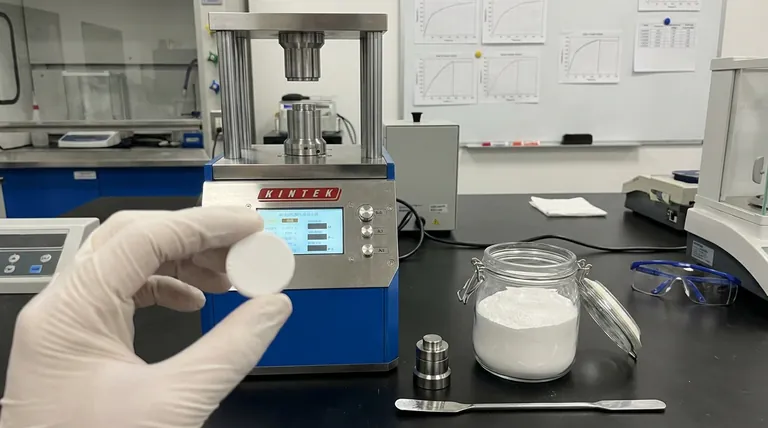
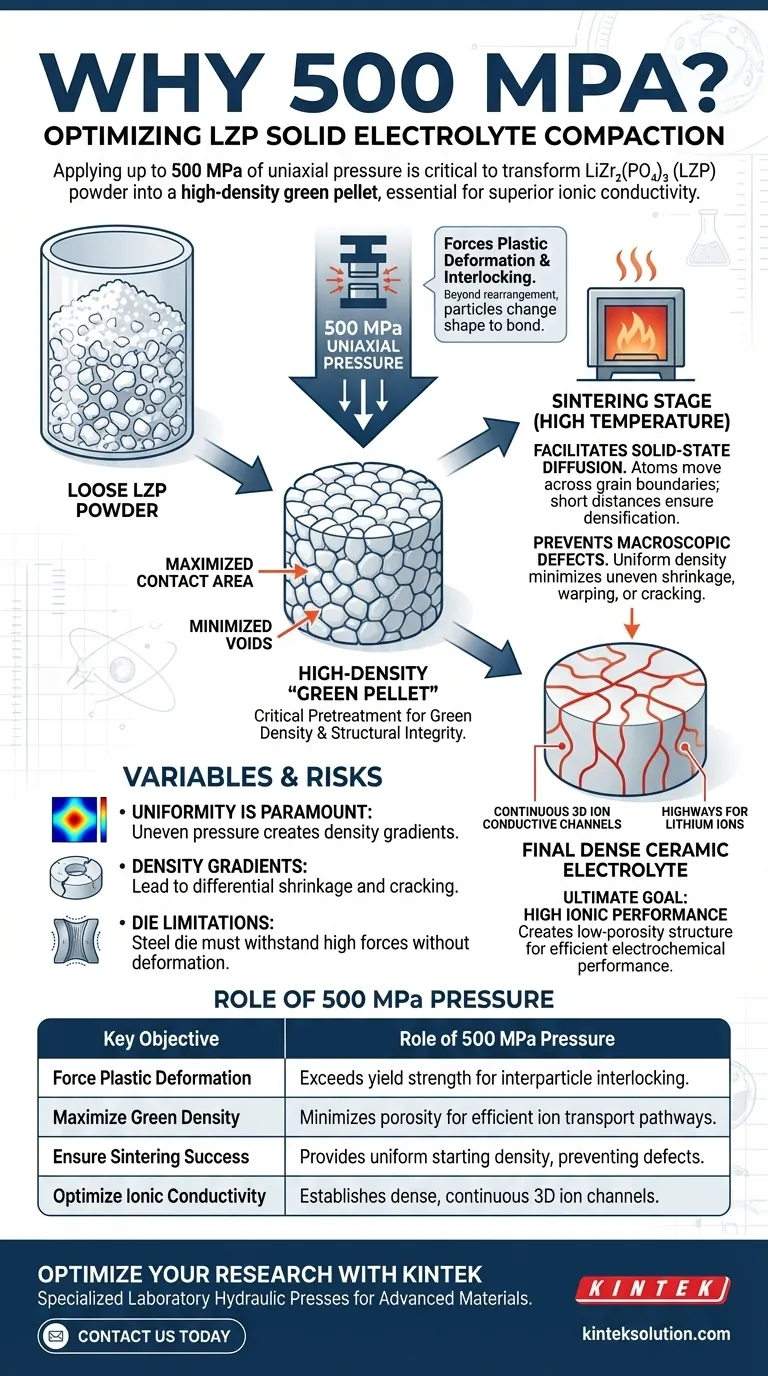
Applying up to 500 MPa of uniaxial pressure is required to force LiZr₂(PO₄)₃ (LZP) powder particles beyond simple rearrangement and into a state of plastic deformation. This immense force is necessary to maximize the contact area between particles, creating a high-density "green pellet" that possesses the structural integrity required to survive high-temperature processing.
Core Insight: The application of 500 MPa is not merely about shaping the powder; it is a critical pretreatment to maximize green density. This initial density is the primary determinant of the final material's ionic conductivity, as it minimizes voids that would otherwise impede lithium-ion transport in the finished solid electrolyte.
The Mechanics of High-Pressure Compaction
Forcing Plastic Deformation
At lower pressures, powder particles simply slide past one another to fill empty spaces. However, achieving the density required for LZP electrolytes requires overcoming the material's yield strength.
The 500 MPa load forces the particles to undergo plastic deformation, physically changing their shape to interlock with neighbors. This mechanical interlocking provides the green pellet with significant strength, allowing it to be handled without crumbling before sintering.
Maximizing Intimate Contact
For a solid electrolyte to function, ions must move freely between crystalline grains. This requires intimate contact between particles.
High-pressure compaction significantly reduces the voids (porosity) between loose composite powders. By eliminating these air gaps at the pressing stage, you establish the physical pathways necessary for efficient ion transport later on.
The Critical Link to Sintering Success
Facilitating Solid-State Diffusion
The green pellet is a precursor to the final ceramic. During the subsequent high-temperature sintering, the material densifies further through mass transport.
This process relies heavily on solid-state diffusion, where atoms move across grain boundaries. This diffusion is only effective if the particles are already physically touching. The high packing density achieved by the hydraulic press ensures these diffusion distances are short, facilitating rapid and complete densification.
Preventing Macroscopic Defects
Sintering causes material shrinkage. If the initial green density is low or uneven, this shrinkage will be significant and unpredictable.
A highly dense green pellet minimizes the degree of shrinkage required during firing. This stability helps prevent the formation of macroscopic defects such as uneven shrinkage, warping, or cracking, which would render the electrolyte sheet useless.
The Ultimate Goal: Ionic Performance
Creating Ion-Conductive Channels
The primary metric for LZP is ionic conductivity. The hydraulic press lays the foundation for this by creating a low-porosity structure.
By ensuring high density early in the process, the final sintered ceramic develops uniform, orderly three-dimensional ion conduction channels. These channels are the "highways" for lithium ions; without the initial high-pressure compaction, these pathways would be interrupted by pores, drastically reducing electrochemical performance.
Understanding the Variables and Risks
While high pressure is critical, it must be applied correctly to avoid diminishing returns or defects.
- Uniformity is Paramount: The pressure must be uniaxial and uniform. If the pressure distribution is uneven, density gradients will form within the pellet.
- Density Gradients: Uneven density leads to differential shrinkage during sintering. Parts of the pellet will shrink faster than others, causing the ceramic to crack or warp despite the high pressure used.
- Die Limitations: The steel die used in the laboratory press must be rated to withstand these forces without deformation, which would compromise the pellet's dimensional accuracy.
Making the Right Choice for Your Goal
When establishing your pellet pressing protocol, consider your primary objective:
- If your primary focus is Maximum Ionic Conductivity: Prioritize pressures near the 500 MPa upper limit to maximize plastic deformation and minimize porosity, ensuring the best possible ion transport pathways.
- If your primary focus is Structural Integrity: Ensure the pressure application is slow and uniform to prevent density gradients that lead to cracking during the sintering phase.
Summary: The 500 MPa requirement is a functional necessity to transform loose LZP powder into a dense, defect-free ceramic capable of high-efficiency lithium-ion conduction.
Summary Table:
| Key Objective | Role of 500 MPa Pressure |
|---|---|
| Force Plastic Deformation | Exceeds yield strength to interlock particles, increasing green strength. |
| Maximize Green Density | Minimizes porosity to create pathways for efficient ion transport. |
| Ensure Sintering Success | Provides uniform starting density to prevent defects like cracking. |
| Optimize Ionic Conductivity | Establishes dense, continuous 3D channels for lithium-ion movement. |
Ready to optimize your solid electrolyte research with precise, high-pressure compaction?
KINTEK specializes in laboratory hydraulic presses, including automatic and heated models, designed to deliver the uniform, high-pressure (up to 500 MPa and beyond) required for processing advanced materials like LiZr₂(PO₄)₃ (LZP) powder. Our presses help you achieve the critical green density necessary for superior ionic conductivity in your final ceramic electrolytes.
Contact us today using the form below to discuss how our robust lab press solutions can enhance your material synthesis and reliability. #ContactForm
Visual Guide
Related Products
- Automatic Laboratory Hydraulic Press Lab Pellet Press Machine
- Manual Laboratory Hydraulic Press Lab Pellet Press
- Manual Laboratory Hydraulic Pellet Press Lab Hydraulic Press
- Laboratory Hydraulic Press Lab Pellet Press Machine for Glove Box
- Laboratory Hydraulic Press Lab Pellet Press Button Battery Press
People Also Ask
- What is the primary purpose of a manual lab hydraulic pellet press? Ensure Accurate Sample Prep for XRF and FTIR
- What is the primary purpose of manual lab hydraulic pellet presses? Achieve High-Precision Sample Preparation for Spectroscopy
- How does an automatic laboratory hydraulic press improve KBr pellet preparation? Achieve Precision IR Spectroscopy
- What are the advantages of using an automatic laboratory hydraulic press? Enhance Precision in Sample Preparation
- What are the technical advantages of an automatic laboratory hydraulic press for biomimetic surfaces?



















