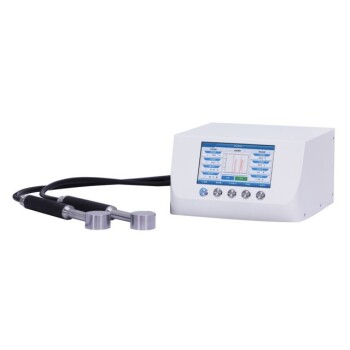
Strict thermal regulation is non-negotiable. A programmable temperature-controlled vacuum oven is necessary because it executes precise, step-wise heating profiles, such as a controlled ramp from 80°C to 120°C. This specific thermal management is required to balance the competing reaction rates of polyurethane and epoxy components, ensuring they cross-link in a chemically synchronized sequence rather than chaotically.
By synchronizing the curing speeds of distinct polymer chains, programmable heating prevents local overheating and thermal stress. This controlled environment is critical for forming a high-quality "forced interpenetrating" network that delivers superior damping performance.
Orchestrating Reaction Kinetics
Balancing Component Reactivity
Polyurethane and epoxy resins do not cure at the exact same speed naturally. The programmable oven allows you to balance the reaction rates of these different components. By holding specific temperatures, you ensure that neither the polyurethane nor the epoxy cures too quickly relative to the other.
Controlling the Reaction Sequence
A successful Interpenetrating Polymer Network (IPN) relies on order. The oven ensures that cross-linking reactions—between isocyanate groups and chain extenders, and epoxy groups and curing agents—proceed in a predetermined sequence. Without this programmed control, the network formation would be unpredictable and mechanically weak.
Mitigating Thermal Defects
Preventing Local Overheating
Polymer curing is often exothermic, meaning it generates heat. Without precise external regulation, this can lead to local overheating within the material. The programmable oven modulates the ambient temperature to counteract potential runaway reactions, keeping the thermal profile uniform throughout the sample.
Reducing Thermal Stress Concentration
Rapid, uncontrolled heating shocks the material. This often results in thermal stress concentration, which creates internal weaknesses or cracks. A step-wise heating profile gradually introduces energy, allowing the material to cure without building up destructive internal forces.
Enabling "Forced Interpenetration"
The ultimate goal of this process is a physical interlocking of polymer chains known as a "forced interpenetrating" network. This structure is what gives the final material its enhanced damping performance. It can only be achieved if the curing environment is strictly controlled to prevent phase separation during the reaction.
Common Pitfalls to Avoid
Ignoring the Ramp Rate
Simply setting a final cure temperature is insufficient. The rate of change (the ramp) is just as critical as the target temperature. Ignoring the step-wise transition (e.g., jumping straight to 120°C) will likely result in a network with inferior mechanical properties.
Overlooking Vacuum Necessity
While temperature is the primary driver of reaction kinetics, the vacuum component is essential for removing entrapped air and volatiles. A programmable oven that lacks vacuum capability risks locking voids into the material structure, compromising the high-quality finish needed for advanced applications.
Making the Right Choice for Your Goal
To maximize the performance of your Polyurethane/Epoxy Resin IPN, align your curing strategy with your specific material requirements.
- If your primary focus is Damping Performance: Prioritize a multi-stage heating profile to ensure the formation of a dense, "forced interpenetrating" network structure.
- If your primary focus is Structural Integrity: Utilize slower ramp rates within the program to minimize thermal stress concentrations and prevent local overheating.
Mastering the thermal history of your polymer is the only way to transform raw chemicals into a high-performance engineering material.
Summary Table:
| Feature | Benefit for IPN Curing |
|---|---|
| Step-Wise Heating | Synchronizes reaction rates and prevents phase separation |
| Programmable Ramp | Reduces thermal stress and prevents local overheating |
| Vacuum Capability | Removes air and volatiles to eliminate structural voids |
| Thermal Regulation | Ensures "forced interpenetration" for superior damping |
| Sequence Control | Orchestrates cross-linking for high mechanical integrity |
Elevate Your Polymer Research with KINTEK
Precise thermal management is the difference between a weak composite and a high-performance forced interpenetrating network. KINTEK specializes in comprehensive laboratory pressing and thermal solutions, offering a range of manual, automatic, and programmable ovens designed for the most demanding battery research and material science applications.
Our advanced systems provide the strict ramp control and vacuum stability needed to optimize damping performance and structural integrity. Ready to perfect your curing process? Contact us today to find the ideal solution for your lab!
References
- Guofeng You, Yanhui Niu. Effect of Disulfide Bond Density on the Properties of Polyurethane/Epoxy Interpenetrating Networks. DOI: 10.3390/ma18071636
This article is also based on technical information from Kintek Solution Knowledge Base .
Related Products
People Also Ask
- How do precision temperature-controlled heating plates function in electrolyte thermal stability storage experiments?
- What is the importance of a precision temperature-controlled heating module? Ensure Aluminum-Cadmium Thermal Stability
- How does heating platen precision affect rubber specimens? Achieve uniform density and reliable testing results.
- How are thin polymer films produced for spectroscopic analysis? Expert Guide to Heat and Low-Pressure Methods
- What accessories and field services can be used to optimize the capabilities of presses? Maximize Your Lab Performance