
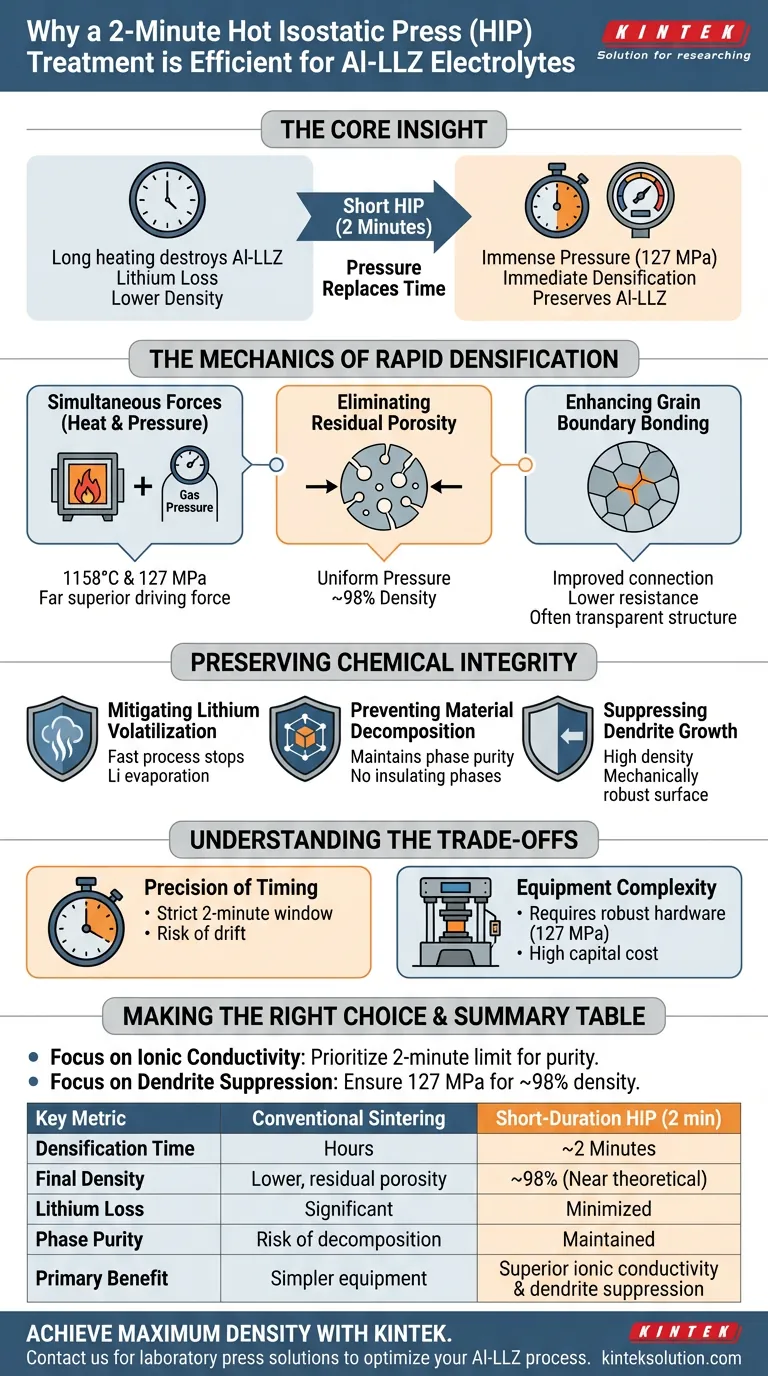
A short-duration Hot Isostatic Press (HIP) treatment serves as an efficient strategy for Al-LLZ electrolytes because it leverages immense pressure to decouple densification from prolonged heating. By applying high isostatic pressure (e.g., 127 MPa) alongside high temperature, the process generates a massive driving force that closes pores and bonds grain boundaries in as little as two minutes. This rapidity is critical because it achieves near-theoretical density while drastically limiting the time the material is exposed to damaging heat, effectively preventing lithium loss and chemical decomposition.
The Core Insight: Standard sintering requires long heating times to achieve density, which often destroys the chemical makeup of Al-LLZ through lithium evaporation. A short HIP treatment uses pressure to force immediate densification, allowing you to achieve a highly dense structure before chemical degradation can occur.
The Mechanics of Rapid Densification
The Role of Simultaneous Forces
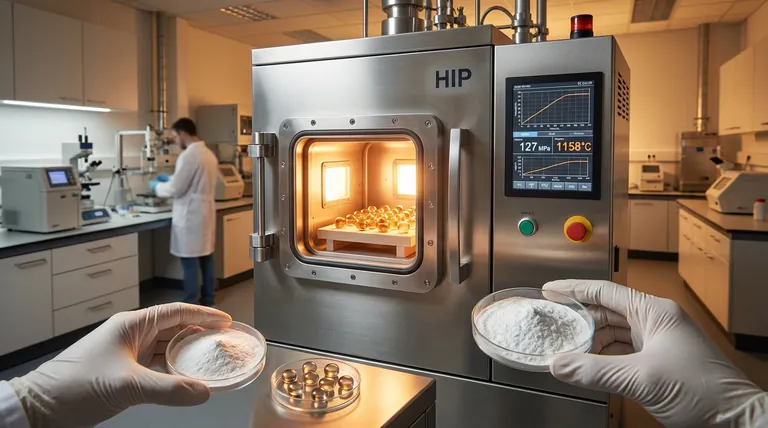
The efficiency of this method stems from the simultaneous application of thermal and mechanical energy. Rather than relying solely on thermal diffusion, the process subjects the material to high temperatures (around 1158°C) and high-pressure gas (around 127 MPa). This combination provides a driving force far superior to conventional sintering methods.
Eliminating Residual Porosity
The primary physical goal of the HIP treatment is the removal of structural defects. The uniform isostatic pressure effectively squeezes out residual porosity that persists after conventional sintering. This action boosts the relative density of the ceramic pellets to approximately 98%.
Enhancing Grain Boundary Bonding
Beyond simple density, the pressure significantly improves the connection between individual grains. Stronger grain boundary bonding is essential for lowering interfacial resistance. The result is a ceramic structure that is often transparent, indicating a lack of light-scattering voids.
Preserving Chemical Integrity
Mitigating Lithium Volatilization
The greatest challenge in processing Al-LLZ is the material's instability at high temperatures. Extended dwell times typically lead to the volatilization (evaporation) of lithium. By limiting the treatment to roughly two minutes, the process finishes before significant lithium loss can compromise the material's stoichiometry.
Preventing Material Decomposition
Prolonged heat exposure can cause Al-LLZ to break down into undesirable secondary phases. These secondary phases act as insulators, severely impeding ionic conductivity. Rapid processing maintains the phase purity required for high-performance electrolytes.
Suppressing Dendrite Growth
The structural integrity gained from this short treatment has direct operational benefits. A highly dense, non-porous surface is mechanically robust enough to suppress the growth of lithium dendrites. This is achieved without sacrificing the ionic conductivity that would be lost during a longer heat treatment.
Understanding the Trade-offs
The Precision of Timing
While efficient, the "short" aspect of this strategy is a strict constraint, not just a suggestion. Extending the process beyond the necessary window reintroduces the risks of volatilization and decomposition. Operators must precisely control the thermal cycle to ensure the dwell time does not drift.
Equipment Complexity
Achieving 127 MPa at 1158°C requires specialized, robust hardware compared to standard furnaces. The efficiency of the process is high, but the capital requirement for the machinery is significant. This method is best reserved for final densification rather than initial forming.
Making the Right Choice for Your Goal
To maximize the utility of short-duration HIP treatments for your Al-LLZ electrolytes, consider your primary performance metrics:
- If your primary focus is Ionic Conductivity: Prioritize the strict two-minute limit to ensure phase purity and prevent the formation of insulating secondary phases.
- If your primary focus is Dendrite Suppression: Ensure the applied pressure reaches the 127 MPa threshold to achieve the ~98% density required for mechanical resistance.
By substituting time with pressure, you resolve the fundamental conflict between physical density and chemical stability.
Summary Table:
| Key Metric | Conventional Sintering | Short-Duration HIP (2 min) |
|---|---|---|
| Densification Time | Hours | ~2 Minutes |
| Final Density | Lower, with residual porosity | ~98% (Near theoretical) |
| Lithium Loss | Significant due to volatilization | Minimized |
| Phase Purity | Risk of decomposition | Maintained |
| Primary Benefit | Simpler equipment | Superior ionic conductivity & dendrite suppression |
Achieve maximum density and ionic conductivity for your solid-state battery materials with KINTEK's precision lab presses.
Our specialized heated lab presses and isostatic presses are engineered to deliver the exacting conditions—like 127 MPa of pressure at 1158°C—required for rapid, effective HIP treatments. This allows researchers like you, working with sensitive materials like Al-LLZ, to eliminate porosity and preserve chemical integrity in minutes, not hours.
Contact us today to discuss how our laboratory press solutions can optimize your process and accelerate your R&D.
Visual Guide
Related Products
- Warm Isostatic Press for Solid State Battery Research Warm Isostatic Press
- Electric Lab Cold Isostatic Press CIP Machine
- Electric Split Lab Cold Isostatic Pressing CIP Machine
- Lab Isostatic Pressing Molds for Isostatic Molding
- Manual Cold Isostatic Pressing CIP Machine Pellet Press
People Also Ask
- Why must composite cathodes be sealed in vacuum lamination bags for WIP? Ensure Battery Stability and Density
- How do sacrificial volume materials (SVM) maintain microchannels in isostatic pressing? Ensure Structural Integrity
- What is the function of elastic molds in warm isostatic pressing? Achieve Uniform Density in Composite Particles
- How does Warm Isostatic Pressing differ from traditional pressing methods? Unlock Uniform Density for Complex Parts
- What are the advantages of using a Warm Isostatic Press (WIP) for batteries? Achieve Superior Interface Contact



















