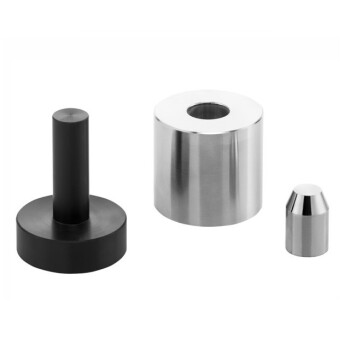
The fundamental challenge in testing all-solid-state batteries is purely mechanical: ensuring the active materials remain in physical contact while they change shape.
A specialized test fixture is required to apply constant external pressure (e.g., 120 MPa) to the battery stack during cycling. Because electrode materials undergo significant volume expansion and contraction as they charge and discharge, rigid solid-state electrolytes cannot flow to fill the resulting gaps. Without this specialized fixture to actively compress the layers, the interface separates, leading to a spike in contact resistance and rapid performance decay.
The Core Insight In liquid batteries, the electrolyte flows to maintain contact; in solid-state batteries, contact must be forced mechanically. A specialized fixture bridges this gap by applying continuous pressure to compensate for volume changes, preventing the delamination that inevitably destroys cycle life.
The Physical Challenge: Volume Expansion
The "Breathing" of Electrode Materials
During the cycling process (charging and discharging), electrode materials do not remain static. They actively expand and contract as lithium ions move in and out of their structure.
The Rigidity of Solid Electrolytes
Unlike liquid electrolytes, which naturally flow to fill voids, solid-state electrolytes are rigid. They lack the fluidity to self-repair or adjust to the changing geometry of the electrodes.
If the electrode shrinks and the electrolyte cannot follow, physical gaps form.
The Role of Constant Pressure
Preventing Interfacial Separation
The primary function of the test fixture is to maintain tight physical contact between the various solid-phase layers—specifically the anode, electrolyte, and cathode.
By applying a constant external load (referenced as high as 120 MPa in some high-performance testing scenarios), the fixture forces these layers together. This prevents the electrode-electrolyte interface from delaminating or cracking when the internal materials shift.
Stabilizing Contact Resistance
When layers separate, contact resistance increases immediately. This impedance prevents the efficient flow of ions.
By mechanically constraining the stack, the fixture ensures stable, low interfacial impedance. This is the only way to ensure the electrochemical data you collect reflects the material's true chemistry, rather than a mechanical failure of the test setup.
Inhibiting Dendrite Growth
Continuous pressure also serves a protective structural role. Tight physical contact helps suppress the formation of voids and inhibits the growth of lithium dendrites, which thrive in loose interfaces.
Understanding the Trade-offs
Constant Pressure vs. Fixed Gap
It is critical to distinguish between a "constant pressure" fixture and a simple clamp (fixed gap).
A simple clamp creates a fixed volume. If the battery expands against it, pressure spikes dangerously; if the battery shrinks, contact is lost completely.
The Necessity of Specialized Mechanisms
A specialized fixture often uses springs, pneumatic pistons, or calibrated bolts to adapt to the battery's breathing. It maintains the target pressure (whether 5 MPa or 120 MPa) regardless of the stack's instantaneous thickness.
Failing to use a fixture that adapts to these changes will result in unreliable data regarding cycle life and capacity utilization.
Making the Right Choice for Your Goal
To ensure your testing yields valid results, select your fixture strategy based on your specific technical objectives:
- If your primary focus is Long-Term Cycle Life: You must use a fixture capable of maintaining constant high pressure to prevent physical delamination, which is the leading cause of premature failure.
- If your primary focus is Material Characterization: Ensure the fixture provides uniform pressure distribution to guarantee that the measured impedance is intrinsic to the material, not an artifact of poor contact.
- If your primary focus is Failure Analysis: utilize a fixture equipped with real-time force sensors to correlate internal stress evolution with specific electrochemical failure points (like short circuits or capacity dives).
The test fixture is not just a holder; it is an active component of the solid-state battery system that compensates for the lack of liquid mechanics.
Summary Table:
| Feature | Liquid Electrolyte Batteries | All-Solid-State Batteries (ASSBs) |
|---|---|---|
| Electrolyte State | Fluid; flows to fill gaps | Rigid; cannot adapt to volume changes |
| Interface Contact | Naturally maintained by liquid | Must be mechanically forced |
| Fixture Role | Simple containment/support | Active pressure application (up to 120 MPa) |
| Volume Change | Minimal impact on contact | Leads to delamination without constant load |
| Primary Goal | Leak prevention | Maintaining low interfacial impedance |
Maximize Your Battery Research Precision with KINTEK
As a leader in comprehensive laboratory pressing solutions, KINTEK understands that the success of your all-solid-state battery research depends on mechanical stability. Our specialized test fixtures and presses—including manual, automatic, and glovebox-compatible models—are engineered to maintain the precise constant pressure required to prevent delamination and inhibit dendrite growth.
Whether you need standard cold isostatic presses or advanced heated systems for battery stack cycling, KINTEK provides the tools to ensure your data reflects true material performance. Contact KINTEK today to find the perfect pressing solution for your lab!
Related Products
- Warm Isostatic Press for Solid State Battery Research Warm Isostatic Press
- Lab Infrared Press Mold for Laboratory Applications
- Lab Cylindrical Press Mold for Laboratory Use
- Carbide Lab Press Mold for Laboratory Sample Preparation
- Lab Button Battery Tablet Press Sealing Mold
People Also Ask
- Why must composite cathodes be sealed in vacuum lamination bags for WIP? Ensure Battery Stability and Density
- What is the function of elastic molds in warm isostatic pressing? Achieve Uniform Density in Composite Particles
- How do sacrificial volume materials (SVM) maintain microchannels in isostatic pressing? Ensure Structural Integrity
- What is the mechanism of a Warm Isostatic Press (WIP) on cheese? Master Cold Pasteurization for Superior Safety
- What is the function of hydraulic pressure in warm isostatic pressing? Achieve Uniform Material Density