
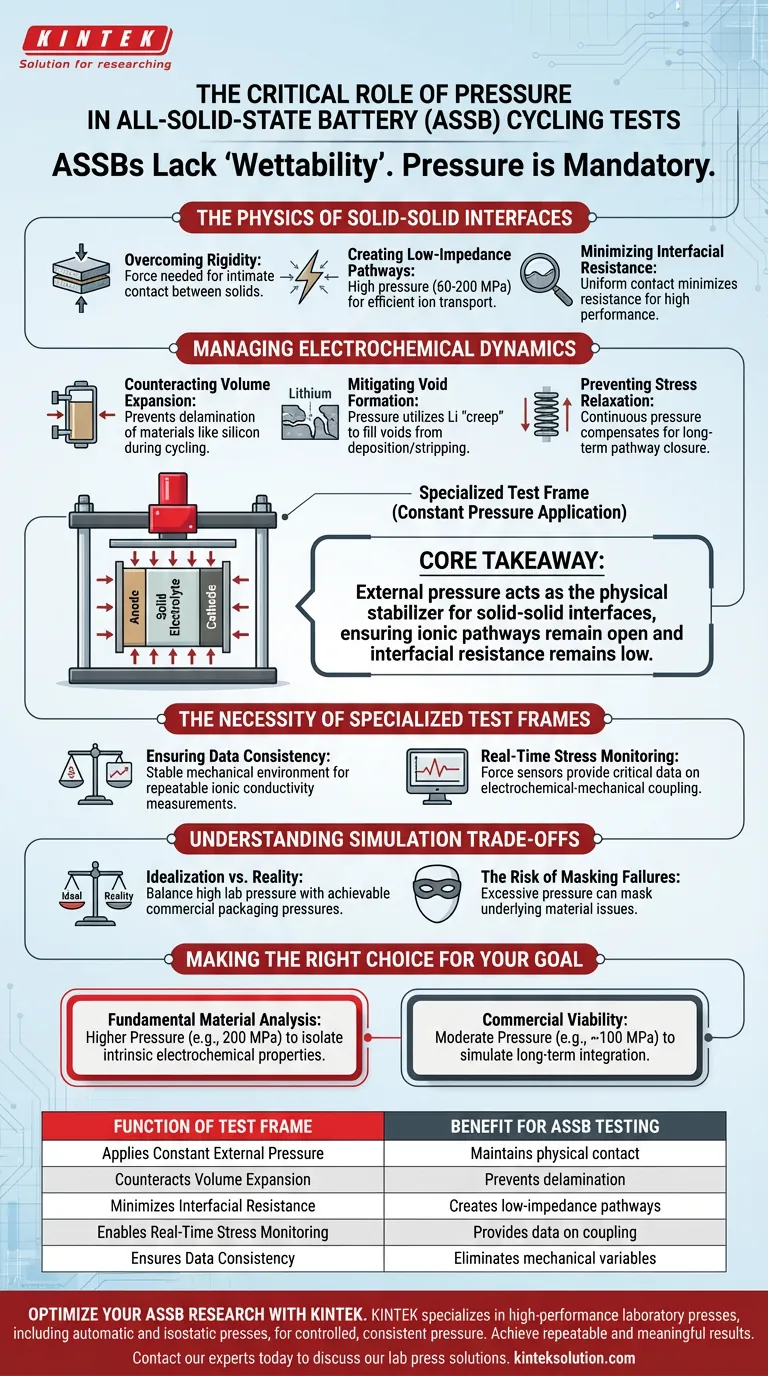
All-solid-state batteries (ASSBs) lack the inherent "wettability" of liquid electrolytes. Because the internal components are rigid solids, a specialized test frame applying constant external pressure is mandatory to maintain physical contact between layers. Without this mechanical force, the interfaces separate during operation, leading to immediate performance failure.
Core Takeaway In the absence of a liquid medium to bridge gaps, external pressure acts as the necessary physical stabilizer for solid-solid interfaces. It counteracts the material volume expansion and contraction inherent to cycling, ensuring that ionic pathways remain open and interfacial resistance remains low.
The Physics of Solid-Solid Interfaces
Overcoming Material Rigidity
Unlike liquid batteries where the electrolyte flows into porous electrodes, solid-state batteries rely on rigid solid-solid interfaces. These materials do not naturally fuse; they require force to establish intimate contact.
Creating Low-Impedance Pathways
Applying high pressure (often ranging from 60 MPa to 200 MPa) creates a low-impedance interface. This physical compression is a fundamental prerequisite for efficient ion transport between the electrode and the electrolyte.
Minimizing Interfacial Resistance
Without sustained pressure, gaps exist between the active material and the electrolyte. A specialized frame ensures uniform contact, which is critical for minimizing interfacial resistance and achieving high rate performance.
Managing Electrochemical Dynamics
Counteracting Volume Expansion
Active materials, particularly silicon anodes, undergo significant volumetric changes during charging and discharging. An external stack pressure is required to counteract this expansion and prevent the material layers from delaminating or separating.
Mitigating Void Formation
During the charge cycle, lithium deposition and stripping can create voids at the interface, leading to contact loss. Pressure utilizes the natural "creep" properties of lithium metal to physically press the material into these voids, maintaining connection.
Preventing Stress Relaxation
Interfacial stress relaxation can occur during long-term cycling, causing ionic pathways to close. Continuous pressure compensates for this relaxation, keeping the pathways unobstructed for stable, long-cycle-life performance (e.g., exceeding 400 cycles).
The Necessity of Specialized Test Frames
Ensuring Data Consistency
To obtain repeatable and accurate measurements of ionic conductivity, the mechanical environment must be stable. A specialized frame eliminates variables caused by fluctuating contact, ensuring data reflects chemical performance rather than mechanical failure.
Real-Time Stress Monitoring
Advanced test fixtures are often equipped with force sensors. This allows researchers to monitor internal stress evolution in real-time, providing critical data on failure mechanisms related to electrochemical-mechanical coupling.
Understanding the Simulation Trade-offs
Idealization vs. Reality
While high pressure (e.g., 200 MPa) optimizes conductivity in a lab setting, it may not perfectly reflect the constraints of a commercial battery package. Researchers must balance "ideal" contact pressure with the realistic pressures achievable in final product packaging.
The Risk of Masking Failures
Applying excessive pressure can sometimes mask underlying material issues by artificially forcing contact. It is essential to choose a pressure that stabilizes the interface without rendering the test conditions irrelevant to real-world applications.
Making the Right Choice for Your Goal
Selecting the correct pressure parameters for your test frame depends on your specific research stage.
- If your primary focus is Fundamental Material Analysis: Apply higher pressures (e.g., 200 MPa) to eliminate contact resistance variables and isolate the intrinsic electrochemical properties of the materials.
- If your primary focus is Commercial Viability: Apply moderate pressures (e.g., roughly 100 MPa or lower) to simulate the operational conditions of an actual battery package and test for long-term integration stability.
Ultimately, the test frame is not just a holder; it is an active component that substitutes for the lack of liquid cohesion in solid-state chemistry.
Summary Table:
| Function of Test Frame | Benefit for ASSB Testing |
|---|---|
| Applies Constant External Pressure | Maintains physical contact between rigid solid layers |
| Counteracts Volume Expansion | Prevents delamination during charge/discharge cycles |
| Minimizes Interfacial Resistance | Creates low-impedance pathways for efficient ion transport |
| Enables Real-Time Stress Monitoring | Provides data on electrochemical-mechanical coupling |
| Ensures Data Consistency | Eliminates variables from fluctuating mechanical contact |
Optimize Your All-Solid-State Battery Research with KINTEK
Accurate cycling tests are fundamental to developing next-generation batteries. The precise mechanical pressure required to simulate real-world conditions and ensure data integrity is exactly what our specialized lab press machines are designed to deliver.
KINTEK specializes in high-performance laboratory presses, including automatic lab presses and isostatic presses, engineered to meet the demanding requirements of battery research and development. Our equipment provides the controlled, consistent pressure essential for reliable testing of solid-solid interfaces.
Let us help you achieve repeatable and meaningful results.
Contact our experts today to discuss how our lab press solutions can enhance your ASSB testing protocol and accelerate your R&D timeline.
Visual Guide
Related Products
- Warm Isostatic Press for Solid State Battery Research Warm Isostatic Press
- Lab Infrared Press Mold for Laboratory Applications
- Laboratory Hydraulic Press Lab Pellet Press Button Battery Press
- Button Battery Sealing Press Machine for Lab
- Lab Button Battery Tablet Press Sealing Mold
People Also Ask
- Why must composite cathodes be sealed in vacuum lamination bags for WIP? Ensure Battery Stability and Density
- What is the function of elastic molds in warm isostatic pressing? Achieve Uniform Density in Composite Particles
- How do sacrificial volume materials (SVM) maintain microchannels in isostatic pressing? Ensure Structural Integrity
- What is the function of hydraulic pressure in warm isostatic pressing? Achieve Uniform Material Density
- What is the mechanism of a Warm Isostatic Press (WIP) on cheese? Master Cold Pasteurization for Superior Safety





