
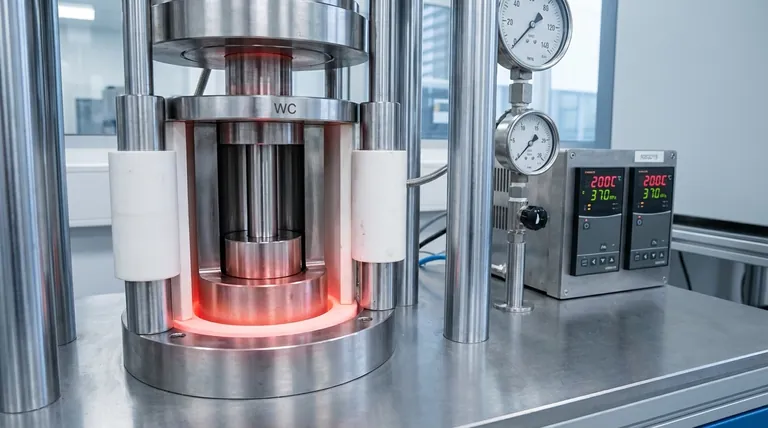
Tungsten carbide (WC) is strictly required for hot-pressing all-solid-state battery stacks because standard die materials cannot maintain structural integrity under the extreme combination of heat and pressure needed for densification.
While standard stainless steel dies may function at lower pressures, they are prone to deformation or failure when subjected to the requisite processing conditions of 370 MPa at 200°C. WC provides the exceptional hardness and compressive strength necessary to transmit this force effectively, ensuring the battery stack achieves the high density required for performance.
The Core Insight Producing a viable solid-state battery is a densification challenge. You are not just compressing powder; you are forcing the electrolyte to flow plastically to eliminate voids. This requires tooling (WC) that is significantly harder and more rigid than the materials being compressed, ensuring the energy goes into densifying the battery, not deforming the tool.
The Physics of Densification
To understand the need for Tungsten Carbide, you must first understand the physical transformation required inside the battery stack.
Achieving Plastic Flow
Solid-state electrolytes, particularly sulfide glasses, must be processed above their glass transition temperature ($T_g$).
At elevated temperatures (e.g., 200°C), the material softens. High mechanical pressure is then applied to induce plastic flow, forcing the material to rearrange and fill microscopic gaps.
Eliminating Porosity
The goal of hot-pressing is to reduce the stack's porosity from a loose 15-30% to a dense state of below 10%.
This reduction is critical for volumetric energy density. Without the extreme pressure that WC facilitates, voids remain, impeding ion movement and reducing battery capacity.
Why Standard Materials Fail
The specific operational parameters of hot-pressing rule out softer tooling materials.
Withstanding Extreme Pressure
The fabrication process often requires pressures up to 370 MPa.
At this magnitude, common die materials like standard stainless steel can reach their yield point. If the die yields or expands outward, the pressure applied to the battery powder drops, resulting in an inconsistent, low-density pellet.
Maintaining Dimensional Accuracy
WC ensures mechanical stability and dimensional accuracy.
Because WC does not deform under these loads, it guarantees that the force applied by the hydraulic press is transmitted uniformly to the powder. This results in a structurally intact electrode stack with precise geometry.
The Component Ecosystem
While WC is the hero of the high-pressure phase, it functions within a specific assembly of parts.
The Role of Stainless Steel
Stainless steel plungers are often used in conjunction with the die to uniformly transmit the load.
They are generally capable of handling the transmission of high pressures (e.g., 265 MPa) onto the stacked powders, acting as the pistons within the system.
The Role of Ceramics
It is critical to note that while WC handles pressure, it is electrically conductive.
A ceramic sleeve is often integrated into the die set. Its hardness helps contain the powder, but its primary function is electrical insulation. It prevents short circuits between the top and bottom electrodes during the high-pressure assembly.
Understanding the Trade-offs
Using Tungsten Carbide is necessary for performance, but it introduces specific handling constraints.
Brittle Failure Modes
While WC has immense compressive strength, it is brittle compared to steel.
Misalignment in the hydraulic press or uneven loading can cause WC dies to crack or shatter. Unlike steel, which yields (bends) before failure, WC fails catastrophically.
Thermal Expansion Mismatch
Operating at 200°C introduces thermal expansion.
The clearances between the WC die, ceramic sleeves, and steel plungers must be calculated precisely. If components expand at different rates, the die can seize, leading to fracture or inability to eject the sample.
Making the Right Choice for Your Goal
Selecting the correct die material depends entirely on the stage of battery development you are executing.
- If your primary focus is fabrication (Hot-Pressing): You must use Tungsten Carbide to safely achieve the 370 MPa / 200°C conditions required to reduce porosity below 10%.
- If your primary focus is electrochemical testing (Cycling): You may use lighter-duty rigs that apply lower continuous pressures (15–50 MPa) to maintain interfacial contact, as the heavy densification work is already done.
Ultimately, Tungsten Carbide is not just a tooling preference; it is a prerequisite for achieving the material density that makes solid-state batteries viable.
Summary Table:
| Key Requirement | Standard Die Material Issue | Tungsten Carbide (WC) Solution |
|---|---|---|
| Pressure Resistance | Deforms or fails at 370 MPa | Exceptional hardness and compressive strength |
| Dimensional Stability | Loses accuracy under load | Maintains precise geometry for uniform densification |
| Process Temperature | May yield or expand at 200°C | Withstands heat without deformation |
| Primary Goal | Inconsistent, low-density pellets | Achieves porosity below 10% for viable batteries |
Achieve the critical densification for your all-solid-state battery research with the right tooling. KINTEK specializes in robust lab press solutions, including automatic and heated lab presses designed for extreme conditions. Our expertise ensures your lab can reliably reach 370 MPa at 200°C with precision. Contact us today (#ContactForm) to discuss how our presses and dies can enhance your battery development process.
Visual Guide

Related Products
- XRF KBR Steel Ring Lab Powder Pellet Pressing Mold for FTIR
- XRF KBR Plastic Ring Lab Powder Pellet Pressing Mold for FTIR
- Lab Ring Press Mold for Sample Preparation
People Also Ask
- What considerations are important regarding the die size of an XRF pellet press? Optimize for Your XRF Spectrometer and Sample
- Why are pellets used in XRF analysis, and what is their limitation? Boost Accuracy and Speed in Your Lab
- What is the general process for preparing a sample pellet for XRF? Master Consistency for Accurate Analysis
- What are the differences between manual and automatic XRF pellet presses? Choose the Right Press for Your Lab's Needs
- What are the different types of XRF pellet preparation methods available? Manual, Hydraulic, and Automated Presses Explained


