
Pre-forming NZSSP electrolyte powder with a uniaxial hydraulic press at 200 MPa is primarily done to transform loose powder into a cohesive "green pellet" with high initial density.
This specific pressure threshold is required to mechanically lock the particles together, eliminating air voids and maximizing surface contact. Without this pre-compaction step, the material would lack the necessary mechanical strength to be handled and would fail to densify effectively during the subsequent high-temperature sintering process.
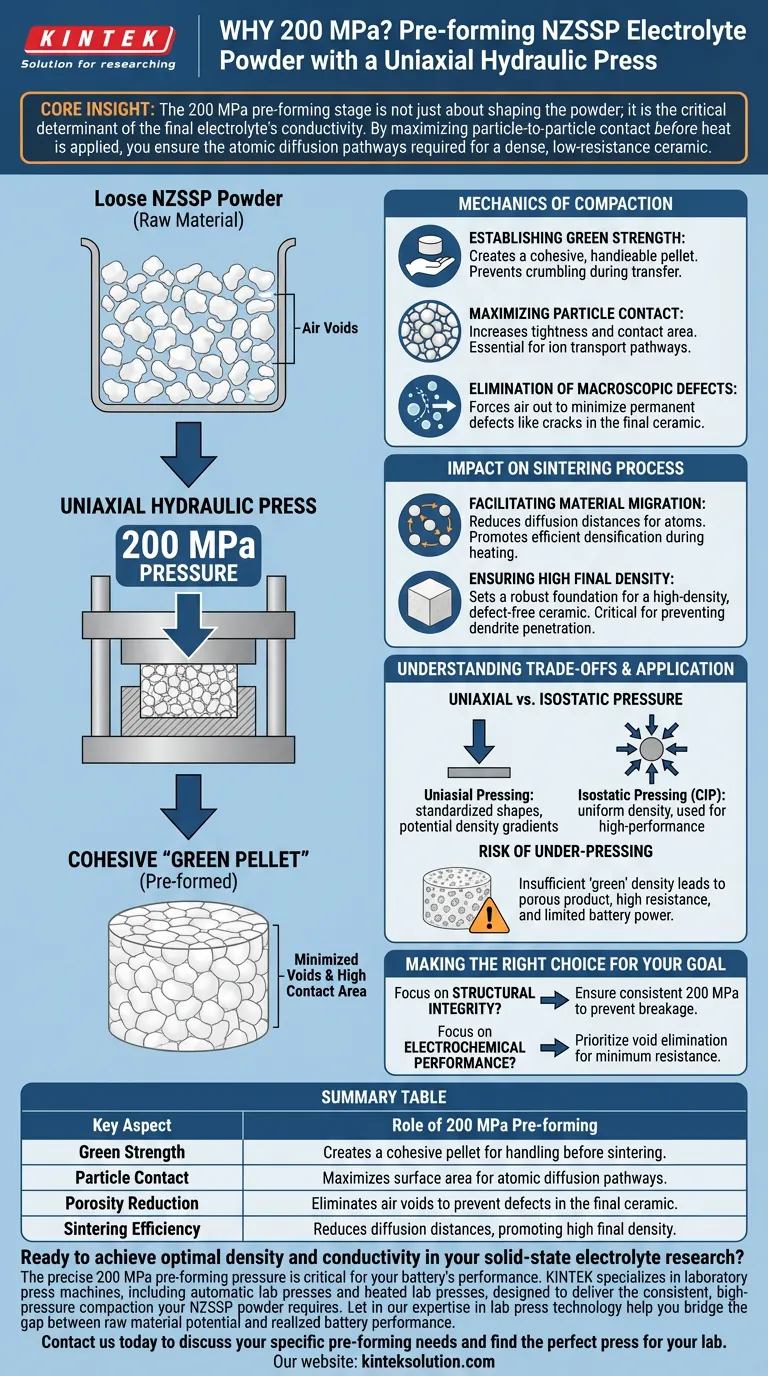
Core Insight: The 200 MPa pre-forming stage is not just about shaping the powder; it is the critical determinant of the final electrolyte’s conductivity. By maximizing particle-to-particle contact before heat is applied, you ensure the atomic diffusion pathways required for a dense, low-resistance ceramic.
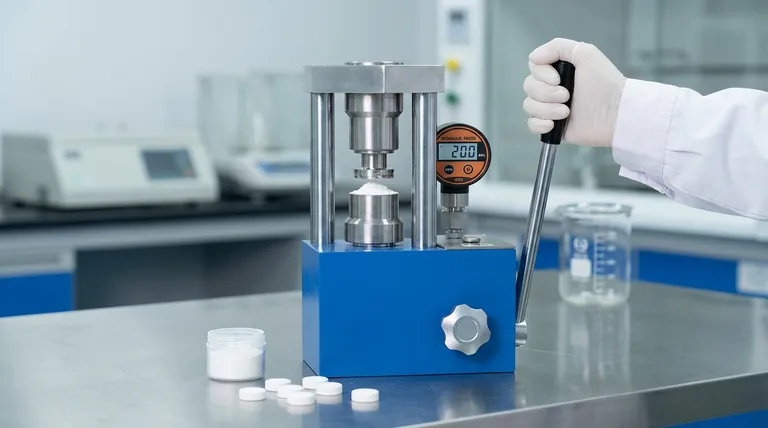
The Mechanics of Compaction
Establishing Green Strength
The immediate goal of applying 200 MPa is to create a "green body" or pellet.
Loose NZSSP powder has no structural integrity. The hydraulic press forces particles to interlock, providing sufficient mechanical strength to allow the pellet to be ejected from the die and handled without crumbling. This structural stability is a prerequisite for any further processing.
Maximizing Particle Contact
Electrical performance starts with physical proximity.
The high pressure significantly increases the tightness and contact area between individual powder particles. For solid-state electrolytes, ion transport relies on continuous pathways; loose connections result in high resistance.
Elimination of Macroscopic Defects
Applying 200 MPa forces air out of the powder matrix.
This reduction in porosity minimizes voids that could become permanent defects. If these voids remain during sintering, they create cracks or weak points that drastically reduce the mechanical and electrochemical performance of the final ceramic.
Impact on the Sintering Process
Facilitating Material Migration
Sintering drives densification through atomic diffusion, which only happens where particles touch.
By pre-compressing the NZSSP powder, you reduce the distance atoms must travel to bond. This effectively promotes material migration during the heating stage, allowing the ceramic to reach full density more efficiently.
Ensuring High Final Density
The initial "green density" sets the ceiling for the final sintered density.
A pellet pressed at 200 MPa provides a robust foundation. This leads to a final electrolyte ceramic that is high-density and free of macroscopic defects, which is essential for preventing lithium dendrite penetration in an operating battery.
Understanding the Trade-offs
Uniaxial vs. Isostatic Pressure
While uniaxial pressing is excellent for creating standardized pellet shapes, it applies force in only one direction.
This can sometimes lead to density gradients, where the edges of the pellet are denser than the center. For extremely high-performance requirements, uniaxial pressing is sometimes used merely as a preliminary step before Cold Isostatic Pressing (CIP) to ensure perfect uniformity.
The Risk of Under-Pressing
If the pressure is significantly lower than 200 MPa, the "green" density will be insufficient.
This leads to a porous final product. In a solid-state battery, porosity equates to high grain boundary resistance, choking off ion flow and severely limiting the battery's power output.
Making the Right Choice for Your Goal
How to Apply This to Your Project
- If your primary focus is Structural Integrity: Ensure your press consistently delivers 200 MPa to prevent pellet breakage during transfer to the sintering furnace.
- If your primary focus is Electrochemical Performance: Prioritize the elimination of voids during this stage to minimize resistance and maximize ionic conductivity in the final cell.
The 200 MPa pre-forming step is the bridge between raw material potential and realized battery performance.
Summary Table:
| Key Aspect | Role of 200 MPa Pre-forming |
|---|---|
| Green Strength | Creates a cohesive pellet for handling before sintering. |
| Particle Contact | Maximizes surface area for atomic diffusion pathways. |
| Porosity Reduction | Eliminates air voids to prevent defects in the final ceramic. |
| Sintering Efficiency | Reduces diffusion distances, promoting high final density. |
Ready to achieve optimal density and conductivity in your solid-state electrolyte research?
The precise 200 MPa pre-forming pressure is critical for your battery's performance. KINTEK specializes in laboratory press machines, including automatic lab presses and heated lab presses, designed to deliver the consistent, high-pressure compaction your NZSSP powder requires.
Let our expertise in lab press technology help you bridge the gap between raw material potential and realized battery performance.
Contact us today to discuss your specific pre-forming needs and find the perfect press for your lab.
Visual Guide
Related Products
- Automatic Laboratory Hydraulic Press for XRF and KBR Pellet Pressing
- Laboratory Hydraulic Pellet Press for XRF KBR FTIR Lab Press
- Laboratory Hydraulic Split Electric Lab Pellet Press
- Manual Laboratory Hydraulic Pellet Press Lab Hydraulic Press
- Automatic Laboratory Hydraulic Press Lab Pellet Press Machine
People Also Ask
- Why is pressing powder into a pellet critical before sintering? Ensure Dense, Conductive Solid-State Electrolytes
- What is the role of a laboratory pressure machine and KBr in FTIR? Master Sample Preparation for Flame Retardants
- What are the advantages of using a laboratory automatic hydraulic press for HEA green compact forming?
- What are the advantages of using a lab automatic hydraulic press for HEA green body molding? Ensure Material Integrity
- What are the technical advantages of an automatic laboratory hydraulic press for biomimetic surfaces?



















