
Achieving high density via a lab press is the fundamental enabler of ionic conductivity in all-solid-state batteries (ASSBs). Unlike liquid electrolytes that naturally wet surfaces and fill gaps, solid electrolytes require mechanical force to establish connectivity. The lab press eliminates microscopic voids between particles, creating the continuous physical pathways necessary for lithium ions to move from the anode to the cathode.
In a solid-state system, ions cannot travel through air or empty space. Compressing materials to high density transforms a loose network of particles into a cohesive solid block, drastically reducing interfacial resistance and unlocking the battery's ability to store and release energy.
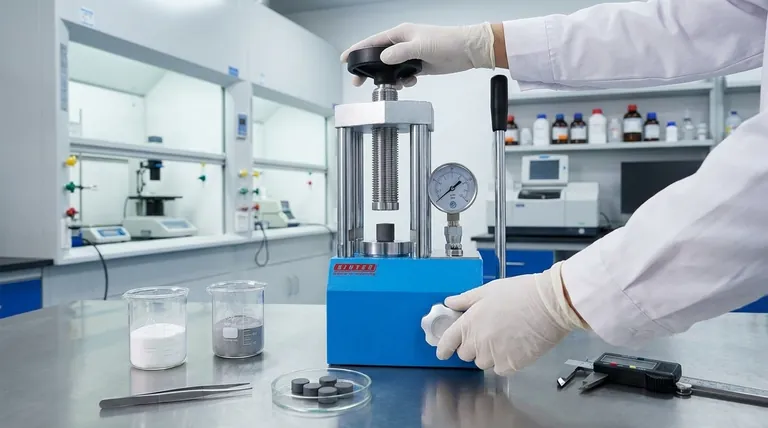
The Physics of Solid-State Ion Transport
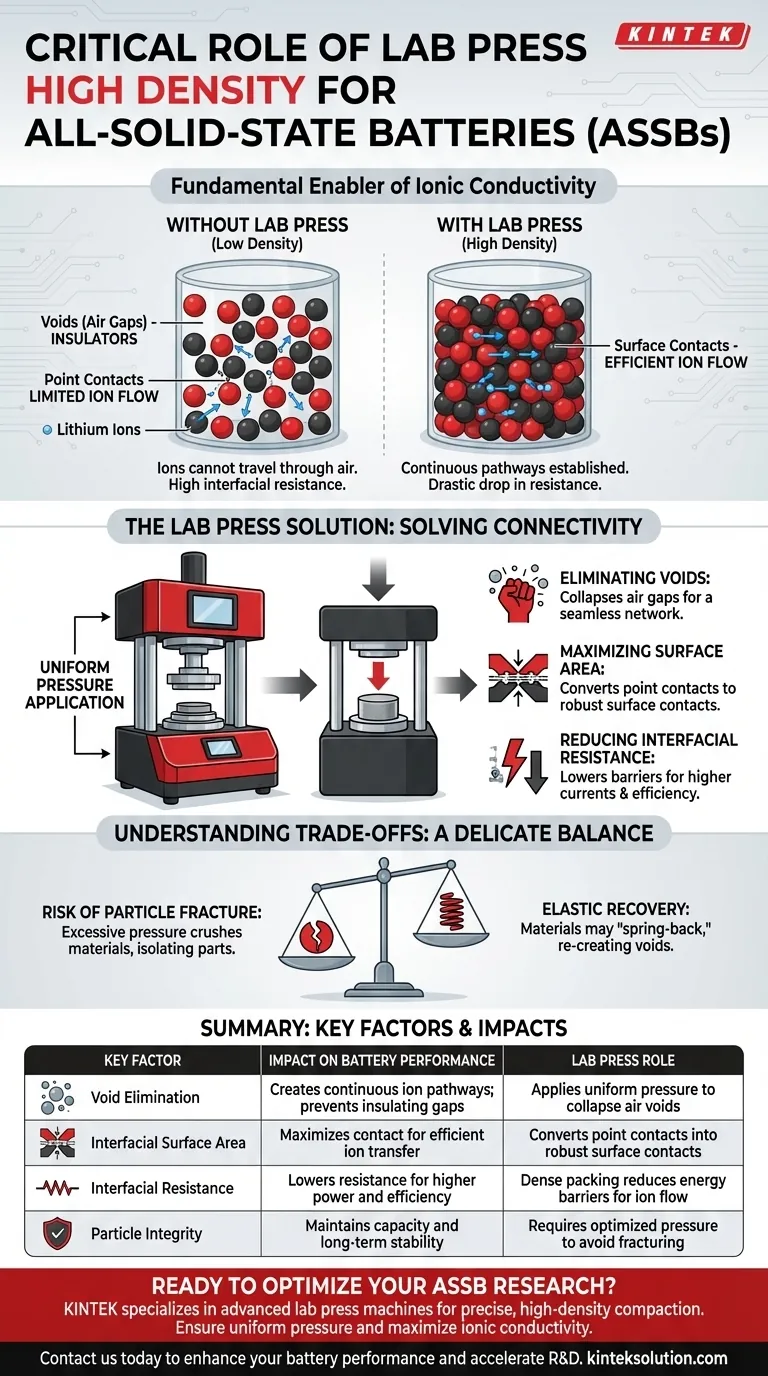
The Challenge of "Point Contact"
In traditional batteries, liquid electrolytes flow into every crevice, ensuring total contact with the active materials. Solid-state batteries lack this fluidity.
Without compression, solid electrolyte particles only touch the active material particles at tiny, singular points. This limited contact area creates a bottleneck that severely restricts the flow of ions.
The Problem of Voids
When solid powders are loosely packed, significant volume is taken up by air voids. These voids act as insulators.
Lithium ions cannot traverse these gaps. If a battery has low density, it is essentially a landscape of broken bridges, preventing the current from flowing efficiently.
How the Lab Press Solves the Connectivity Issue
Eliminating Voids for a Seamless Network
The primary function of the lab press is to apply significant, uniform pressure to the battery pellet or stack.
This pressure physically collapses the voids between particles. By forcing the materials together, the press ensures a dense, seamless network where particles are packed tightly against one another.
Maximizing Interfacial Surface Area
High-density compaction converts weak "point contacts" into robust "surface contacts."
This maximizes the surface area available for ion transfer. The more surface area available for contact between the electrolyte and the electrode, the easier it is for ions to migrate.
Reducing Interfacial Resistance
The direct result of eliminating voids and maximizing contact is a massive drop in interfacial resistance.
High resistance generates heat and impedes power delivery. By densifying the cell, the lab press lowers this resistance barrier, allowing the battery to operate at higher currents and improved efficiency.
Understanding the Trade-offs
The Risk of Particle Fracture
While high density is critical, excessive pressure can be detrimental.
If the pressure applied by the lab press is too high, it may crush or fracture the active material particles. This damage can isolate parts of the material, ironically reducing the capacity of the battery despite the high density.
Elastic Recovery and Contact Loss
Materials often exhibit "spring-back" or elastic recovery after the pressure is released.
If the particles separate slightly after the press is removed, voids may re-emerge. This is why optimizing the pressing pressure and hold time is a delicate balance between achieving density and maintaining structural integrity.
Making the Right Choice for Your Goal
To optimize your solid-state battery fabrication, consider your specific performance objectives when determining pressure parameters.
- If your primary focus is Maximizing Ionic Conductivity: Prioritize higher pressure settings to eliminate all possible voids, ensuring the lowest possible interfacial resistance.
- If your primary focus is Long-Term Cycle Stability: Use moderate pressure to avoid fracturing particles, ensuring the physical structure of the active material remains intact over repeated charges.
Final thought: High density is not just a manufacturing metric; it is the physical bridge that allows a solid-state battery to function as a cohesive electrochemical system.
Summary Table:
| Key Factor | Impact on Battery Performance | Lab Press Role |
|---|---|---|
| Void Elimination | Creates continuous ion pathways; prevents insulating gaps. | Applies uniform pressure to collapse air voids between particles. |
| Interfacial Surface Area | Maximizes contact for efficient ion transfer. | Converts point contacts into robust surface contacts. |
| Interfacial Resistance | Lowers resistance for higher power and efficiency. | Dense packing reduces energy barriers for ion flow. |
| Particle Integrity | Maintains capacity and long-term stability. | Requires optimized pressure to avoid fracturing active materials. |
Ready to optimize your all-solid-state battery research with precise, high-density compaction?
KINTEK specializes in advanced lab press machines—including automatic, isostatic, and heated lab presses—designed to meet the exacting demands of solid-state battery development. Our equipment ensures uniform pressure application, critical for eliminating voids and maximizing ionic conductivity in your ASSB pellets.
Contact us today at #ContactForm to discuss how our lab press solutions can enhance your battery performance and accelerate your R&D.
Visual Guide
Related Products
- Warm Isostatic Press for Solid State Battery Research Warm Isostatic Press
- Laboratory Hydraulic Press Lab Pellet Press Button Battery Press
- Lab Cylindrical Press Mold for Laboratory Use
- Automatic Laboratory Hydraulic Press for XRF and KBR Pellet Pressing
- Laboratory Hydraulic Press 2T Lab Pellet Press for KBR FTIR
People Also Ask
- Why must composite cathodes be sealed in vacuum lamination bags for WIP? Ensure Battery Stability and Density
- How do sacrificial volume materials (SVM) maintain microchannels in isostatic pressing? Ensure Structural Integrity
- What is the function of elastic molds in warm isostatic pressing? Achieve Uniform Density in Composite Particles
- What is the significance of temperature control in Warm Isostatic Pressing? Unlock Uniform Densification and Process Stability
- What is the role of the flexible material in warm isostatic pressing? Key to Uniform Density & Precision



















