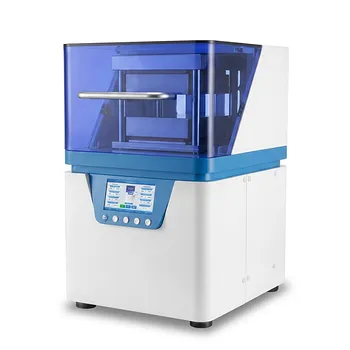
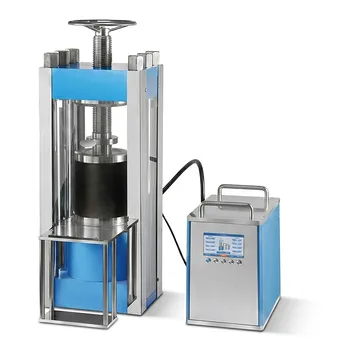
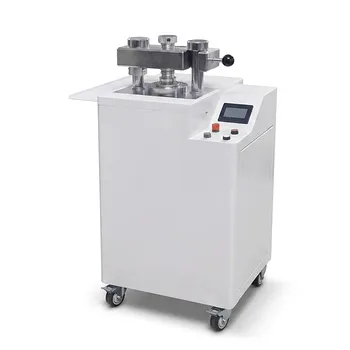
The primary reason an automatic heated laboratory press is superior for manufacturing PEEK and carbon nanotube laminates is its ability to enforce strict, programmable thermal and mechanical cycles.
Unlike manual systems, automatic presses can maintain cooling speeds at less than 3 °C per minute, which is critical for regulating the crystallization of semi-crystalline PEEK. This precision prevents the accumulation of internal stresses and ensures consistent interfacial bonding between the polymer matrix and the carbon nanotubes, significantly enhancing the laminate's toughness.
Core Takeaway: Automatic laboratory presses provide the precise, repeatable control over cooling rates and pressure programs necessary to manage PEEK crystallization and carbon nanotube distribution, effectively eliminating the human errors that compromise material performance and research data.
Managing Thermal Dynamics and Crystallization
The Criticality of Regulated Cooling
For semi-crystalline thermoplastics like PEEK, the transition from melt to solid dictates the final material properties. An automatic press allows for precise execution of specific cooling rates, such as the vital threshold of less than 3 °C per minute.
Preventing Internal Stress and Delamination
Rapid or uneven cooling, common in manual operations, leads to the accumulation of internal stresses within the laminate. By strictly controlling the temperature descent, automatic systems ensure a uniform crystalline structure that enhances delamination resistance and overall toughness.
Optimizing Interfacial Bonding
High-temperature processing (often reaching 380 °C) requires simultaneous, steady pressure to eliminate internal air bubbles. This ensures a strong interfacial bond between the PEEK polymer and the carbon nanotubes, which is essential for the mechanical integrity of the composite.
Pressure Precision and Structural Integrity
Eliminating Manual Pressure Fluctuations
Manual presses are prone to human-induced pressure spikes and inconsistent dwell times. Automatic systems provide smooth pressurization and depressurization, which prevents the formation of microscopic cracks and internal density gradients.
Consistency in Compaction Density
To study the quantitative relationship between carbon nanotube content and electrical conductivity, the compaction density must remain identical across batches. Automatic presses utilize preset programs to ensure that every sample is subjected to the exact same force for the exact same duration.
Improving Yield Rates for Brittle Materials
Advanced functional materials can be highly sensitive to the rate at which pressure is applied. The programmable pressure boosting of an automatic press significantly improves the yield rate by protecting the "green body" of the material from structural failure during the molding process.
Research Reliability and Data Integrity
Removing Operator Variability
Experimental deviations often arise from variations in pressing speed or manual force between different operators. Automatic control systems provide repeatable pressure output, ensuring that the resulting data reflects the material's intrinsic properties rather than operator technique.
Monitoring and Traceability
Many modern automatic presses feature integrated monitoring and touch-screen displays for real-time tracking of the pressing cycle. This creates a documented, repeatable process that is essential for rigorous scientific research and industrial quality control.
Understanding the Trade-offs
High Initial Investment and Complexity
The most significant drawback of an automatic heated press is the higher capital cost compared to manual alternatives. These machines require a larger upfront budget and may involve a steeper learning curve for programming the control systems.
Maintenance and Calibration Requirements
Because these systems rely on sensitive sensors and automated hydraulics, they require regular calibration and specialized maintenance. A failure in the electronic control system can halt production entirely, whereas a manual press is often more robust and easier to repair in basic facilities.
How to Apply This to Your Project
Recommendations for Material Processing
- If your primary focus is PEEK crystallization control: Prioritize a press with programmable cooling rates to ensure maximum toughness and delamination resistance.
- If your primary focus is Carbon Nanotube conductivity research: Choose an automatic press to maintain consistent compaction density across all experimental batches.
- If your primary focus is high-volume sample production: Utilize an automatic system with preset dwell times to eliminate human error and maximize batch-to-batch repeatability.
Selecting an automatic heated press transforms material processing from a variable-heavy manual task into a precise, repeatable scientific procedure.
Summary Table:
| Feature | Manual Laboratory Press | Automatic Heated Press |
|---|---|---|
| Cooling Control | Rapid/Uneven (Manual) | Programmable (e.g., < 3°C/min) |
| Pressure Consistency | Prone to spikes/fluctuations | Smooth, repeatable cycles |
| PEEK Crystallization | Difficult to regulate | Precisely managed for toughness |
| Data Integrity | High operator variability | High repeatability & traceability |
| Ideal Application | Simple prototyping/Basic molding | Advanced composites & PEEK research |
Optimize Your Advanced Material Synthesis with KINTEK
Don't let manual inconsistencies compromise your research data. KINTEK specializes in comprehensive laboratory pressing solutions designed to meet the rigorous demands of material science. From manual and automatic heated models to multifunctional, glovebox-compatible, and isostatic presses (CIP/WIP), our equipment provides the precise thermal and mechanical control essential for PEEK crystallization and battery research.
Ready to enhance your lab's precision? Contact our technical experts today to find the perfect pressing solution for your specific application.
References
- Ana M. Díez‐Pascual, Marián A. Gómez‐Fatou. Influence of carbon nanotubes on the thermal, electrical and mechanical properties of poly(ether ether ketone)/glass fiber laminates. DOI: 10.1016/j.carbon.2011.03.011
This article is also based on technical information from Kintek Solution Knowledge Base .
Related Products
- Automatic Heated Hydraulic Lab Press with Programmable Touch Screen Controls and Precision Temperature Regulation
- Automatic Heated Hydraulic Lab Press 120x120mm Plate Fully Automated Material Research Press
- Automatic Heated Hydraulic Press Machine with Hot Plates for Laboratory
- Automatic Heated Hydraulic Lab Press Machine 200x200 Plate Size for Battery Research and Materials Science
- Automatic Large Format Laboratory Heated Hydraulic Press 400x400mm Plate Capacity
People Also Ask
- Why is a laboratory heated hydraulic press required? Ensure Precise Vulcanization for NBR/EPDM Nanocomposites
- What are the industrial applications of heated hydraulic presses? Master Heat & Force for Precision Manufacturing
- What is the necessity of a laboratory hydraulic press with heating functions? Master Rubber Vulcanization Precision
- How does a heated laboratory hydraulic press contribute to the formation of dense mycelium-based materials? Expert Tips
- Why is a heated laboratory hydraulic press necessary for producing controlled-release fertilizer tablets? Gain Precision.