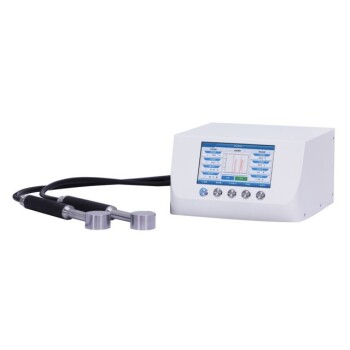
High-precision temperature regulation is the fundamental reason an electric heating system equipped with a PID (Proportional-Integral-Derivative) controller is required for black liquor pyrolysis. This system provides critical real-time monitoring and feedback adjustments to maintain the reactor temperature within a specific, optimal range of 300 to 450 °C.
Core Takeaway: The PID controller serves as the guardian of experimental validity. By eliminating thermal fluctuations, it ensures that the chemical composition of the pyrolysis products (gas, bio-oil, and bio-char) remains consistent and that the experiment can be accurately reproduced.
The Critical Role of Temperature Stability
Sensitivity of Black Liquor
Black liquor is chemically complex, and its pyrolysis characteristics are highly sensitive to temperature changes.
Even minor deviations in heat can significantly alter the reaction pathways. This sensitivity dictates that standard heating methods are insufficient for reliable data.
Maintaining the Optimal Range
The system aims to keep the reactor temperature strictly between 300 and 450 °C.
The PID controller ensures the environment remains within these bounds by constantly adjusting the power input based on the current temperature reading.
How PID Ensures Experimental Success
Real-Time Feedback Mechanisms
Unlike simple on/off thermostats, a PID controller utilizes real-time monitoring and feedback.
It continuously calculates the difference between the actual temperature and the setpoint, making micro-adjustments to the heating element.
Minimizing Thermal Fluctuations
The primary goal of this feedback loop is to ensure minimal fluctuations in the reactor's heat profile.
This stability is what prevents temperature spikes or drops that could skew the resulting data.
The Impact on Reaction Products
Consistency of Component Distribution
Precise control directly impacts the quality of the output.
It guarantees the consistency of the pyrolysis gas, bio-oil, and bio-char product components, ensuring the ratios and chemical makeup match the intended experimental conditions.
Ensuring Reproducibility
For scientific data to be valid, an experiment must be repeatable.
The PID system guarantees experimental reproducibility, allowing researchers to attribute changes in results to their variables, rather than to erratic heating equipment.
Understanding the Risks of Inadequate Control
The Cost of Thermal Lag
Without the predictive capabilities of a PID controller, heating systems suffer from thermal lag.
This results in "overshooting" the target temperature, potentially degrading the bio-oil or altering the bio-char structure before the system can stabilize.
Data Integrity vs. Equipment Complexity
Implementing a PID system adds a layer of complexity to the experimental setup compared to simple rheostats.
However, this is a necessary trade-off; without it, the resulting data on product yields cannot be trusted as accurate representations of the black liquor's pyrolysis behavior.
Making the Right Choice for Your Goal
When designing your black liquor pyrolysis apparatus, consider your primary objectives:
- If your primary focus is Product Quality: You must use a PID controller to ensure the precise fractional composition of bio-oil and bio-char remains uncompromised by thermal spikes.
- If your primary focus is Scientific Publication: You require the strict reproducibility provided by PID feedback to validate your data against peer review standards.
Ultimate precision in heating is not a luxury in black liquor pyrolysis; it is the prerequisite for valid results.
Summary Table:
| Feature | Standard Heating | PID-Controlled Electric Heating |
|---|---|---|
| Temperature Range | Erratic / High Fluctuations | Stable 300°C - 450°C Range |
| Control Mechanism | Simple On/Off (Overshooting) | Real-Time Feedback & Micro-Adjustments |
| Product Consistency | Variable (Gas/Oil/Char Ratios) | High (Guaranteed Component Consistency) |
| Reproducibility | Low / Difficult to Repeat | High / Scientifically Valid |
| Thermal Lag | Significant Risk | Minimized via Predictive Logic |
Maximize Your Research Precision with KINTEK
Ensure the integrity of your chemical reactions with KINTEK’s advanced laboratory solutions. KINTEK specializes in comprehensive laboratory pressing and heating solutions, offering a range of manual, automatic, and multifunctional systems designed for high-precision environments like battery research and biomass pyrolysis.
Whether you require heated presses or specialized thermal equipment, our products deliver the stability needed for consistent bio-oil and bio-char yields. Don't let thermal fluctuations compromise your data.
Contact KINTEK Experts Today for a Consultation
References
- Florian Marin, Anca Maria Zaharioiu. Mesoporous Silica Nanocatalyst-Based Pyrolysis of a By-Product of Paper Manufacturing, Black Liquor. DOI: 10.3390/su16083429
This article is also based on technical information from Kintek Solution Knowledge Base .
Related Products
- Cylindrical Lab Electric Heating Press Mold for Laboratory Use
- Infrared Heating Quantitative Flat Plate Mold for Precise Temperature Control
- Automatic Heated Hydraulic Press Machine with Heated Plates for Laboratory
- Automatic Heated Hydraulic Press Machine with Hot Plates for Laboratory
- Automatic High Temperature Heated Hydraulic Press Machine with Heated Plates for Lab
People Also Ask
- How does a laboratory electric heated press ensure sample quality? Optimize SiR-EPDM vulcanization and molding.
- What role does a laboratory electric heated press play in polymer composite fabrication? Key for Standardized Specimens
- What role does a laboratory electric heating press play in NBR molding? Master Vulcanization & Material Density
- Why is a laboratory electric heating press required for PP/EPDM molding? Achieve Superior Specimen Integrity
- What is the purpose of incorporating cartridge heaters into a lab press mold for MLCC block compression? Optimize Results