
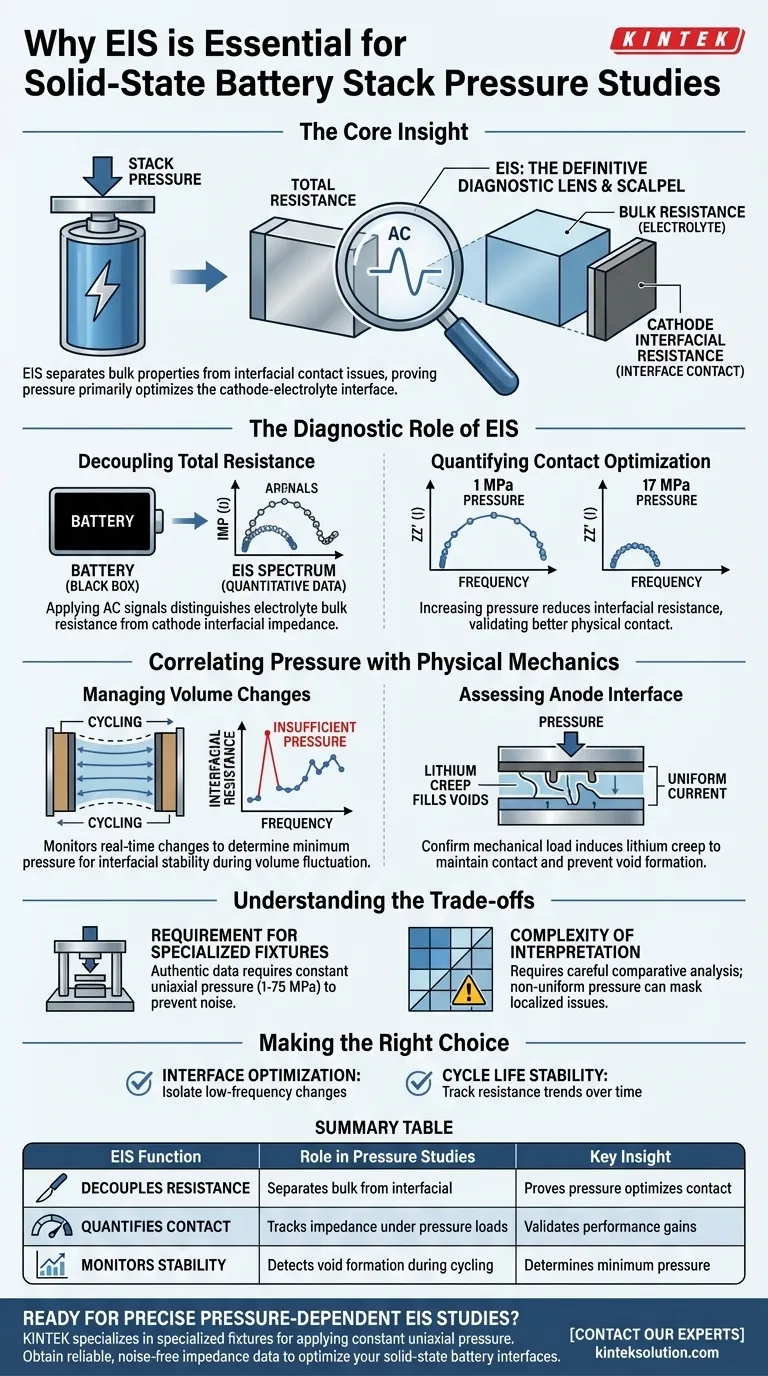
Electrochemical Impedance Spectroscopy (EIS) acts as the definitive diagnostic lens for understanding the relationship between physical pressure and electrochemical performance in solid-state batteries. While pressure creates the necessary physical contact, EIS provides the quantitative evidence required to distinguish where that pressure is effective, specifically by isolating the cathode interfacial resistance from the bulk resistance of the electrolyte.
The Core Insight In solid-state battery research, total resistance is a blunt metric; EIS is the scalpel that dissects it. By separating bulk material properties from interfacial contact issues, EIS confirms that stack pressure primarily optimizes the cathode-electrolyte interface, ensuring that performance gains are attributed to physical mechanics rather than material chemistry.
The Diagnostic Role of EIS in Pressure Studies
Decoupling Total Resistance
A simple voltage or current test treats the battery as a "black box" with a single resistance value. EIS changes this by applying AC signals at varying frequencies to generate a spectrum of data.
This process accurately separates the total internal resistance into its distinct contributing factors.
Specifically, it allows researchers to distinguish between the electrolyte bulk resistance (the inherent conductivity of the material) and the cathode interfacial impedance (the resistance at the junction where materials meet).
Quantifying Contact Optimization
When studying stack pressure, the goal is often to prove that physical compression improves particle-to-particle contact.
By comparing impedance spectra taken under different pressure loads (e.g., increasing from 1 MPa to 17 MPa), researchers can observe shifts in specific frequency regions.
This provides direct experimental evidence that increasing pressure reduces interfacial resistance, validating the hypothesis that the performance gain comes from better physical contact rather than changes in the bulk material.
Correlating Pressure with Physical Mechanics
Managing Volume Changes
Solid-state batteries experience significant volume changes during cycling, which can lead to gaps or "voids" between layers.
EIS allows researchers to monitor these changes in real-time. If the interfacial resistance spikes during cycling, it indicates that the stack pressure is insufficient to counteract the volume expansion or contraction.
This data is crucial for determining the minimum pressure required to maintain interfacial stability and prevent the separation of the cathode active material from the solid-state electrolyte.
Assessing Anode Interface Quality
In anode-free designs, stack pressure is required to ensure the newly formed lithium metal layer maintains intimate contact with the electrolyte.
EIS serves as a stability check in this context. It detects the formation of voids during stripping or the penetration of dendrites.
A stable impedance spectrum under pressure confirms that the mechanical load is successfully inducing lithium creep to fill voids, leading to a more uniform current distribution.
Understanding the Trade-offs
The Requirement for Specialized Fixtures
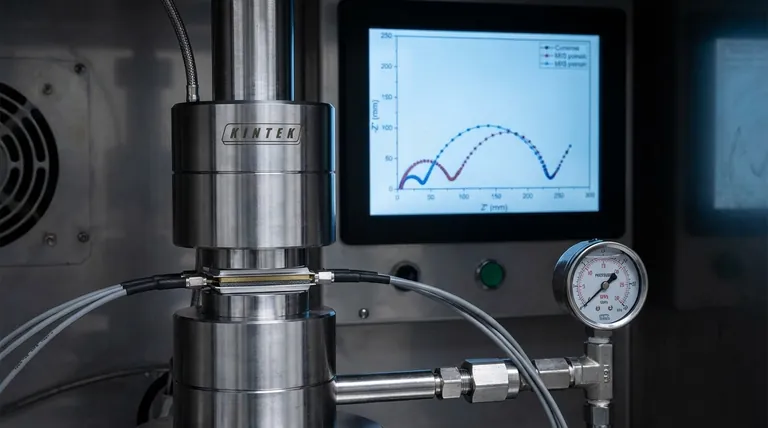
You cannot effectively utilize EIS for these studies without a rigorous mechanical setup.
Authentic and reproducible data requires a specialized cell holder capable of maintaining constant uniaxial pressure (often between 1 MPa and 75 MPa depending on the cell type) during the electrochemical test.
Without this active control, the EIS data becomes unreliable, as fluctuations in physical contact will create noise in the impedance spectrum that mimics chemical degradation.
Complexity of Interpretation
While EIS separates resistance components, interpreting the spectra requires careful comparative analysis.
Researchers must ensure that the pressure is applied uniformly. Non-uniform pressure can create localized hotspots of low resistance, which EIS might average out, potentially masking underlying contact issues in other areas of the cell.
Making the Right Choice for Your Goal
To leverage EIS effectively in your solid-state pressure studies, align your analysis with your specific research objectives:
- If your primary focus is Interface Optimization: Use EIS to isolate the low-frequency region changes, confirming that your pressure settings are specifically minimizing cathode interfacial resistance.
- If your primary focus is Cycle Life Stability: Use time-resolved EIS to track resistance trends over long durations, ensuring that your applied pressure is sufficient to prevent void formation during volume expansion.
By using EIS to look past the total resistance, you transform mechanical pressure from a variable into a precise tool for engineering superior interface contact.
Summary Table:
| EIS Function | Role in Pressure Studies | Key Insight |
|---|---|---|
| Decouples Resistance | Separates bulk electrolyte resistance from cathode interfacial impedance. | Proves pressure optimizes contact, not material chemistry. |
| Quantifies Contact | Tracks impedance changes under varying pressure loads (e.g., 1-75 MPa). | Validates that performance gains are from better physical contact. |
| Monitors Stability | Detects void formation and interface degradation during cycling. | Determines minimum pressure for long-term interfacial stability. |
Ready to conduct precise pressure-dependent EIS studies? KINTEK specializes in laboratory equipment, including specialized fixtures for applying constant uniaxial pressure during electrochemical testing. Our solutions help researchers like you obtain reliable, noise-free impedance data to accurately optimize solid-state battery interfaces. Contact our experts today to discuss your specific cell testing requirements and ensure your mechanical setup meets your research goals.
Visual Guide
Related Products
- Lab Infrared Press Mold for No Demolding
- XRF KBR Plastic Ring Lab Powder Pellet Pressing Mold for FTIR
- Automatic Laboratory Hydraulic Press for XRF and KBR Pellet Pressing
- Electric Split Lab Cold Isostatic Pressing CIP Machine
- Manual Laboratory Hydraulic Pellet Press Lab Hydraulic Press
People Also Ask
- What is the purpose of incorporating cartridge heaters into a lab press mold for MLCC block compression? Optimize Results
- What is the function of a pressing tool in thermoplastic panels? Master Precision Shaping & Fusion Bonding
- Why is precise cooling management of the lab press mold necessary? Protect Core Integrity in Thermoforming
- What role do precision positioning and pressure molds play in single-lap joints? Ensure 100% Data Integrity
- Why is a lab press used for KBr pellet preparation in polyurethane FTIR? Achieve High-Resolution Spectral Data




