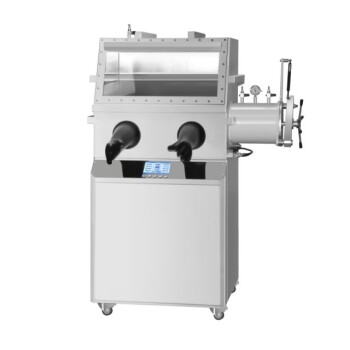
Precision environmental control is the primary requirement for successful lead-tin perovskite fabrication. Nitrogen-filled gloveboxes are essential because the divalent tin ions (Sn²⁺) in these materials are extremely sensitive to oxygen and moisture. Exposure triggers a rapid oxidation process that converts Sn²⁺ to Sn⁴⁺, creating high densities of vacancy defects and "p-type" self-doping that degrade the material's semiconducting properties almost instantly.
Core Takeaway: Maintaining an ultra-pure nitrogen environment (typically below 0.1 ppm oxygen and moisture) is vital to preventing the oxidation of tin ions. Without this control, the material loses its stoichiometric balance, resulting in poor carrier lifetimes and total device failure.
The Chemical Instability of Mixed Lead-Tin Systems
The Oxidation of Sn²⁺ to Sn⁴⁺
The central challenge with mixing tin into lead perovskites is the inherent instability of the Sn²⁺ oxidation state. When exposed to even trace amounts of oxygen, tin undergoes a valence state transition to Sn⁴⁺, effectively poisoning the crystal lattice.
Creation of Vacancy Defects
This oxidation process does not just change the chemistry; it fundamentally alters the physical structure by creating cation vacancies. These vacancies act as recombination centers, which trap charge carriers and significantly decrease the carrier lifetime of the perovskite layer.
The Impact of "Self-Doping"
The oxidation of Sn²⁺ leads to a phenomenon known as unintentional p-type doping. This increase in background carrier concentration makes it difficult to manage the electronic properties of the material, leading to low open-circuit voltages and poor efficiency in solar cells.
Maintaining Integrity Throughout the Fabrication Workflow
Stability During Precursor Preparation
The need for an inert atmosphere begins with weighing and dissolving the precursors. Because tin salts are highly hygroscopic, exposure to humidity during the initial mixing phase can lead to deliquescence, where the material absorbs enough water to liquefy and spoil before the film is even cast.
Controlled Crystallization and Annealing
The spin-coating and heat treatment phases are when the perovskite lattice actually forms. A nitrogen environment ensures that the stoichiometric balance is maintained during this critical window, preventing atmospheric impurities from interfering with the crystallization of the thin film.
Protection of Organic Charge Transport Layers
Beyond the perovskite itself, secondary materials like TFB or other organic charge transport layers are susceptible to photo-oxidation. The glovebox protects these sensitive interfaces, ensuring that the entire device stack remains chemically stable and the experimental data stays repeatable.
Understanding the Trade-offs and Limitations
The Rigor of "Ultra-Low" Requirements
Achieving an environment with less than 0.1 ppm of oxygen and moisture is technically demanding and requires frequent sensor calibration. If the purification catalyst in the glovebox is saturated, even a "nitrogen environment" may hold enough residual oxygen to cause subtle, invisible degradation that ruins experimental consistency.
Economic and Operational Overhead
Operating a high-purity glovebox introduces significant operational costs, including high-purity nitrogen gas and specialized maintenance for the purification columns. Researchers must balance these costs against the fact that lead-tin perovskite research is virtually impossible to conduct in ambient or poorly controlled conditions.
Encapsulation is Still Mandatory
While a glovebox protects the material during fabrication, it does not solve the long-term stability problem. Once the device leaves the inert environment, it will fail unless final encapsulation is performed within the glovebox to seal the sensitive layers from the outside world.
How to Apply This to Your Research
To achieve high-performance results with lead-tin mixed perovskites, your environmental control strategy must be the foundation of your experimental design.
- If your primary focus is experimental repeatability: Ensure your glovebox oxygen and moisture levels are monitored in real-time and kept strictly below 0.1 ppm during the entire spin-coating and annealing process.
- If your primary focus is maximizing carrier lifetime: Prioritize the purity of your nitrogen source and the integrity of your glovebox seals to prevent even minor Sn⁴⁺ formation, which acts as a "killer" defect.
- If your primary focus is device longevity: Perform all stages of fabrication, including the application of organic transport layers and final encapsulation, without ever exposing the device to ambient air.
The successful development of low-lead perovskite alternatives depends entirely on your ability to mask the inherent atmospheric vulnerability of tin through rigorous environmental isolation.
Summary Table:
| Key Challenge | Impact on Perovskite | Environmental Solution |
|---|---|---|
| Oxygen/Moisture Exposure | Rapid Sn²⁺ to Sn⁴⁺ oxidation | Nitrogen-filled glovebox (< 0.1 ppm) |
| Cation Vacancies | Reduced carrier lifetime & recombination | Rigorous atmospheric isolation |
| Trace Humidity | Precursor deliquescence & liquid spoilage | Inert atmosphere weighing & dissolving |
| Ambient Transfer | Unintentional p-type self-doping | In-situ fabrication & encapsulation |
Secure Your Research Integrity with KINTEK
Precise environmental control is non-negotiable for high-performance lead-tin mixed perovskites. KINTEK specializes in comprehensive laboratory pressing and processing solutions designed for the most sensitive materials. We offer a diverse range of manual, automatic, heated, multifunctional, and glovebox-compatible models, as well as cold and warm isostatic presses tailored for battery research and advanced material science.
Don't let Sn²⁺ oxidation and vacancy defects compromise your device efficiency. Ensure stoichiometric balance and maximize carrier lifetimes with our industry-leading equipment.
Ready to elevate your lab's capabilities? Contact us today to find the perfect solution for your research workflow!
References
- Lei Gao, Mischa Bonn. Tailoring Polaron Dimensions in Lead‐Tin Hybrid Perovskites. DOI: 10.1002/adma.202406109
This article is also based on technical information from Kintek Solution Knowledge Base .
Related Products
People Also Ask
- How does a laboratory hydraulic press contribute to the preparation of Li3-3xScxSb samples? Optimize Ionic Conductivity
- What is the function of a laboratory hydraulic press in FT-IR of curcumin-coated MWCNTs? Achieve Optical Clarity.
- Why is a laboratory hydraulic press required for compression molding boron-siloxane? Solve High-Loading Density Challenges
- What role does a laboratory hydraulic press play in reaction pellets? Optimizing Lunar Soil and Metal Fuel Density
- What role does a laboratory hydraulic press play in the preparation of piezoelectric ceramic discs for DC-PG? | KINTEK