
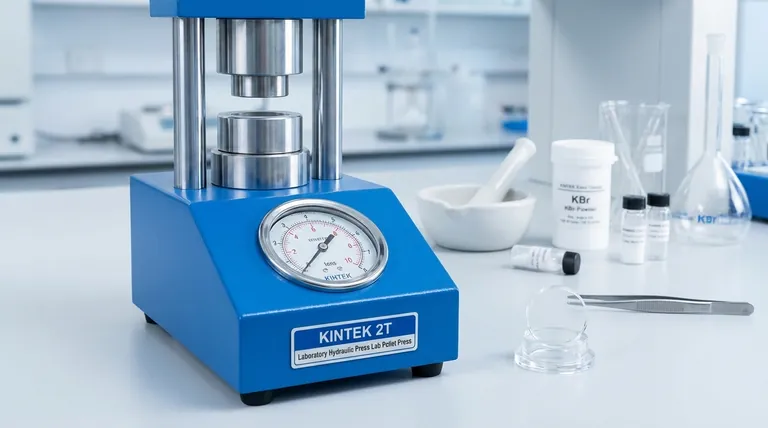
An integrated pressure gauge is essential because it provides direct, real-time feedback on the force applied during the pellet-making process. This control is the single most important factor for creating high-quality, consistent KBr pellets, which in turn ensures the accuracy and reliability of your FTIR analysis results.
The pressure gauge transforms pellet pressing from a subjective "art" into a repeatable science. It is not a secondary feature; it is the primary tool that enables reproducible sample preparation, which is the foundation of trustworthy spectroscopic data.
The Role of Pressure in Pellet Quality
The physical quality of the KBr pellet directly determines the quality of the resulting infrared spectrum. The pressure gauge is your interface for controlling this critical variable.
Achieving Optimal Transparency
A good KBr pellet must be transparent to infrared radiation to allow for a clear spectrum with a stable baseline.
Applying too little pressure results in a soft, opaque, or "cloudy" pellet. This scatters the IR beam, reducing signal strength and making the resulting spectrum noisy and often unusable.
Applying too much pressure can also cause problems, sometimes leading to a pellet that is overly brittle or even fracturing the die set. The gauge helps you apply the optimal force—typically 8 to 10 tons—to achieve a glassy, transparent pellet every time.
Ensuring Uniformity and Path Length
For any analysis that is quantitative or even semi-quantitative, consistency is paramount. The pressure applied directly influences the pellet's final density and thickness (path length).
Without a gauge, it is impossible to ensure this consistency from one sample to the next. Variations in path length will alter the absorbance intensity according to the Beer-Lambert law, making it impossible to reliably compare spectra.
Guaranteeing Reproducibility
Reproducibility is the cornerstone of scientific work. An integrated pressure gauge allows you to record the exact pressure used for a sample and apply that same pressure for subsequent samples, even months later or with a different operator.
This removes the guesswork and subjective "feel," standardizing the procedure and ensuring that any differences observed in the FTIR spectra are due to the sample itself, not inconsistent sample preparation.
How the Gauge Integrates with the Press
The gauge does not exist in isolation; it is the visual readout for the press's core mechanical system.
The Principle of Hydraulic Operation
Most laboratory KBr presses are fully hydraulic. This system allows for the smooth, precise, and controlled application of immense force with minimal user effort.
Typically, the user simply rotates a load knob or pumps a handle. The hydraulic system multiplies this small input into the tons of force needed to fuse the KBr powder into a solid disc.
The Gauge as Your Real-Time Monitor
The pressure gauge is the calibrated "speedometer" for this hydraulic system. It translates the invisible hydraulic force into a clear, quantifiable reading (e.g., in metric tons).
This real-time feedback allows you to slowly increase the pressure to the desired setpoint and hold it there, ensuring proper pellet formation without overshooting and potentially damaging the sample or equipment.
Understanding the Trade-offs
While essential, a press with an integrated gauge exists within a specific context of use.
The Advantage of Simplicity
Manual hydraulic presses are valued for their durability, compact size, and low cost of ownership. They are simple to operate and require minimal maintenance.
The integrated gauge is the key feature that elevates this simple, robust design, giving it the precision required for serious analytical work without adding unnecessary complexity or cost.
The Limitation on Throughput
It is important to recognize that these are manual tools designed for precision, not speed. The process of loading the die, pressing the sample while monitoring the gauge, and cleaning up is deliberate.
This makes them ideal for research, quality control, or teaching labs but unsuitable for high-throughput production environments where hundreds of samples must be processed daily.
The Pitfall of Operating "Blind"
Operating a press without a gauge means you are preparing samples "blind." You are relying on a subjective feeling of resistance, which is not repeatable, not transferable to other users, and not scientifically valid for comparative analysis. This is the most common source of poor-quality and inconsistent FTIR results.
Making the Right Choice for Your Goal
The pressure gauge is the feature that connects your action to a measurable, repeatable outcome.
- If your primary focus is reproducible quantitative analysis: A press with an integrated, calibrated pressure gauge is non-negotiable. It is the only way to ensure consistent pellet path length and density.
- If your primary focus is simple qualitative identification: While still highly recommended for good results, you might tolerate slight pressure variations. However, a gauge will save significant time by helping you quickly find the pressure that yields a clear, transparent pellet.
- If you are managing a multi-user laboratory: The gauge is essential for creating a Standard Operating Procedure (SOP). It ensures that results are comparable regardless of who operates the press.
Ultimately, the integrated gauge gives you direct control over sample quality, ensuring you have confidence in every spectrum you collect.
Summary Table:
| Aspect | Impact of Integrated Pressure Gauge |
|---|---|
| Pellet Transparency | Prevents cloudy or brittle pellets by enabling optimal pressure (8-10 tons) for clear IR transmission |
| Uniformity and Path Length | Ensures consistent density and thickness, vital for quantitative analysis via Beer-Lambert law |
| Reproducibility | Allows exact pressure recording and application, standardizing results across users and time |
| Real-Time Control | Provides immediate feedback during hydraulic operation, reducing errors and equipment damage |
Upgrade your lab's precision with KINTEK's advanced lab press machines! Our automatic lab presses, isostatic presses, and heated lab presses are designed to deliver consistent, high-quality results for your FTIR analysis. Don't let inconsistent sample preparation compromise your data—contact us today to learn how our solutions can enhance reproducibility and efficiency in your laboratory.
Visual Guide

Related Products
- Laboratory Hydraulic Press 2T Lab Pellet Press for KBR FTIR
- XRF KBR Plastic Ring Lab Powder Pellet Pressing Mold for FTIR
- XRF KBR Steel Ring Lab Powder Pellet Pressing Mold for FTIR
- Laboratory Hydraulic Pellet Press for XRF KBR FTIR Lab Press
- Automatic Laboratory Hydraulic Press for XRF and KBR Pellet Pressing
People Also Ask
- What is the role of a laboratory pressure machine and KBr in FTIR? Master Sample Preparation for Flame Retardants
- What is the role of a laboratory hydraulic press in high-loading NCM811 cathode prep for solid-state batteries?
- What role does a laboratory hydraulic press play in reaction pellets? Optimizing Lunar Soil and Metal Fuel Density
- Why is a laboratory hydraulic press necessary for sample preparation? Precise Pelleting for Spiro Heterocyclic Analysis
- What is a laboratory hydraulic press? Essential Guide to Precision Sample Preparation and Testing



















