
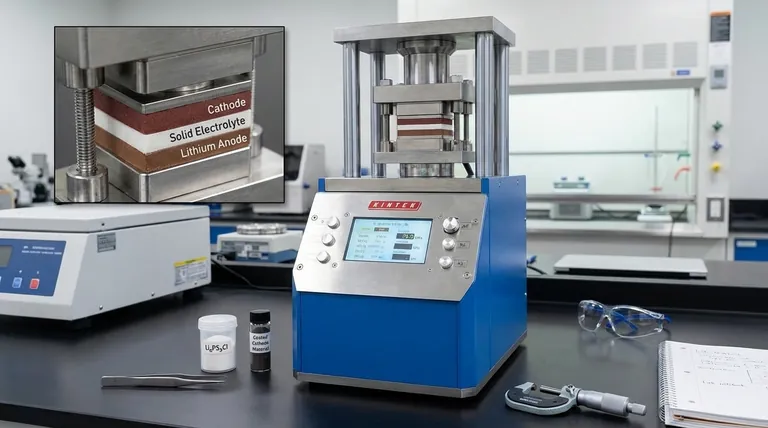
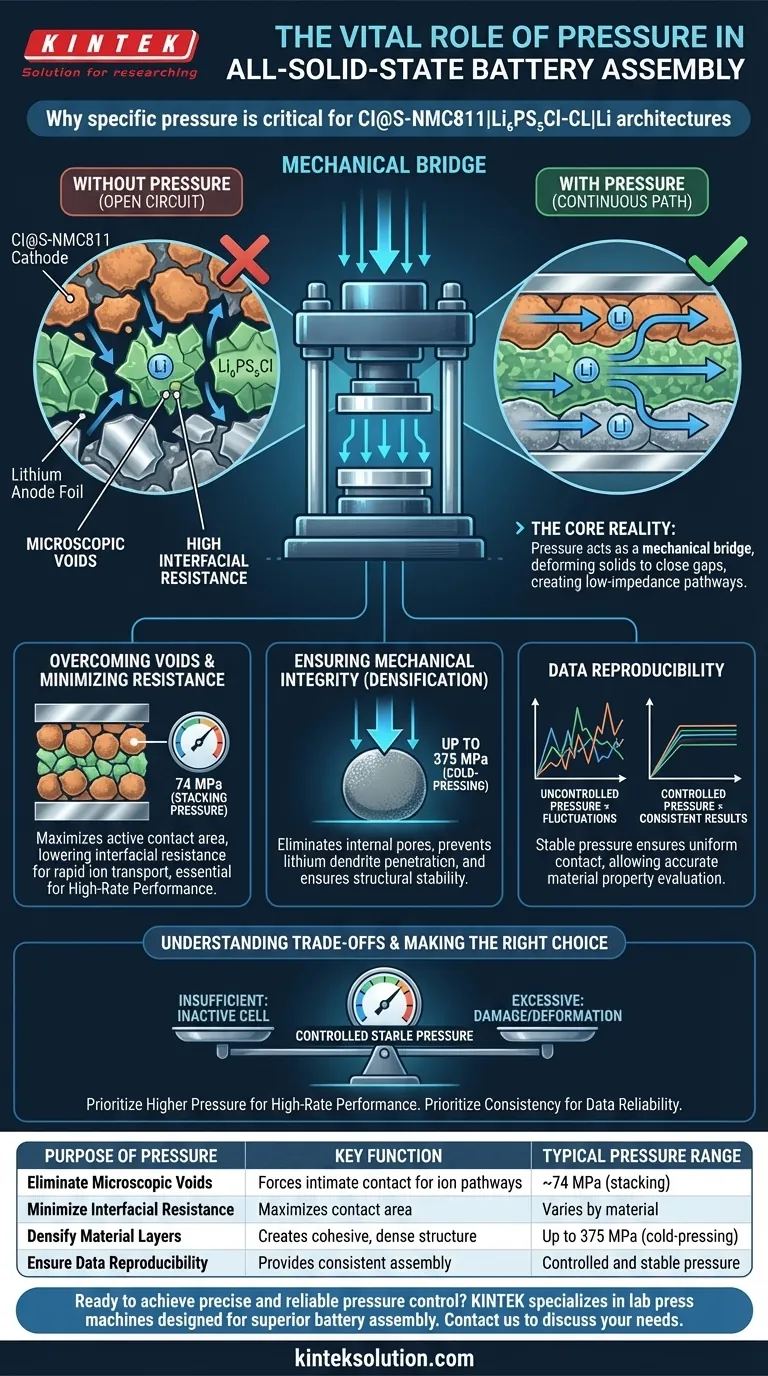
Applying specific pressure is critical in the assembly of all-solid-state batteries (ASSBs) because, unlike liquid electrolytes, solid materials do not naturally wet surfaces or flow into gaps. For an architecture like CI@S-NMC811|Li₆PS₅Cl-CL|Li, the press forces the rigid cathode, sulfide electrolyte, and lithium anode into intimate physical contact. This mechanical force is the only way to eliminate microscopic voids that otherwise block ion movement and create high internal resistance.
The Core Reality: In a solid-state system, an interface without pressure is essentially an electrical open circuit. The application of controlled pressure serves as a "mechanical bridge," deforming the solid particles to close gaps and creating the continuous, low-impedance pathways required for lithium ions to travel efficiently between the anode and cathode.
The Challenge of the Solid-Solid Interface
Overcoming Microscopic Voids
Liquid electrolytes naturally permeate porous electrodes, ensuring total coverage. In contrast, solid components like Li₆PS₅Cl (solid electrolyte) and NMC811 (cathode) possess surface roughness and rigidity.
Without external pressure, this roughness creates microscopic gaps and voids between the layers. These voids act as insulators, physically preventing lithium ions from crossing the boundary.
Minimizing Interfacial Resistance
The primary enemy of battery performance is interfacial contact resistance. When layers merely touch loosely, the contact area is extremely small, creating a bottleneck for current.
Applying pressure—often cited around 74 MPa for stacking or higher for densification—maximizes the active contact area. This significantly lowers the resistance, providing an unobstructed pathway for rapid ion transport.
Enabling High-Rate Performance
Low internal resistance is a prerequisite for power. If the lithium ions cannot move quickly across the interface due to poor contact, the battery cannot discharge at high rates.
Pressure ensures the seamless connectivity required to sustain high current densities without significant voltage drops.
Ensuring Mechanical Integrity and Consistency
Densification of Material Layers
Beyond just the interfaces, pressure is required to densify the bulk materials. High cold-pressing pressure (up to 375 MPa in some fabrication steps) creates a dense, cohesive pellet.
This eliminates internal pores within the electrolyte layer itself, which is critical for preventing lithium dendrite penetration and ensuring structural stability.
Reproducibility in Research data
For researchers, the data derived from a cell is only as good as the assembly consistency. Variations in stacking pressure lead to massive fluctuations in impedance spectra and cycling performance.
Maintaing a stable, controlled pressure ensures that the contact quality is identical across different cells. This allows for the accurate evaluation of material properties, rather than measuring artifacts of the assembly process.
Understanding the Trade-offs
The Necessity of "Controlled" Pressure
While pressure is vital, the references emphasize that it must be stable and controlled. The goal is to achieve mechanical integrity without destroying the components.
Insufficient pressure leaves voids that render the cell inactive. However, uncontrolled or excessive pressure could potentially damage the delicate structures of coated cathode particles (like the CI@S-NMC811) or cause deformation issues with the soft lithium metal anode.
The Role of Rigidity
Solid-state batteries are rigid systems. Unlike pouch cells with liquids that can accommodate some movement, solid interfaces are unforgiving.
Once pressure is released or if it fluctuates, contact can be lost immediately. Therefore, in many testing setups, maintaining external pressure during operation is just as critical as the initial pressing step to accommodate volume changes and maintain the interface.
Making the Right Choice for Your Goal
The application of pressure is not a generic step; it is a precise variable that dictates the success of your assembly.
- If your primary focus is High-Rate Performance: Prioritize higher pressures that maximize surface contact area to achieve the lowest possible impedance, ensuring ions flow freely during rapid discharge.
- If your primary focus is Data Reliability: Focus on the consistency of the pressure applied across all samples to eliminate assembly variables and ensure your electrochemical data reflects the true material properties.
The specific pressure applied effectively "activates" the battery, transforming a stack of loose powders and foils into a unified, functional electrochemical device.
Summary Table:
| Purpose of Pressure | Key Function | Typical Pressure Range |
|---|---|---|
| Eliminate Microscopic Voids | Forces intimate contact between solid layers to create ion pathways | ~74 MPa (stacking) |
| Minimize Interfacial Resistance | Maximizes contact area for low-impedance ion transport | Varies by material |
| Densify Material Layers | Creates cohesive, dense structure to prevent dendrite penetration | Up to 375 MPa (cold-pressing) |
| Ensure Data Reproducibility | Provides consistent assembly for accurate electrochemical testing | Controlled and stable pressure |
Ready to achieve precise and reliable pressure control for your all-solid-state battery research? KINTEK specializes in lab press machines, including automatic and heated lab presses, designed to deliver the exact, consistent pressure required for superior battery assembly. Our equipment ensures optimal interfacial contact, minimizes resistance, and enhances the reproducibility of your data. Transform your battery prototyping with KINTEK’s precision technology—contact us today to discuss your specific needs!
Visual Guide
Related Products
- Warm Isostatic Press for Solid State Battery Research Warm Isostatic Press
- Laboratory Hydraulic Press Lab Pellet Press Button Battery Press
- Button Battery Sealing Press Machine for Lab
- Lab Button Battery Tablet Press Sealing Mold
- Lab Infrared Press Mold for Laboratory Applications
People Also Ask
- Why must composite cathodes be sealed in vacuum lamination bags for WIP? Ensure Battery Stability and Density
- How do sacrificial volume materials (SVM) maintain microchannels in isostatic pressing? Ensure Structural Integrity
- What is the function of elastic molds in warm isostatic pressing? Achieve Uniform Density in Composite Particles
- How does Warm Isostatic Pressing differ from traditional pressing methods? Unlock Uniform Density for Complex Parts
- What is the significance of temperature control in Warm Isostatic Pressing? Unlock Uniform Densification and Process Stability





