
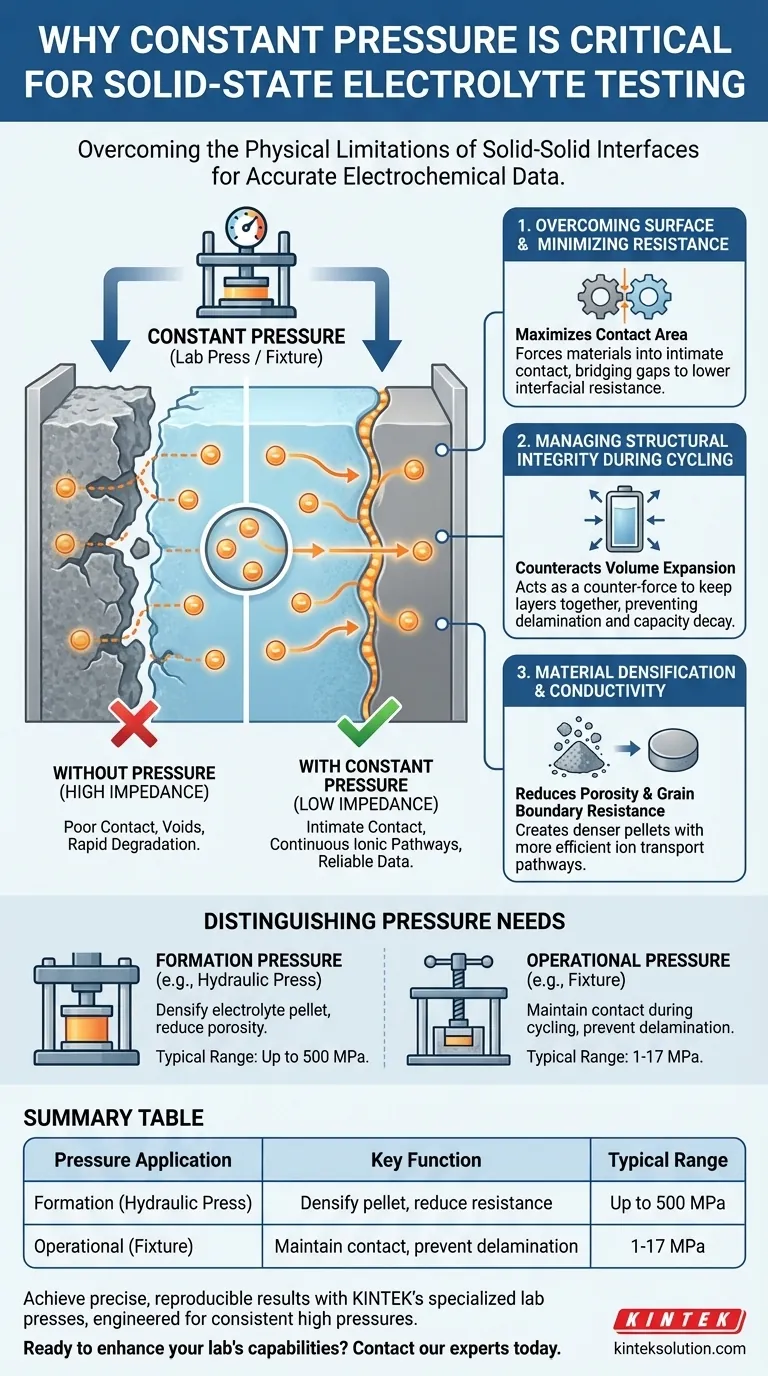
Applying constant pressure is a fundamental requirement for overcoming the inherent physical limitations of solid-to-solid interfaces. unlike liquid electrolytes which naturally wet electrode surfaces, solid-state electrolytes rely entirely on mechanical force to establish and maintain atomic-level contact. Without this external pressure, microscopic gaps and voids create high interfacial impedance, rendering electrochemical measurements inaccurate and leading to rapid performance degradation.
The primary function of constant pressure is to minimize interfacial resistance by forcing the solid electrolyte and electrode materials into intimate contact. This external force is critical for maintaining continuous ionic pathways during the volume changes inherent in battery cycling, ensuring data is both physically relevant and reproducible.
The Physics of the Solid-Solid Interface
Overcoming Surface Roughness
On a microscopic level, the surfaces of solid electrolytes and electrodes are rough and uneven. Intimate physical contact is necessary to bridge these gaps.
Applying constant pressure deforms the materials slightly to maximize the contact area. This ensures that ions can move efficiently across the interface rather than being blocked by voids.
Minimizing Interfacial Resistance
The quality of the contact directly dictates the interfacial resistance. Poor contact results in high impedance, which bottlenecks the battery's performance.
By using a lab press or fixture to apply uniform pressure, you effectively lower this resistance barrier. This allows for the accurate measurement of intrinsic material properties, such as ionic conductivity, without artifacts caused by poor connectivity.
Managing Structural Integrity During Cycling
Counteracting Volume Expansion
Active electrode materials experience significant volume changes (expansion and contraction) during charge and discharge cycles.
Without external pressure, this "breathing" can cause the electrode to detach from the electrolyte. A constant stack pressure acts as a counter-force, keeping the layers pressed together despite these internal mechanical shifts.
Preventing Delamination
When contact is lost due to volume changes, it leads to interfacial delamination. This permanent separation isolates active material, causing capacity decay.
Specialized fixtures maintaining pressures (e.g., 3.2 to 17 MPa) suppress this delamination. This is essential for obtaining high-rate performance and long-term cycling stability that reflects the material's true potential.
Material Densification and Conductivity
Reducing Porosity
Pressure is required to increase the density of the solid electrolyte membrane itself. This process minimizes porosity within the material.
Eliminating internal voids is crucial because air gaps act as insulators. A denser pellet facilitates a more direct path for ion movement.
Lowering Grain Boundary Resistance
For powder-based electrolytes (like Li-argyrodite), high pressure (often up to 500 MPa during formation) is needed to force individual particles together.
This reduces grain boundary resistance, which is the resistance encountered by ions moving from one particle to another. Continuous, tight packing creates efficient pathways for ion transport throughout the bulk of the material.
Understanding the Trade-offs
Distinguishing Formation vs. Operational Pressure
It is critical to distinguish between the pressure required to form a pellet and the pressure required to cycle a cell.
Formation often requires extremely high pressures (e.g., 500 MPa) to achieve densification, while testing typically requires lower, constant "stack pressure" (e.g., 1-17 MPa) to maintain contact. Confusing these two distinct needs can lead to mechanical failure of the cell or unrealistic testing conditions.
The Risk of Inconsistent Variables
If pressure is not controlled, the interfacial contact area will vary from cell to cell.
This variation makes it impossible to compare data between experiments reliability. To isolate the chemical performance of the material, the mechanical variable (pressure) must be kept constant using a hydraulic press or calibrated fixture.
Making the Right Choice for Your Goal
To obtain valid data, you must align your pressure application with your specific testing objectives.
- If your primary focus is Material Synthesis and Characterization: Prioritize high-pressure formation (e.g., hydraulic pressing) to minimize porosity and grain boundary resistance for accurate bulk conductivity readings.
- If your primary focus is Electrochemical Cycling and Stability: Prioritize the use of a specialized cell fixture that maintains constant "stack pressure" to prevent delamination caused by volume expansion during operation.
Ultimately, treating pressure as a precisely controlled experimental variable is just as important as the chemistry of the materials themselves.
Summary Table:
| Pressure Application | Key Function | Typical Range |
|---|---|---|
| Formation (Hydraulic Press) | Densify electrolyte pellet, reduce porosity & grain boundary resistance | Up to 500 MPa |
| Operational (Fixture) | Maintain interfacial contact during cycling, prevent delamination | 1-17 MPa |
Achieve precise, reproducible results in your solid-state battery research with KINTEK's specialized lab presses.
Our automatic lab presses, isostatic presses, and heated lab presses are engineered to deliver the consistent, high pressures required for reliable electrochemical testing—ensuring accurate data on ionic conductivity and long-term cycling stability.
Ready to enhance your lab's capabilities? Contact our experts today to find the perfect press for your solid-state electrolyte development needs.
Visual Guide
Related Products
- 24T 30T 60T Heated Hydraulic Lab Press Machine with Hot Plates for Laboratory
- Manual Heated Hydraulic Lab Press with Integrated Hot Plates Hydraulic Press Machine
- Laboratory Hydraulic Pellet Press for XRF KBR FTIR Lab Press
- Lab Infrared Press Mold for Laboratory Applications
- Laboratory Hydraulic Press Lab Pellet Press Machine for Glove Box
People Also Ask
- Function of a Laboratory Hydraulic Press with Heated Platens in SSE? Enhance Battery Density & Conductivity
- Why is a laboratory hydraulic press with heating plates required for PLA/TEC films? Achieve Precise Sample Integrity
- What role does a laboratory heated hydraulic press play in LTCC? Essential for High-Density Ceramic Lamination
- Why is a laboratory heated hydraulic press required? Ensure Precise Vulcanization for NBR/EPDM Nanocomposites
- Why reduce load when applying composite strengthening tabs? Protect Specimen Integrity and Data Accuracy



















